All species › Passerines › Tyrant flycatchers and allies › Pied Water Tyrant
Position in the tree Birds Aves › Birds with a flexible palate Neognathae › All other modern birds Neoaves › Landbirds Telluraves › Falcons, parrots and passerines Australaves › Falcons and passerines Eufalconimorphae › Parrots and passerines Psittacopasserae
Pied Water Tyrant | Fluvicola pica
Bonte watertiran | Viudita pía
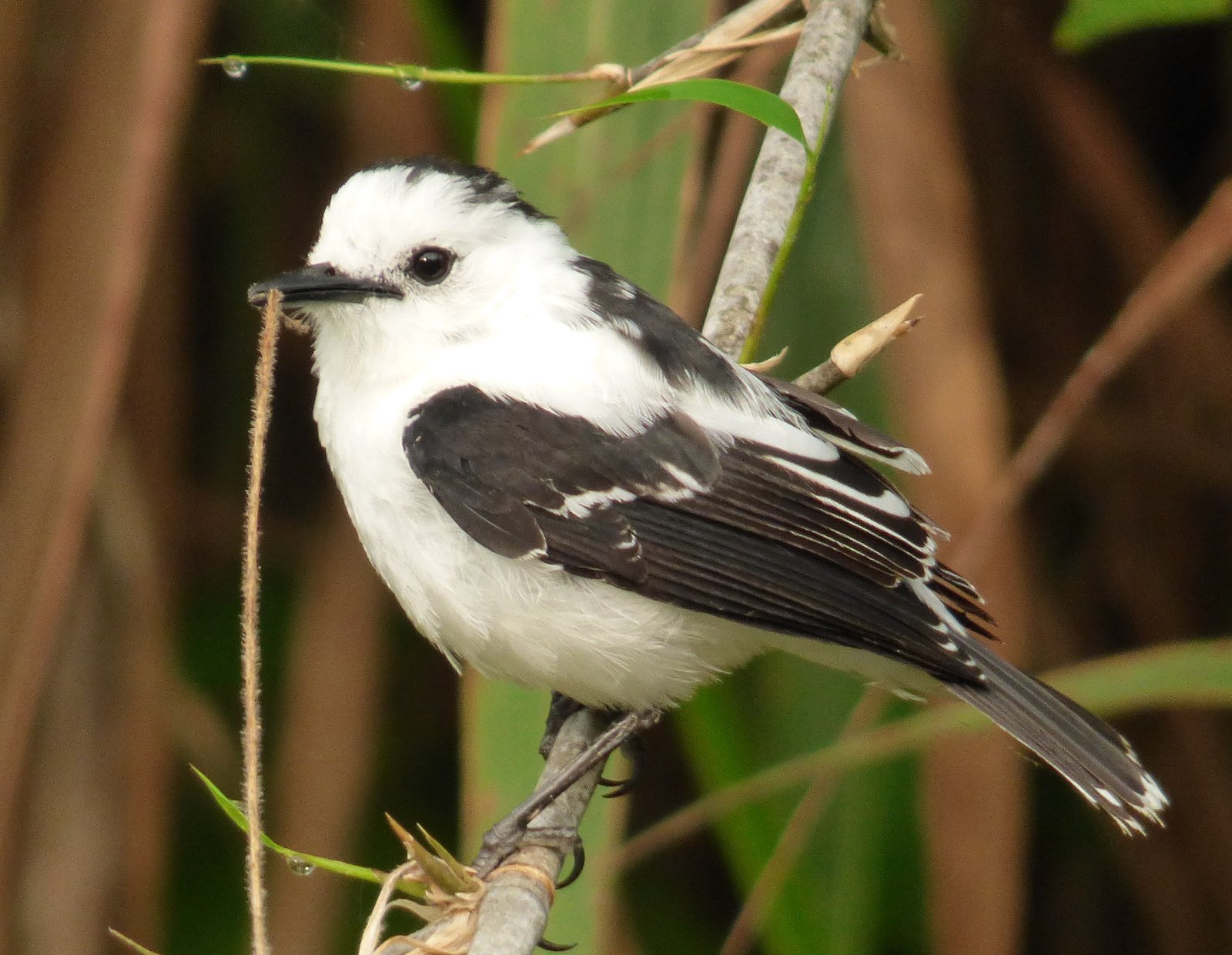
The Pied Water Tyrant is a small black-and-white tyrant flycatcher of open marshes and wet grassland. It feeds low among aquatic plants and along the water's edge and stands out through its contrasting pattern. In the guide area it lives only locally in central and eastern Panama.
Voice
Short, nasal calls, often repeated, and a simple, soft song.
Recording: Jaime Suárez — CC BY-NC-SA 4.0 · converted to mono · xeno-canto
Identification
12–13 cm, with a short, thin black bill. Forehead, face, throat and underparts white. Hindcrown, nape and back black. Wings black with white edges to the coverts. Rump white, tail black. Male and female are alike.
Confusion species
No other tyrant in the guide area shows a similar black-and-white pattern in marshland. Long-tailed Tyrant Colonia colonus is black with a white crown and very long central tail feathers, and lives at forest edges, not in marshes.
Habitat
Open freshwater marshes, wet grassland, edges of ponds and ditches with floating and low aquatic vegetation, also wet pastures and rice fields. It takes insects low in the vegetation, on floating plants and on the ground at the water's edge, often moving its tail. The nest is a globular structure with a side entrance, usually in a bush over water.
Where the bird is most at home, classified by the vegetation units of Mexico and Central America.



Range and movements
In the guide area only in central and eastern Panama, mainly in the lowlands around and east of Panama City. Outside the guide area in northern South America: Colombia, Venezuela, the Guianas, Trinidad and northern Brazil.
- Resident
- dark = core range, pale = thinly spread
How and when to look
Best looked for in the marshes and wet pastures east of Panama City, such as around Tocumen. It often perches in the open on low plants or fence posts near water.
Conservation status
Not threatened. Local and scarce in the guide area; dependent on open freshwater marshes, which can disappear through drainage and building.
Scientific name
Fluvicola pica | (Boddaert, 1783)
Boddaert described the species in 1783 as Muscicapa pica; because it was later moved to another genus, the author and year stand in brackets. The genus Fluvicola was introduced in 1827 by Swainson. Fluvicola is Latin, from fluvius 'river' and -cola 'dweller': 'river-dweller'. pica is Latin for 'magpie', after the black-and-white plumage. The specimen the first description was based on came from Cayenne, French Guiana.