All species › Passerines › Tyrant flycatchers and allies › Vermilion Flycatcher
Position in the tree Birds Aves › Birds with a flexible palate Neognathae › All other modern birds Neoaves › Landbirds Telluraves › Falcons, parrots and passerines Australaves › Falcons and passerines Eufalconimorphae › Parrots and passerines Psittacopasserae
Vermilion Flycatcher | Pyrocephalus rubinus
Rode tiran | Mosquero cardenal
The Vermilion Flycatcher is a small tyrant flycatcher of open, dry country with scattered trees. The male, with its scarlet head and underparts, is unmistakable; the female is far less conspicuous. It hunts insects from a low perch and often pumps its tail. In the guide area it lives from northern Mexico to Nicaragua.

Voice
The song is a high, tinkling pit-a-see or pit-pit-a-zee, often given in a display flight in which the male rises fluttering with raised crest. The call is a sharp peest.
Recording: JAYRSON ARAUJO DE OLIVEIRA — CC BY-NC-SA 4.0 · converted to mono · xeno-canto
Identification
13–14 cm, with a short, thin black bill. The male has a scarlet crown, throat and underparts, a blackish-brown band through the eye, and dark greyish-brown back, wings and tail; the red crown feathers can be raised into a small crest. The female is greyish-brown above, with a white throat, a whitish breast with fine dark streaks, and a salmon-pink to pale yellow belly and undertail coverts. Young males show red patches on a female-like plumage.
Confusion species
No other bird in the guide area resembles the male. The female is similar to Say's Phoebe Sayornis saya, but that species is larger, with an unstreaked greyish-brown breast, a cinnamon belly and a black tail. Empidonax flycatchers lack the breast streaks and pink belly.
Habitat
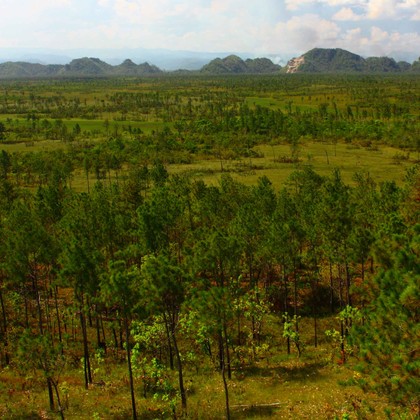
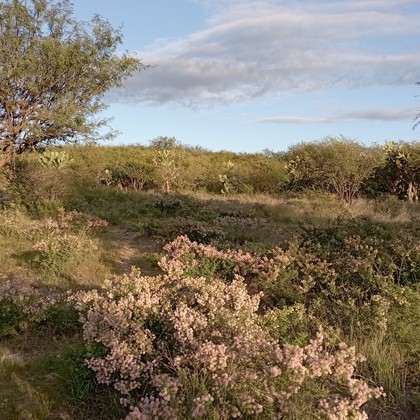
Open and semi-open country with scattered trees and bushes: dry grassland, semi-desert, savanna, pasture, golf courses, parks and village edges, often near water; from the lowlands into the highlands. It catches insects in the air or on the ground from a low branch, post or wire. The nest is a small cup on a horizontal branch.
Where the bird is most at home, classified by the vegetation units of Mexico and Central America.




Range and movements
From the south-western United States through most of Mexico except the most humid lowlands, and in northern Central America (Belize, Guatemala, Honduras, El Salvador) to Nicaragua; rare in Costa Rica and Panama. In winter, birds from the north of the range partly move south and to lower areas. Outside the guide area in much of South America and on the Galápagos Islands; the division of these populations into one or more species differs between sources.
- Resident
- dark = core range, pale = thinly spread
How and when to look
Common in open country on the Mexican Plateau, also in parks and on golf courses; the male stands out from afar as a red dot on a fence or bush.
Conservation status
Not threatened. Common and widespread; it has declined locally but also benefits from open, man-made landscapes.
Scientific name
Pyrocephalus rubinus | (Boddaert, 1783)
Boddaert described the species in 1783 as Muscicapa rubinus; because it was later moved to another genus, the author and year stand in brackets. The genus Pyrocephalus was introduced in 1838 by Gould. Pyrocephalus is Greek, from pur 'fire' and kephalē 'head', after the male's fiery red head. rubinus is New Latin for 'ruby-red', after the male's brilliant red plumage. The specimen the first description was based on came from Tefé, Amazonas, Brazil.