All species › Passerines › Finches, euphonias and allies › Pine Siskin
Position in the tree Birds Aves › Birds with a flexible palate Neognathae › All other modern birds Neoaves › Landbirds Telluraves › Falcons, parrots and passerines Australaves › Falcons and passerines Eufalconimorphae › Parrots and passerines Psittacopasserae
Pine Siskin | Spinus pinus
Dennensijs | Jilguero pinero
The Pine Siskin is a small, brown-streaked siskin of coniferous forest, with yellow in the wing and tail that shows mainly in flight. In the guide area a separate population lives year-round in the pine and fir forests of the Mexican mountains south to Chiapas and Guatemala. In some winters large numbers of migrants from North America join them.

Voice
A distinctive, rising, buzzy zreeeee and a clear tee-ee in flight. The song is a long, hurried series of twitters and trills, interspersed with the buzzy note. Flocks call almost constantly.
Recording: Greg Irving — CC BY-NC-SA 4.0 · shortened to the first 60 s, mono · xeno-canto
Identification
11–13 cm. Small, with a thin, pointed bill and a notched tail. Upperparts brown with dark streaks; underparts whitish with dense brown streaks. Two pale wing bars and a yellow stripe at the base of the flight feathers, forming a conspicuous yellow band in flight; the base of the tail is also yellow. The male shows more yellow than the female. Birds from Chiapas and Guatemala are on average greener and yellower.
Confusion species
Black-capped Siskin Spinus atriceps (highlands of Chiapas and Guatemala) is green and nearly unstreaked, with a dark cap; intermediates with Pine Siskin occur. Females of House Finch Haemorhous mexicanus and Cassin's Finch Haemorhous cassinii are larger, have a thicker bill and lack yellow in the wing. Female Lesser Goldfinch Spinus psaltria is unstreaked olive and yellow.
Habitat
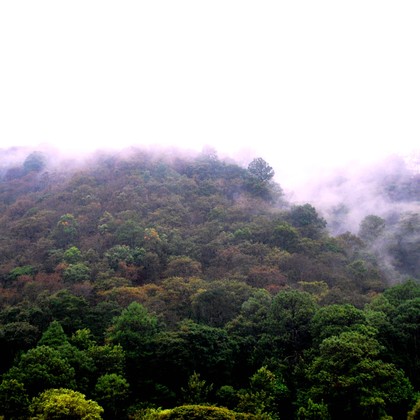
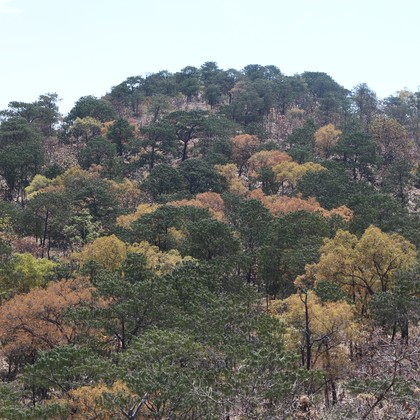
Pine, pine-oak and fir forest in the mountains, mostly between 1500 and 3500 m, also forest edges, clearings and gardens in mountain villages. Winter visitors also appear lower, in parks, gardens and at feeders. It eats seeds of conifers, alders and herbs, as well as buds and insects. Outside the breeding season it lives in flocks.
Where the bird is most at home, classified by the vegetation units of Mexico and Central America.


Range and movements
Breeds in Alaska, Canada and the western United States. In the guide area resident in the mountains of Baja California, along the Sierra Madre Occidental and Sierra Madre Oriental, in the volcanic belt of central Mexico and south to Chiapas and the highlands of Guatemala. Migrants from the north winter irregularly in northern Mexico, in some years in large numbers.
- Resident
- Summer visitor (c. Apr–Sep)
- Winter visitor (c. Oct–Mar)
- Passage (Mar–Apr, Oct–Nov)
- dark = core range, pale = thinly spread
How and when to look
Best found in high-elevation pine forest, such as on the slopes of the great volcanoes of central Mexico; flocks are often heard by their buzzy call before they are seen in the treetops.
Conservation status
Not threatened (LC). Common in the mountain forests of Mexico; numbers of winter visitors vary greatly from year to year. Clear-felling of high-elevation conifer forest is a local threat.
Scientific name
Spinus pinus | (Wilson, 1810)
Wilson described the species in 1810 as Fringilla pinus; because it was later moved to another genus, the author and year stand in brackets. The genus Spinus was introduced in 1816 by Koch. Spinus goes back to Ancient Greek spinos, a name for a small bird that can no longer be identified with certainty. pinus is Latin for 'pine', after its preference for conifer forest and pine seeds. The specimen the first description was based on came from Bush Hill near Philadelphia, Pennsylvania, USA.