All species › Passerines › Finches, euphonias and allies › Black-capped Siskin
Position in the tree Birds Aves › Birds with a flexible palate Neognathae › All other modern birds Neoaves › Landbirds Telluraves › Falcons, parrots and passerines Australaves › Falcons and passerines Eufalconimorphae › Parrots and passerines Psittacopasserae
Black-capped Siskin | Spinus atriceps
Groene sijs | Jilguero corona negra
The Black-capped Siskin is a dark olive-green siskin with a blackish cap, restricted to the high mountains of Chiapas and western Guatemala. It lives in open pine and fir forest and searches for seeds in small flocks. Its relationship with Pine Siskin, with which it locally forms intermediates, is not fully resolved.
No photograph of a living wild bird of this species with a suitable Creative Commons licence exists. Do you have one that meets the rules? Send it in.
Voice
Calls and song resemble those of Pine Siskin: a buzzy, rising zreee, high tsee calls and a fast, twittering song.
No recording with a suitable Creative Commons licence is available for this species yet.
Identification
11–12 cm. Compact, with a thin, pointed bill. The male is dark olive-green with a blackish crown and a yellower belly; on the black wing a yellow wing bar and a yellow stripe at the base of the flight feathers, and the base of the tail is also yellow. The female is duller and greyer green, with a less dark cap and less yellow. Upperparts almost unstreaked.
Confusion species
Pine Siskin Spinus pinus occurs in the same area but is brown and clearly streaked throughout; birds showing features of both species are reported. Black-headed Siskin Spinus notatus has an entirely black head and throat and bright yellow underparts and back.
Habitat
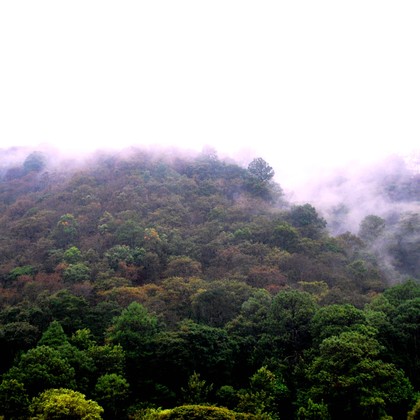
Open pine, pine-oak and fir forest, forest edges, clearings and fields with shrubs and trees in the highlands, mostly between 2300 and 3500 m. It searches in small flocks for seeds of herbs, alders and conifers, often together with Pine Siskins.
Where the bird is most at home, classified by the vegetation units of Mexico and Central America.


Range and movements
Endemic to the guide area: the highlands of Chiapas in southern Mexico and western Guatemala.
- Resident
- dark = core range, pale = thinly spread
How and when to look
Look for it in the forests and field edges of the highlands around San Cristóbal de las Casas in Chiapas and around Quetzaltenango in Guatemala; small flocks give themselves away by their buzzy call.
Conservation status
Not threatened (LC). Small range, but locally fairly common; logging and conversion of mountain forest to farmland are the main threats.
Scientific name
Spinus atriceps | (Salvin, 1863)
Salvin described the species in 1863 as Chrysomitris atriceps; because it was later moved to another genus, the author and year stand in brackets. The genus Spinus was introduced in 1816 by Koch. Spinus goes back to Ancient Greek spinos, a name for a small bird that can no longer be identified with certainty. atriceps is Latin, from ater 'black' and -ceps '-headed', after the black cap. The specimen the first description was based on came from near Quetzaltenango, Guatemala.