All species › Passerines › Finches, euphonias and allies › Black-headed Siskin
Position in the tree Birds Aves › Birds with a flexible palate Neognathae › All other modern birds Neoaves › Landbirds Telluraves › Falcons, parrots and passerines Australaves › Falcons and passerines Eufalconimorphae › Parrots and passerines Psittacopasserae
Black-headed Siskin | Spinus notatus
Zwartkopsijs | Jilguero encapuchado
The Black-headed Siskin is a yellow siskin with an entirely black head, typical of the pine and pine-oak forests of Mexico and northern Central America. It lives in pairs or small flocks in the canopy. A separate population inhabits the pine savannas of the Mosquitia in the lowlands of Honduras and Nicaragua.

Voice
It gives a nasal chew or tsee-oo and a high, thin whistle. The song is a fast, twittering and trilling series, similar to that of Pine Siskin but without the long buzzy note.
Recording: Oscar Campbell — CC BY-NC-SA 4.0 · converted to mono · xeno-canto
Identification
10–12 cm. The male has a black head, throat and upper breast; back olive-yellow, underparts bright yellow. Wings black with a large yellow patch at the base of the flight feathers and yellow edges; tail black with a yellow base. The female resembles the male but is duller, with a less intensely black head and a greener back. Bill pointed and fairly long for a siskin.
Confusion species
Male Lesser Goldfinch Spinus psaltria has only a black cap, a yellow throat and a white wing patch. Black-capped Siskin Spinus atriceps is dark olive-green with a black crown but a green throat. Yellow-bellied Siskin Spinus xanthogastrus lives only in Costa Rica and Panama and has a black back and black breast. Hooded Grosbeak Hesperiphona abeillei has a similar pattern but is much larger, with a heavy pale bill.
Habitat
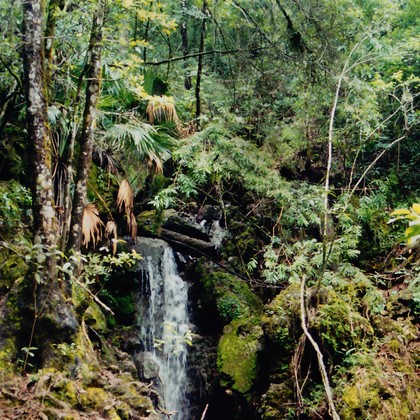
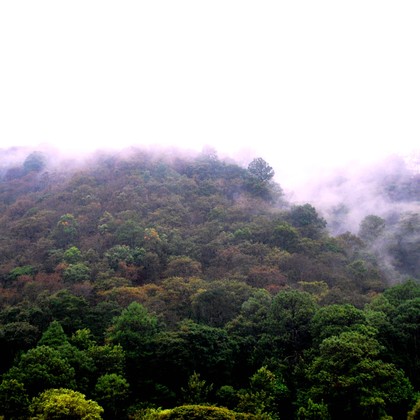
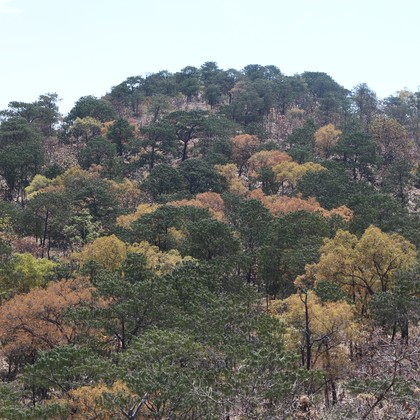
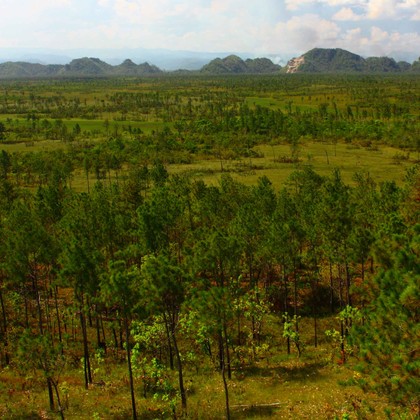
Pine forest, pine-oak forest and the edges of cloud forest in the mountains, mostly between 600 and 3000 m; also forest edges and clearings with scattered trees. In Honduras and Nicaragua also in lowland pine savanna. It eats seeds of pines, alders and herbs.
Where the bird is most at home, classified by the vegetation units of Mexico and Central America.

Range and movements
Along the Sierra Madre Occidental and the Sierra Madre Oriental through the mountains of central and southern Mexico, through Chiapas, Guatemala, El Salvador and Honduras to northern Nicaragua. Also in the pine savannas of the Mosquitia in eastern Honduras and north-eastern Nicaragua.
- Resident
- dark = core range, pale = thinly spread
How and when to look
Often high in the crowns of pines, where the yellow underparts and black head are hard to see against the light; listen for the nasal call and follow small flocks as they move between the trees.
Conservation status
Not threatened (LC). Fairly common in suitable forest; logging and fires in pine forests are local threats.
Scientific name
Spinus notatus | (Du Bus de Gisignies, B-AL, 1847)
Du Bus de Gisignies, B-AL described the species in 1847 as Carduelis notata; because it was later moved to another genus, the author and year stand in brackets. The genus Spinus was introduced in 1816 by Koch. Spinus goes back to Ancient Greek spinos, a name for a small bird that can no longer be identified with certainty. notatus is Latin for 'marked', after the striking black head against the yellow body. The specimen the first description was based on came from Xalapa, Veracruz, Mexico.