All species › Passerines › Tanagers and allies › Plain-colored Tanager
Position in the tree Birds Aves › Birds with a flexible palate Neognathae › All other modern birds Neoaves › Landbirds Telluraves › Falcons, parrots and passerines Australaves › Falcons and passerines Eufalconimorphae › Parrots and passerines Psittacopasserae
Plain-colored Tanager | Tangara inornata
Grijze tangare | Tangara cenicienta
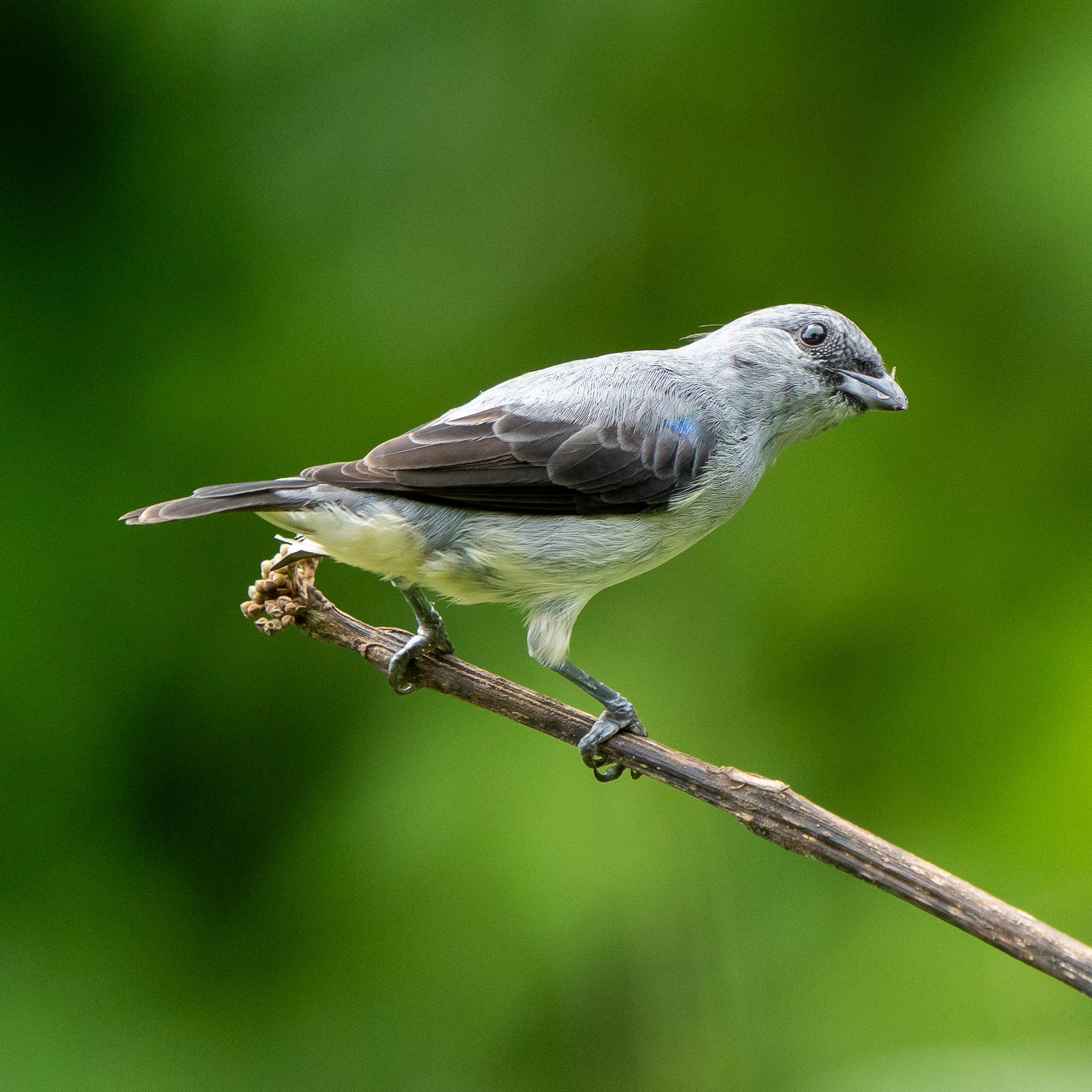
The Plain-colored Tanager is a small, uniformly grey tanager of the lowlands of Panama, the only Tangara in the guide area without bright colours. It lives in small groups in the canopy of forest edges, secondary forest and parks. In the guide area it occurs mainly in central and eastern Panama.
Voice
The calls are high, thin tseet and tsip notes. The song is a rapid series of high, twittering notes.
Recording: William Adsett — CC BY-NC-SA 4.0 · converted to mono · xeno-canto
Identification
11–12 cm. Upperparts slate-grey, underparts paler grey with a whitish to pale buff belly and undertail coverts. Lores dark. A small blue patch on the shoulder, often hidden by the flank feathers. Wings and tail blackish. Bill short and dark. Male and female are alike.
Confusion species
Blue-grey Tanager Thraupis episcopus is larger and bluish grey with blue wings. Female dacnises and honeycreepers are green. Small grey birds such as gnatcatchers and flycatchers have a thinner bill and different behaviour; Plain-colored Tanager often sits in small groups in fruiting trees.
Habitat
Canopy and edges of humid lowland forest and mature secondary forest, gallery forest, open country with tall trees, plantations, parks and gardens, mostly below 1000 m. It forages in pairs or groups of three to six birds, also with mixed flocks. It eats fruit, especially small berries, and insects.
Where the bird is most at home, classified by the vegetation units of Mexico and Central America.




Range and movements
Lowlands of Panama on both slopes, mainly from the Canal area east to Darién; scarcer to the west. Rare and local in extreme south-eastern Costa Rica. Outside the guide area in northern and western Colombia.
- Resident
- dark = core range, pale = thinly spread
How and when to look
Regularly seen along Pipeline Road (Camino del Oleoducto) and around Gamboa and in the Metropolitan Natural Park in Panama City, often in fruiting trees at forest edges.
Conservation status
Not threatened (LC). Common in the lowlands of Panama and tolerant of secondary forest and settled areas.
Scientific name
Tangara inornata | (Gould, 1855)
Gould described the species in 1855 as Calliste inornata; because it was later moved to another genus, the author and year stand in brackets. The genus Tangara was introduced in 1760 by Brisson. Tangara is a Tupi name from Brazil, often explained as 'dancer', for a brightly coloured bird. inornata is Latin for 'unadorned, plain', after the grey plumage, strikingly sober for a Tangara. The specimen the first description was based on came from Bogotá, Colombia.