All species › Passerines › Tanagers and allies › Green-naped Tanager
Position in the tree Birds Aves › Birds with a flexible palate Neognathae › All other modern birds Neoaves › Landbirds Telluraves › Falcons, parrots and passerines Australaves › Falcons and passerines Eufalconimorphae › Parrots and passerines Psittacopasserae
Green-naped Tanager | Tangara fucosa
Groennektangare | Tangara nuquiverde
The Green-naped Tanager is a small black-and-blue tanager with green spangles and a green nape band, found only on a few isolated mountains in eastern Panama and just across the border in Colombia. It is the eastern counterpart of the Spangle-cheeked Tanager. Its range is small and difficult to reach.

Voice
The calls are thin, high tsit notes, especially in groups. The song is little known.
Recording: Ovidio Jaramillo — CC BY-NC-SA 4.0 · converted to mono · xeno-canto
Identification
12–13 cm. Head, back and breast largely black. Cheeks, throat and breast with glossy green to blue-green scale-like spots. A distinct green band across the nape. Wings, rump and tail edged blue. Belly and undertail coverts pale buff to ochre. Bill short and black. Male and female are alike.
Confusion species
Spangle-cheeked Tanager Tangara dowii is very similar but lives only in the mountains of Costa Rica and western Panama; it lacks the green nape band and has a darker, more cinnamon belly. Speckled Tanager Ixothraupis guttata is green with black spots. No other tanager within its small range has a black, green-spangled breast.
Habitat
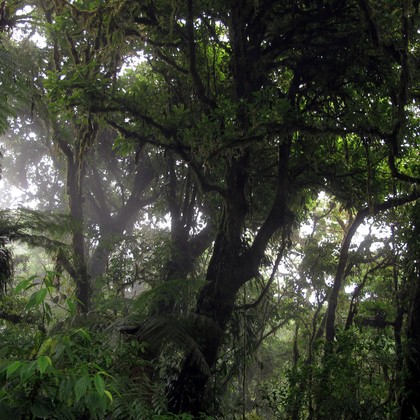
Canopy and edges of humid montane forest and cloud forest, roughly between 1350 and 1700 m, locally slightly lower or higher. It forages in pairs or small groups, usually with mixed flocks. It eats fruit and insects.
Where the bird is most at home, classified by the vegetation units of Mexico and Central America.

Range and movements
Nearly endemic to the guide area: the mountains of eastern Panama in Darién, on Cerro Pirre, Cerro Malí and Cerro Tacarcuna. Outside the guide area only on the Colombian side of Cerro Tacarcuna.
- Resident
- Winter visitor (c. Oct–Mar)
- dark = core range, pale = thinly spread
How and when to look
Most accessible on Cerro Pirre in Darién National Park, from the field station at Cana; a visit requires an organised expedition. Look for mixed flocks of tanagers in the mossy canopy.
Conservation status
Not threatened (LC). Small range, but the montane forest of Darién is largely intact and lies within a national park.
Scientific name
Tangara fucosa | Nelson, 1912
Nelson described the species in 1912 and placed it straight away in the genus where it still stands. The genus Tangara was introduced in 1760 by Brisson. Tangara is a Tupi name from Brazil, often explained as 'dancer', for a brightly coloured bird. fucosa is Latin for 'painted, made-up', from fucus 'rouge', after the gaudy, as if painted plumage. The specimen the first description was based on came from Cerro Pirre, Darién, Panama.