All species › Birds of prey › Kites, Old World vultures, eagles and hawks › Plumbeous Hawk
Position in the tree Birds Aves › Birds with a flexible palate Neognathae › All other modern birds Neoaves › Landbirds Telluraves › Raptors, owls, kingfishers and woodpeckers Afroaves › Hawks and owls Hieraves
Plumbeous Hawk | Cryptoleucopteryx plumbea
Donkergrijze buizerd | Gavilán plomizo
The Plumbeous Hawk is a small, uniformly slate-grey hawk of humid lowland forest, with orange cere and legs and a black tail with one white band. It keeps to the lower and middle levels of the forest, often near streams and swampy places, and is therefore inconspicuous. In the guide area it is a scarce resident of eastern Panama.

Voice
A thin, high, drawn-out and descending whistle, wheeeeeoo, mainly from a perch inside the forest.
Recording: Juan Freile — CC BY-NC-SA 4.0 · shortened to the first 60 s, mono · xeno-canto
Identification
30–37 cm, compact, with broad, rounded wings and a rather short tail. Adults are uniformly dark slate-grey, with orange cere, lores and legs. The tail is black with one narrow white band in the middle and a narrow white tip. In flight the underwing coverts are white and the flight feathers pale grey with dark bars and a dark trailing edge. Young birds are slightly browner grey and have white bars on the belly, flanks and thighs. Male and female are alike.
Confusion species
The Slender-billed Kite Helicolestes hamatus is the same size and also slate-grey, but has a plain dark tail, dark underwings and a thin, strongly hooked bill. The Semiplumbeous Hawk Leucopternis semiplumbeus has the same build but is white below. The Crane Hawk Geranospiza caerulescens is slimmer, with a small head, long red legs, a longer tail with two white bands and in flight a white band across the primaries. The Plumbeous Kite Ictinia plumbea has long, pointed wings with rufous primaries.
Habitat
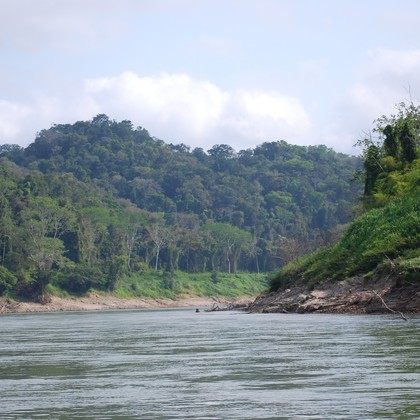
Undisturbed humid lowland and foothill forest up to about 900 m, especially near streams, rivers and swampy places; also the rainforest of Darién. It sits motionless for long periods on a low or mid-level branch in the forest and hunts from there for crabs, frogs, snakes, lizards and fish.
Where the bird is most at home, classified by the vegetation units of Mexico and Central America.



Range and movements
Resident in Panama, on the Caribbean slope from Coclé and Colón east through Panamá province and Guna Yala to Darién, where it is most often seen. Otherwise absent from the guide area. Outside the guide area in western Colombia, western Ecuador and extreme northwestern Peru.
- Resident
- dark = core range, pale = thinly spread
How and when to look
It usually stays hidden in forest along streams; the best chance is in the lowland forest of Darién and on the Caribbean side of central Panama, by walking quietly along forest streams and scanning the branches of the understorey.
Conservation status
Near Threatened. The species has a small range and depends on undisturbed lowland forest, which is shrinking through deforestation.
Scientific name
Cryptoleucopteryx plumbea | (Salvin, 1872) (GBIF: Leucopternis plumbeus)
Salvin described the species in 1872 as Leucopternis plumbea; because it was later moved to another genus, the author and year stand in brackets. The genus Cryptoleucopteryx was introduced in 2009 by Amaral, Sheldon, Gamauf, Haring, Riesing, Silveira & Wajntal. Cryptoleucopteryx is Greek, from kruptos 'hidden', leukos 'white' and pterux 'wing', after the white in the wing that shows only in flight. plumbea is Latin for 'lead-coloured', from plumbum 'lead', after the slate-grey plumage. The specimen the first description was based on came from Ecuador.