All species › Passerines › New World sparrows › Prevost's Ground Sparrow
Position in the tree Birds Aves › Birds with a flexible palate Neognathae › All other modern birds Neoaves › Landbirds Telluraves › Falcons, parrots and passerines Australaves › Falcons and passerines Eufalconimorphae › Parrots and passerines Psittacopasserae
Prevost's Ground Sparrow | Melozone biarcuata
Witwanggrondgors | Toquí cuatroojos
Prevost's Ground Sparrow is a small ground sparrow with a rufous crown and a white face with black markings that lives on the ground in scrub and coffee plantations. It occurs only in northern Central America, from Chiapas to Honduras. The closely related Cabanis's Ground Sparrow of Costa Rica was long treated as the same species.
Voice
The song is a short series of high, thin whistles and ticks. The call is a high, thin tsip; pairs keep in contact with soft, squeaky notes.
Recording: Alfonso Auerbach — CC BY-NC-SA 4.0 · converted to mono · xeno-canto
Identification
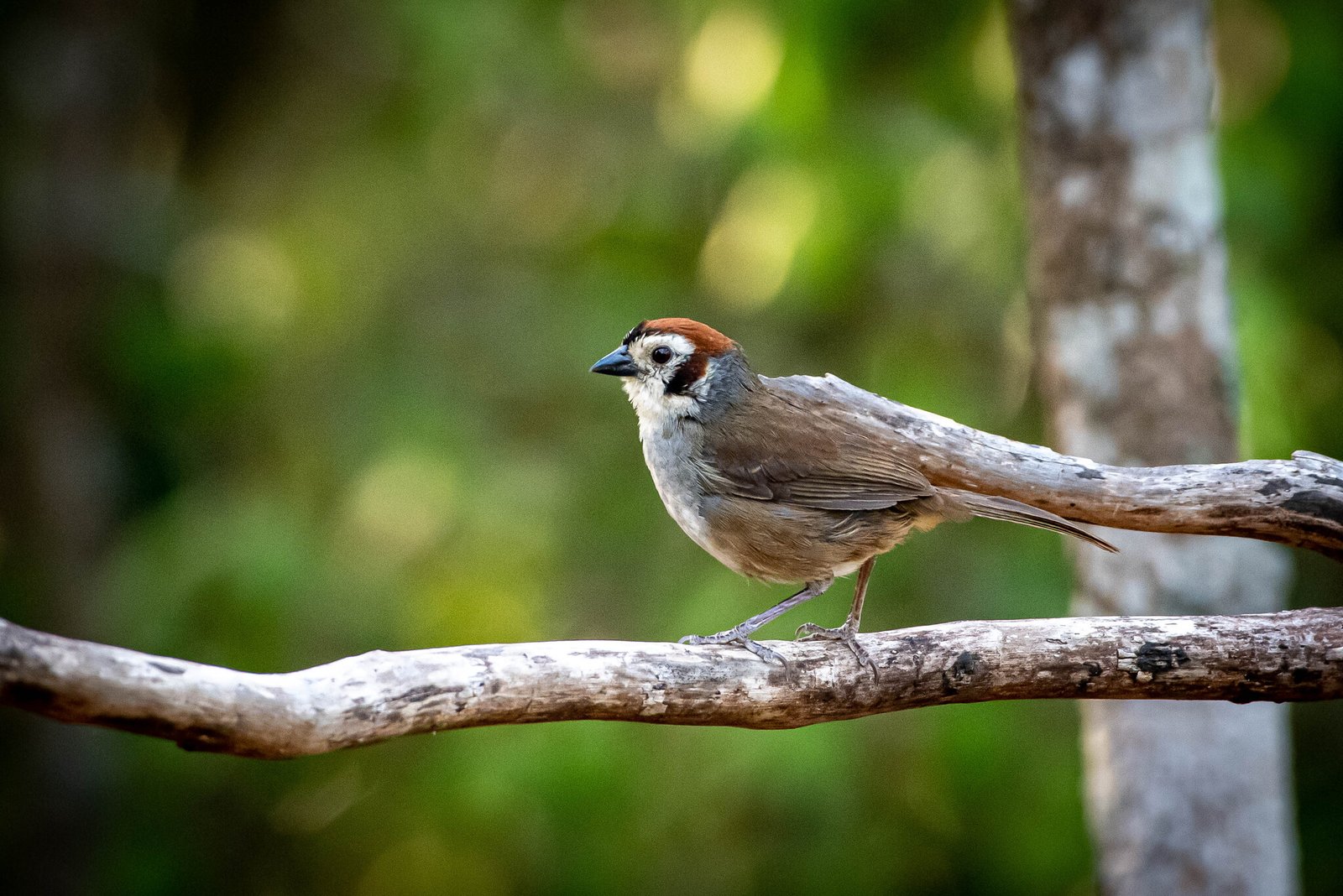
14–16 cm. Crown and nape rufous. Face white, with a black spot in front of the eye, a black crescent below the eye and a black spot on the rear cheek, giving the head a spotted pattern. Throat white, with a black spot in the centre of the breast. Upperparts olive-brown, belly white, flanks olive-grey. Bill dark. The sexes are alike; juveniles are duller with a brownish face.
Confusion species
White-eared Ground Sparrow Melozone leucotis has a black head with white spots and a black throat and breast, and usually lives higher and in more humid terrain. Cabanis's Ground Sparrow Melozone cabanisi is very similar but lives only in the Central Valley of Costa Rica, far outside the range of Prevost's Ground Sparrow. Rusty-crowned Ground Sparrow Melozone kieneri (Mexico, not in Chiapas) has a grey cheek, no white face and a thin black malar stripe.
Habitat
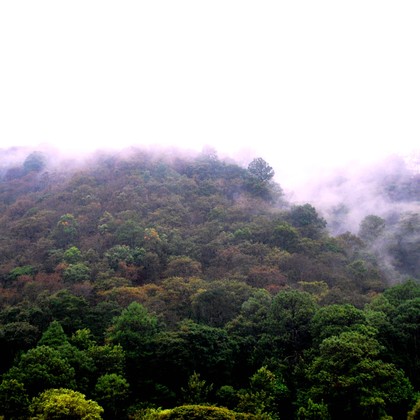
Scrub, hedgerows, edges of dry and semi-humid forest, secondary growth and coffee plantations with dense undergrowth, on the Pacific slope and in interior valleys, mainly between about 500 and 1800 m. It forages on the ground, scratching among the leaf litter for insects and seeds.
Where the bird is most at home, classified by the vegetation units of Mexico and Central America.



Range and movements
Endemic to the guide area: Chiapas (Mexico), Guatemala, El Salvador and western Honduras.
- Resident
- dark = core range, pale = thinly spread
How and when to look
In Guatemala regularly seen in coffee plantations and scrubby gardens around Antigua; it appears briefly on trails and field edges early in the morning.
Conservation status
Not threatened (LC). Fairly common in suitable scrub; locally declining where scrub and shade coffee disappear.
Scientific name
Melozone biarcuata | (Prévost & des Murs, 1842)
Prévost & des Murs described the species in 1842 as Pyrgita biarcuata; because it was later moved to another genus, the author and year stand in brackets. The genus Melozone was introduced in 1850 by Reichenbach. Melozone is Greek, from mēlon 'cheek' and zōnē 'girdle, band', after the patterned cheeks of the type species. biarcuata is Latin, from bi- 'two' and arcuatus 'bow-shaped', after the two arcs in the facial pattern. The specimen the first description was based on came from Guatemala (later designated).