All species › Passerines › New World warblers › Prothonotary Warbler
Position in the tree Birds Aves › Birds with a flexible palate Neognathae › All other modern birds Neoaves › Landbirds Telluraves › Falcons, parrots and passerines Australaves › Falcons and passerines Eufalconimorphae › Parrots and passerines Psittacopasserae
Prothonotary Warbler | Protonotaria citrea
Citroenzanger | Chipe dorado
The Prothonotary Warbler is a golden-yellow warbler with blue-grey wings of swamp forest and mangrove. It breeds in swamp forests in the eastern United States and is one of the few North American warblers that nest in tree cavities. In the guide area it is mainly a passage migrant along the Gulf Coast, on the Yucatán Peninsula and on the Caribbean slope, and winters mainly in mangrove in southern Central America.

Voice
The song is a series of five to ten loud, clear, even notes, tsweet tsweet tsweet tsweet. The call is a loud, metallic chip. In winter mainly the call.
Recording: Richard E. Webster — CC BY-NC-SA 4.0 · shortened to the first 60 s, mono · xeno-canto
Identification
13–14 cm. Head and underparts intense golden yellow to orange-yellow, undertail coverts white. Back olive-green; wings and tail blue-grey without wing bars. The tail has large white spots, seen mainly from below. Large dark eye in a plain yellow head; bill fairly long, pointed and black. Female and young birds are duller, with an olive-green wash on crown and nape.
Confusion species
Blue-winged Warbler Vermivora cyanoptera has a black eye-stripe and two distinct white wing bars. American Yellow Warbler Setophaga aestiva and Mangrove Warbler Setophaga petechia have yellow edges to the wing feathers, yellow tail spots and a shorter bill, and lack blue-grey wings. The female Hooded Warbler Setophaga citrina has olive-green wings and back and yellow undertail coverts.
Habitat
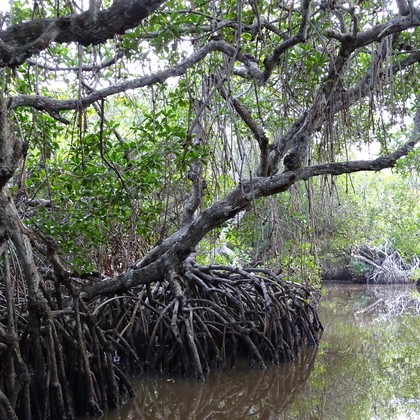
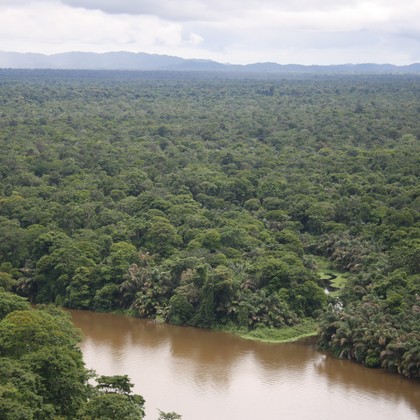
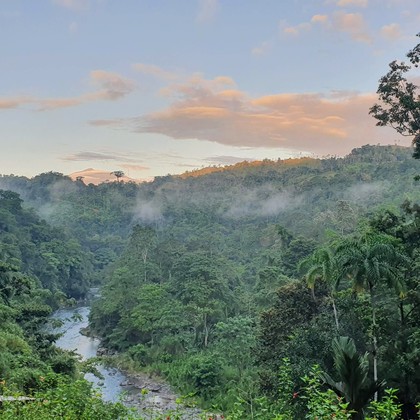
In winter mainly mangrove and swamp forest along the coast, also lagoon edges and flooded forest along lowland rivers. On passage also in coastal woodland, scrub, parks and gardens. It searches for insects and spiders low to mid-level in the vegetation, often close to water; in winter it also takes nectar and fruit.
Where the bird is most at home, classified by the vegetation units of Mexico and Central America.


Range and movements
Breeds in the eastern and south-eastern United States and extreme southern Ontario. Winters from southern Mexico through Central America to northern Colombia and Venezuela, and scarcely in the Caribbean. In the guide area most numerous in winter in mangrove on the Caribbean and Pacific coasts of Costa Rica and Panama; scarcer further north. Passage mainly along the Gulf Coast of Mexico, across the Yucatán Peninsula and along the Caribbean coast.
- Winter visitor (c. Oct–Mar)
- dark = core range, pale = thinly spread
How and when to look
On autumn passage, especially in August and September, on the coast of the Yucatán Peninsula and in Belize; in winter in mangrove on the coasts of Panama.
Conservation status
Not threatened (LC). Has declined over the long term through loss of swamp forest on the breeding grounds; mangrove clearance threatens the wintering area.
Scientific name
Protonotaria citrea | (Boddaert, 1783)
Boddaert described the species in 1783 as Motacilla citrea; because it was later moved to another genus, the author and year stand in brackets. The genus Protonotaria was introduced in 1858 by Baird. Protonotaria comes from Late Latin protonotarius 'prothonotary', a senior papal official whose yellow robes recall the plumage. citrea is Latin for 'lemon-yellow', after the bright yellow plumage. The specimen the first description was based on came from Louisiana (USA).