All species › Swifts › Hummingbirds › Purple-crowned Fairy
Position in the tree Birds Aves › Birds with a flexible palate Neognathae › All other modern birds Neoaves › Birds of the elements Elementaves › Nightjars and swifts Strisores
Purple-crowned Fairy | Heliothryx barroti
Paarskopfeeënkolibrie | Hada enmascarada
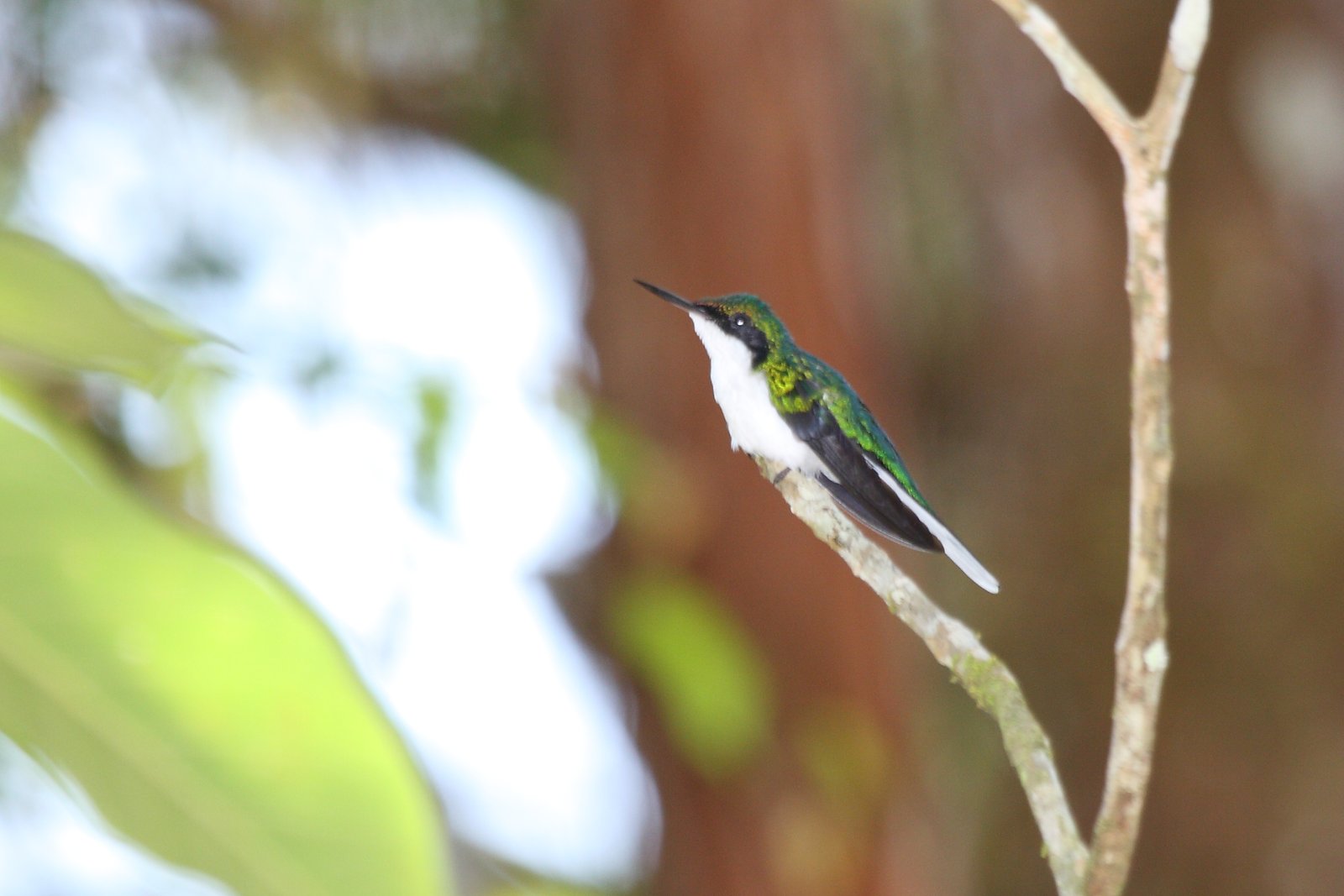
The Purple-crowned Fairy is a green and white hummingbird of the canopy and forest edges of the humid lowlands. With its short, dagger-like bill it often pierces the base of long flowers from outside and drinks the nectar without pollinating the flower. While hovering it constantly fans its long, white tail.
Voice
A high, sharp tsit, often in short series. A song is little known.
Recording: Olaf Jahn — CC BY-NC-SA 4.0 · converted to mono · xeno-canto
Identification
11–13 cm, the female larger than the male because of the longer tail, with a short, straight, sharply pointed black bill. The upperparts are glittering green and the underparts bright white from chin to undertail coverts. A black mask runs from the bill through the eye to a violet-blue ear tuft. The male has a glittering purple crown, the female a green crown. The graduated tail has dark blue central feathers and white outer feathers.
Confusion species
The combination of bright white underparts, black mask and white tail is unique in the guide area. Female White-necked Jacobin Florisuga mellivora has a scaly throat and breast. Crowned Woodnymph Thalurania colombica and Violet-headed Hummingbird Klais guimeti have dark or grey underparts. Female mountaingems have a pale stripe behind the eye and a dark tail.
Habitat
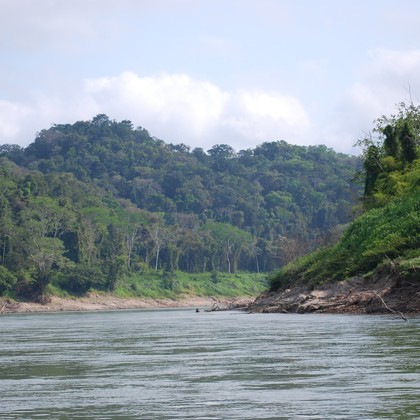
The canopy and edges of humid lowland and foothill forest, tall secondary forest, gallery forest and plantations with tall shade trees, from sea level to about 1200 m. It visits flowers high in trees and lianas, and catches small insects in the air.
Where the bird is most at home, classified by the vegetation units of Mexico and Central America.




Range and movements
From southern Mexico, in Chiapas, Tabasco, Campeche and Quintana Roo, through Belize, Guatemala, Honduras and Nicaragua, mainly on the Caribbean side, to Costa Rica and Panama, where it occurs on both sides of the mountains. Outside the guide area in western Colombia and western Ecuador.
- Resident
- dark = core range, pale = thinly spread
How and when to look
Along forest edges and clearings with a view of the canopy, and at tall flowering trees and lianas. The white underparts and fanned white tail stand out at once in flight.
Conservation status
Least Concern. The species is fairly common in the humid lowlands of Costa Rica and Panama, scarcer in the north of the guide area. It tolerates tall secondary forest, but depends on trees with flowering crowns.
Scientific name
Heliothryx barroti | (Bourcier, 1843)
Bourcier described the species in 1843 as Trochilus Barroti; because it was later moved to another genus, the author and year stand in brackets. The genus Heliothryx was introduced in 1831 by Boie. Heliothryx is Greek, from hēlios 'sun' and thrix, trikhos 'hair': 'sun-hair', after the glittering plumage. barroti honours the French diplomat Adolphe Barrot (1801–1870), consul at Cartagena (Colombia). The specimen the first description was based on came from Cartagena, Colombia.