All species › Swifts › Hummingbirds › Tooth-billed Hummingbird
Position in the tree Birds Aves › Birds with a flexible palate Neognathae › All other modern birds Neoaves › Birds of the elements Elementaves › Nightjars and swifts Strisores
Tooth-billed Hummingbird | Androdon aequatorialis
Tandsnavelkolibrie | Colibrí piquidentado
The Tooth-billed Hummingbird is the only member of its genus and owes its name to the fine, tooth-like serrations along the edge of the bill tip. The bill is also slightly hooked at the tip. It flies regular routes past flowers, but also catches many small arthropods, among others from spider webs. In the guide area it lives only in the foothills and mountains of Darién.

Voice
A high, thin tseep, often in flight. A song has hardly been described.
Recording: Olaf Jahn — CC BY-NC-SA 4.0 · converted to mono · xeno-canto
Identification
13–14 cm, with a very long, straight bill of about 4 cm, with a slightly hooked tip and fine serrations visible only at close range. The crown is dark, the upperparts are bronzy green, with a narrow white band across the rump. The underparts are greyish white with heavy dark streaks. The tail is grey, with a dark band before the white tip. The sexes are almost alike.
Confusion species
Hermits, such as Green Hermit Phaethornis guy and Pale-bellied Hermit Phaethornis anthophilus, have a decurved bill, a facial mask and long central tail feathers. Long-billed Starthroat Heliomaster longirostris has a red throat in the male, a white stripe down the centre of the back and unstreaked underparts. White-tipped Sicklebill Eutoxeres aquila has a strongly curved bill.
Habitat
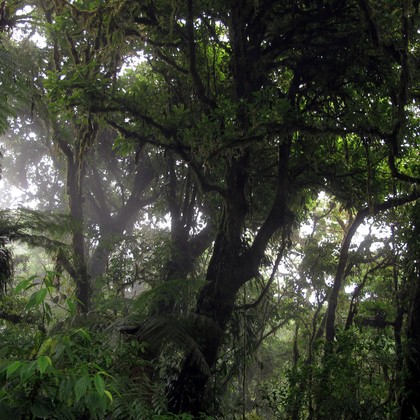
The understorey and mid-levels of humid foothill and lower montane forest, also along forest edges and streams, mainly between about 300 and 1500 m. It visits flowers of epiphytes and shrubs on regular routes and searches leaves and spider webs for arthropods.
Where the bird is most at home, classified by the vegetation units of Mexico and Central America.


Range and movements
In the guide area only in eastern Panama, in the foothills and mountains of Darién, such as the Serranía de Pirre and the area around Cana. Outside the guide area along the Pacific side of Colombia to north-western Ecuador.
- Resident
- dark = core range, pale = thinly spread
How and when to look
Mainly around Cana and on the slopes of Cerro Pirre in Darién, at flowering epiphytes and shrubs along forest trails. The area is remote and can be reached only on an organised trip.
Conservation status
Least Concern. Locally fairly common within its range. In the guide area restricted to a small part of Darién, where the forest is still largely intact.
Scientific name
Androdon aequatorialis | Gould, 1863
Gould described the species in 1863 and placed it straight away in the genus where it still stands. He introduced the genus Androdon in that same work. Androdon is Greek, from anēr, andros 'man' and odous, odontos 'tooth', after the fine serrations near the bill tip of the male. aequatorialis is Latin for 'equatorial', after Ecuador, where the species was described. The specimen the first description was based on came from Ecuador.