All species › Woodpeckers and allies › Woodpeckers › Red-breasted Sapsucker
Position in the tree Birds Aves › Birds with a flexible palate Neognathae › All other modern birds Neoaves › Landbirds Telluraves › Raptors, owls, kingfishers and woodpeckers Afroaves › Mousebirds, rollers and woodpeckers Coraciimorphae › Trogons and cavity nesters Cavitaves › Hornbills, kingfishers and woodpeckers Picocoraciae › Kingfishers, bee-eaters and woodpeckers Picodynastornithes
Red-breasted Sapsucker | Sphyrapicus ruber
Roodborstsapspecht | Chupasavia pechirrojo
The Red-breasted Sapsucker is the sapsucker of the Pacific coast of North America and the only sapsucker with an all-red head and breast. In the guide area it breeds in the mountains of northern Baja California; in winter it also occurs lower there and exceptionally further south. Like other sapsuckers it drills rows of holes in bark and drinks the sap that flows from them.

Voice
A nasal, mewing neeah, as in the other sapsuckers. The drum has the typical sapsucker rhythm: a fast opening followed by a few separate, slower taps.
Recording: Denise Wight — CC BY-NC-SA 4.0 · converted to mono · xeno-canto
Identification
20–22 cm. The head, throat and breast are red, with a pale spot between the bill and the eye. The back is black with pale spots, the belly pale yellow with dark marks on the flanks, the rump white. A long white wing stripe is visible even on perched birds. Male and female are alike. Birds in Baja California and California have a slightly less red head, often still showing a faint black-and-white head pattern. Young birds are brownish without red, with the white wing stripe.
Confusion species
Red-naped Sapsucker Sphyrapicus nuchalis and Yellow-bellied Sapsucker Sphyrapicus varius have a clear black-and-white head pattern with red on the crown and throat and a black breast band instead of a red breast. Hybrids with Red-naped Sapsucker show an intermediate head pattern. Young birds resemble young Yellow-bellied Sapsuckers but are darker and less patterned.
Habitat
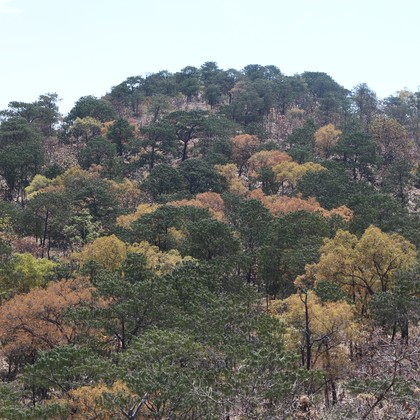
Breeds in mixed coniferous forest in the mountains, often near aspens or in moist valleys. In winter also in oak and riparian woodland, orchards and gardens at lower elevations. It takes sap and insects from its wells and also eats fruit and berries. It nests in holes it excavates in living or dead trees.
Where the bird is most at home, classified by the vegetation units of Mexico and Central America.



Range and movements
Breeds in the Sierra Juárez and the Sierra San Pedro Mártir in northern Baja California, and also present there in winter, partly at lower elevations. In winter rare elsewhere in north-western Baja California and exceptional in Sonora. Outside the guide area it breeds from south-eastern Alaska along the Pacific coast and in the Sierra Nevada to southern California.
- Resident
- Winter visitor (c. Oct–Mar)
- dark = core range, pale = thinly spread
How and when to look
In the breeding season in the coniferous forest of the Sierra San Pedro Mártir. Fresh rows of holes in bark betray its presence; a tree with wet sap wells is visited again and again.
Conservation status
Not threatened. The population in Baja California is small and isolated.
Scientific name
Sphyrapicus ruber | (Gmelin, 1788)
Gmelin described the species in 1788 as Picus ruber; because it was later moved to another genus, the author and year stand in brackets. The genus Sphyrapicus was introduced in 1858 by Baird. Sphyrapicus combines Greek sphura 'hammer' with Picus 'woodpecker': 'hammer woodpecker'. ruber is Latin for 'red', after the entirely red head and breast. The specimen the first description was based on came from Nootka Sound, British Columbia, Canada (originally given in error as Cayenne).