All species › Gannets and cormorants › Boobies and gannets › Red-footed Booby
Position in the tree Birds Aves › Birds with a flexible palate Neognathae › All other modern birds Neoaves › Birds of the elements Elementaves › Tropicbirds and waterbirds Phaethoquornithes › Core waterbirds Aequornithes
Red-footed Booby | Sula sula
Roodpootgent | Piquero patirrojo
The Red-footed Booby is the smallest booby in the guide area and the only one that nests in trees and shrubs. It forages far out at open sea, often at dusk, and comes close to the coast only near its colonies. In the guide area the largest colonies are on the Pacific side, on Cocos Island and the Revillagigedo Islands; on the Caribbean side Half Moon Caye in Belize is the best-known colony.

Voice
Silent at sea. At the colony a harsh, rasping karrr and rattling series ra-ra-ra-ra.
Recording: GABRIEL LEITE — CC BY-NC-SA 4.0 · converted to mono · xeno-canto
Identification
66–77 cm; slimmer and smaller than the other boobies, with a fairly long, pointed tail. Adults have bright red legs, a pale blue bill and pink and blue bare skin at the bill base. There are several colour morphs. The white morph is white with a yellowish tinge to the head and neck and black primaries and secondaries, with a black patch at the carpal on the underwing. The brown morph is uniform grey-brown; in the white-tailed brown morph the tail, rump and undertail coverts are white. On Half Moon Caye nearly all birds are white, while on the Pacific side the brown morphs predominate. Juveniles are uniform brown with a dark bill and greyish to yellowish legs; adult plumage is reached in two to three years.
Confusion species
Masked Booby Sula dactylatra and Nazca Booby Sula granti are larger and bulkier, with a black mask, a black tail and black secondaries forming a broad dark trailing edge along the whole wing. Brown Booby Sula leucogaster and Cocos Booby Sula brewsteri have a sharply demarcated white belly against a dark breast and yellow legs; young birds of these species have a paler belly, whereas young Red-footed Boobies are uniformly brown below. Blue-footed Booby Sula nebouxii has blue feet and a streaked, pale brown head. Almost any booby perched in a tree is a Red-footed Booby.
Habitat
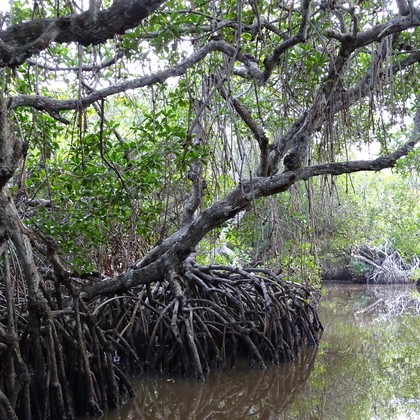
Open, deep tropical water far from the coast, where the birds catch flying fish and squid by plunging at an angle or snatching them above the surface. They also follow ships and rest on rigging and buoys. They breed in colonies in scrub, low forest and mangroves on remote islands, building a stick nest in a tree or shrub.
Where the bird is most at home, classified by the vegetation units of Mexico and Central America.



Range and movements
On the Pacific side the species breeds on the Revillagigedo Islands, such as Socorro and Clarión, and in large numbers on Cocos Island off Costa Rica. Away from the colonies it is seen at sea off the whole Pacific coast from Mexico to Panama, usually far offshore. On the Caribbean side there is a large colony on Half Moon Caye in Belize; elsewhere it is a scarce visitor at sea in the Gulf of Mexico and the Caribbean Sea. Birds on the Pacific side belong to the subspecies S. s. websteri, those on the Caribbean side to the nominate form S. s. sula. Outside the guide area in all tropical oceans.
- Resident
- Summer visitor (c. Apr–Sep)
- Winter visitor (c. Oct–Mar)
- Passage (Mar–Apr, Oct–Nov)
- dark = core range, pale = thinly spread
How and when to look
On Half Moon Caye the breeding birds can be watched from a viewing platform among the treetops; the island is reached by boat from Belize. On the Pacific side, pelagic trips and boat trips to Cocos Island offer the best chances. A booby in a tree or on a ship's rigging is almost always this species.
Conservation status
Not threatened. Colonies are vulnerable to introduced predators, disturbance and the felling of nesting trees; at sea birds become entangled in fishing gear. Half Moon Caye and Cocos Island are protected.
Scientific name
Sula sula | (Linnaeus, 1766)
Linnaeus described the species in 1766 as Pelecanus Sula; because it was later moved to another genus, the author and year stand in brackets. The genus Sula was introduced in 1760 by Brisson. Sula goes back to súla, the Old Norse and Icelandic word for the gannet; the name passed to the boobies. sula comes from the Old Norse and Icelandic súla, the name for the gannet. The specimen the first description was based on came from Barbados (designated later).