All species › Trogons › Trogons › Resplendent Quetzal
Position in the tree Birds Aves › Birds with a flexible palate Neognathae › All other modern birds Neoaves › Landbirds Telluraves › Raptors, owls, kingfishers and woodpeckers Afroaves › Mousebirds, rollers and woodpeckers Coraciimorphae › Trogons and cavity nesters Cavitaves
Resplendent Quetzal | Pharomachrus mocinno
Quetzal | Quetzal mesoamericano
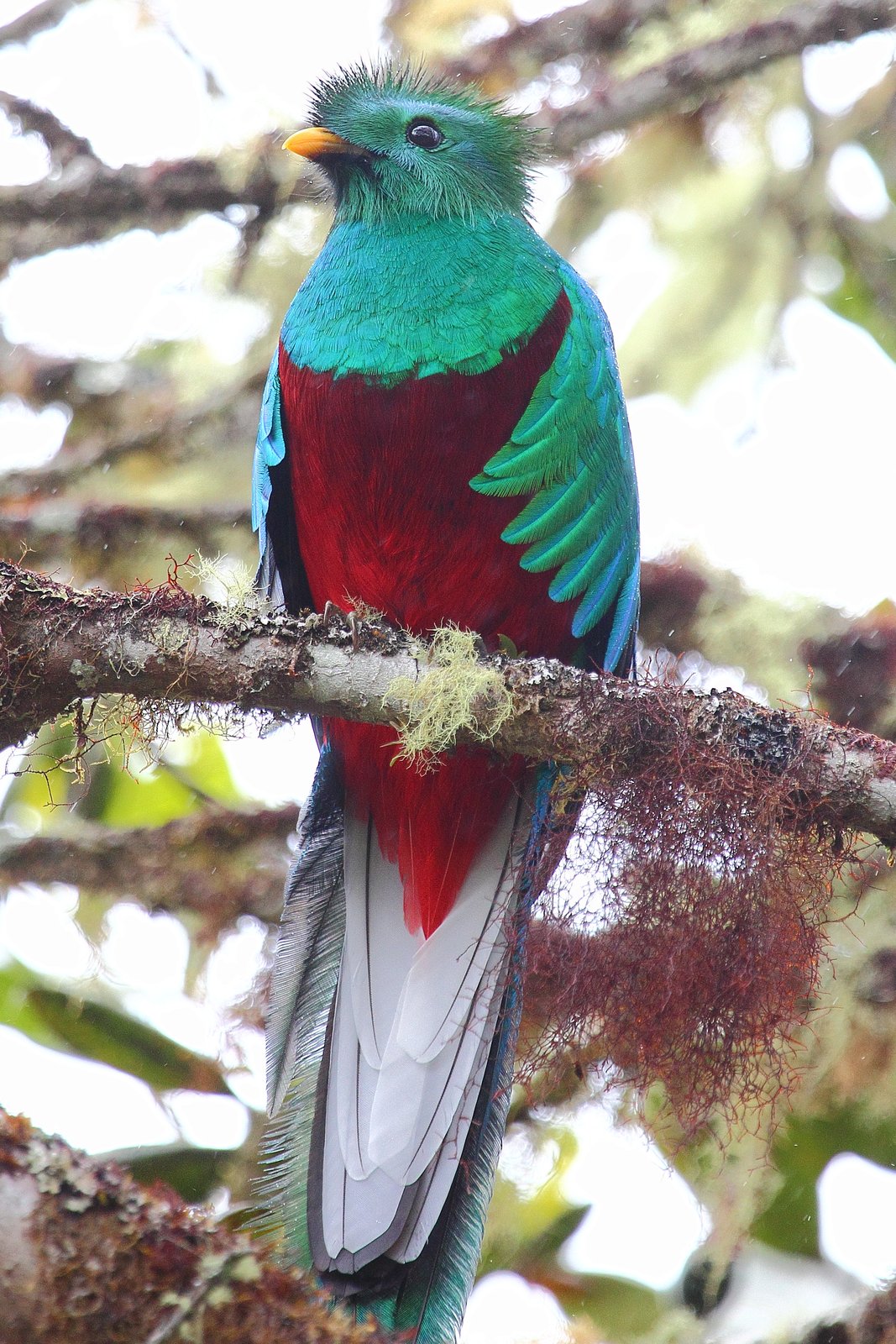
The Resplendent Quetzal is the largest trogon in the guide area and a bird of highland cloud forest, from Chiapas to western Panama. The male carries a train of elongated uppertail coverts that reaches far beyond the tail. The bird is the national symbol of Guatemala, whose currency is named after it.
Voice
The male gives a series of clear, two-part whistles, kee-oo kee-oo, often from a high perch or in a display flight above the canopy. Also a rattling, cackling wek-wek-wek and a dry kwa-kwa when alarmed.
Recording: Manuel Grosselet — CC BY-NC-SA 4.0 · shortened to the first 60 s, mono · xeno-canto
Identification
35–40 cm without the train; in the male the elongated uppertail coverts extend up to about 65 cm beyond the tail tip. The male is glossy emerald green on the head, back and breast, with a round, bristly crest and long, curled green wing coverts over the black wing. The belly and undertail coverts are crimson, the underside of the tail white and the bill yellow. The female is duller bronze-green, with a grey breast and belly, red only on the undertail coverts, a black-and-white barred undertail, a dark bill and no crest or train. Birds in Costa Rica and Panama (P. m. costaricensis) have a shorter, narrower train in the male than those in the north (P. m. mocinno).
Confusion species
Trogons such as Collared Trogon Trogon collaris and Mountain Trogon Trogon mexicanus are much smaller at about 25–30 cm, have a white breast band between the green and the red, a square-ended, barred tail and no crest. The female quetzal differs from female trogons in size, green upperparts and the lack of a white breast band.
Habitat
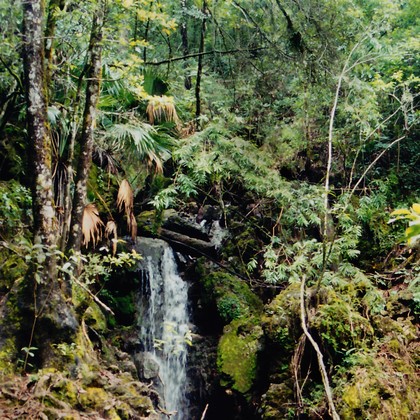
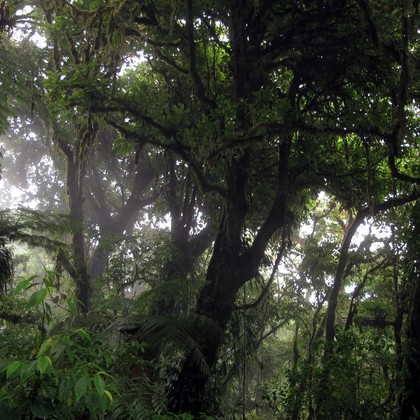
Humid montane forest and cloud forest between about 1200 and 3000 m, with abundant epiphytes and fruiting trees of the laurel family, such as wild avocado; also forest edges and pasture with scattered old trees next to forest. After breeding many birds move to lower slopes and valleys, sometimes below 1000 m. It eats mainly fruit, plucked from the branch in flight, and in the breeding season also insects and small lizards. It nests in a cavity that both parents excavate in a rotting trunk.
Where the bird is most at home, classified by the vegetation units of Mexico and Central America.


Range and movements
Highlands of Chiapas (and a small area of eastern Oaxaca), Guatemala, north-western El Salvador, Honduras and northern Nicaragua (P. m. mocinno), and further south in the mountains of Costa Rica and western Panama east to Veraguas (P. m. costaricensis). The two groups are separated by a gap in the Nicaraguan lowlands. The species does not occur outside the guide area.
- Resident
- dark = core range, pale = thinly spread
How and when to look
In the breeding season, March to June, the chances are best at fruiting wild avocado trees early in the morning. Well-known sites include El Triunfo in Chiapas, the Sierra de las Minas in Guatemala, the Talamanca range at San Gerardo de Dota and Monteverde in Costa Rica, and the slopes of Barú in Chiriquí. A perched bird stays motionless for long periods; its call usually gives it away first.
Conservation status
Near Threatened. The species is declining through the loss and fragmentation of montane forest, especially of the lower slopes on which the birds depend outside the breeding season. In large protected forests it is still locally fairly common.
Scientific name
Pharomachrus mocinno | de la Llave, 1832
De la Llave described the species in 1832 and placed it straight away in the genus where it still stands. He introduced the genus Pharomachrus in that same work. Pharomachrus is Greek, from pharos 'mantle' and makros 'long', after the long, glossy coverts that trail over the tail. mocinno honours the Mexican naturalist José Mariano Mociño (1757–1820), who took part in a scientific expedition that included Guatemala. The specimen the first description was based on came from Guatemala and Chiapas (Mexico).