All species › Waterfowl › Ducks, swans and geese › Ross's Goose
Position in the tree Birds Aves › Birds with a flexible palate Neognathae › Fowl Galloanserae
Ross's Goose | Anser rossii
Ross' gans | Ánsar de Ross
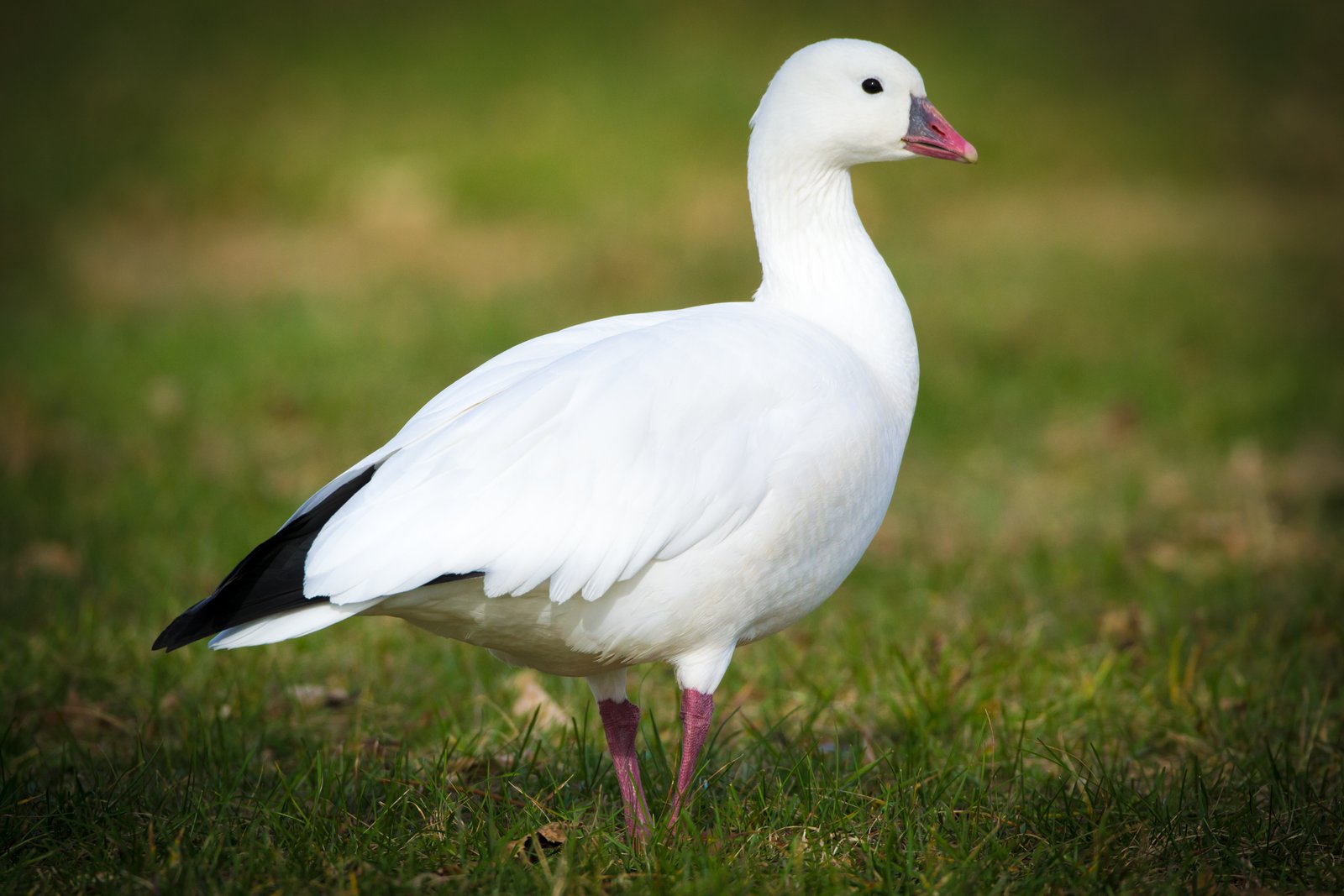
Ross's Goose is the smallest white goose of North America, a breeding bird of the central Canadian Arctic. In the guide area it winters in northern Mexico, nearly always among Snow Geese, of which it looks like a scaled-down version. The species is named after Bernard Ross, a trader of the Hudson's Bay Company.
Voice
Higher, weaker and shorter than in Snow Goose: a short, squeaky kek or luk and a low murmur; hard to pick out in the large, noisy flocks of Snow Geese.
Recording: Paul Marvin — CC BY-NC-SA 4.0 · converted to mono · xeno-canto
Identification
53–66 cm, clearly smaller than Snow Goose, with a round head, a short neck and a small, triangular bill. Adults are pure white with black primaries; the pink bill lacks the black 'grin patch' along the cutting edges and in older birds has a bluish-grey, warty base. Legs pink. Juveniles are white with a pale grey wash on the head, back and wings, paler than juvenile Snow Geese. A dark morph, comparable to the blue morph of Snow Goose, is very rare. It flies with quicker wingbeats than Snow Goose.
Confusion species
Snow Goose Anser caerulescens is larger, with a longer neck, a flatter, sloping forehead and a longer bill with a black 'grin patch' along the cutting edges. Hybrids between the two species occur regularly and show intermediate features. Juvenile Snow Geese are much greyer than juvenile Ross's Geese and have a dark bill.
Habitat
Maize, grain and alfalfa stubble, wet grassland, lakes and shallow lagoons on the plateau and in the north-western lowlands. It roosts on open water and feeds by day on the fields, together with Snow Geese and Sandhill Cranes.
Where the bird is most at home, classified by the vegetation units of Mexico and Central America.




Range and movements
Winters in northern Mexico, mainly on the plateau of Chihuahua and Durango and in the farmland of Sonora and Sinaloa, further in Coahuila, Nuevo León, Tamaulipas and northern Baja California. Rare further south. Breeds in the central Canadian Arctic, mainly around Queen Maud Gulf, and winters mostly in California, the southern Great Plains and Texas.
- Winter visitor (c. Oct–Mar)
- dark = core range, pale = thinly spread
How and when to look
In the large flocks of Snow Geese at the Babícora and Bustillos lagoons in Chihuahua; look for a smaller white goose with a short, stubby bill and a round head.
Conservation status
Not threatened globally; the population has increased strongly since the 1960s. In the guide area a locally fairly common winter visitor.
Scientific name
Anser rossii | Cassin, 1861
Cassin described the species in 1861 and placed it straight away in the genus where it still stands. The genus Anser was introduced in 1760 by Brisson. Anser is the Latin word for 'goose'. rossii honours Bernard Rogan Ross (1827–1874), a chief factor of the Hudson's Bay Company, who collected the first specimens of this goose. The specimen the first description was based on came from Great Slave Lake, Canada.