All species › Jacamars and puffbirds › Jacamars › Rufous-tailed Jacamar
Position in the tree Birds Aves › Birds with a flexible palate Neognathae › All other modern birds Neoaves › Landbirds Telluraves › Raptors, owls, kingfishers and woodpeckers Afroaves › Mousebirds, rollers and woodpeckers Coraciimorphae › Trogons and cavity nesters Cavitaves › Hornbills, kingfishers and woodpeckers Picocoraciae › Kingfishers, bee-eaters and woodpeckers Picodynastornithes
Rufous-tailed Jacamar | Galbula ruficauda
Roodstaartglansvogel | Jacamar colirrufo
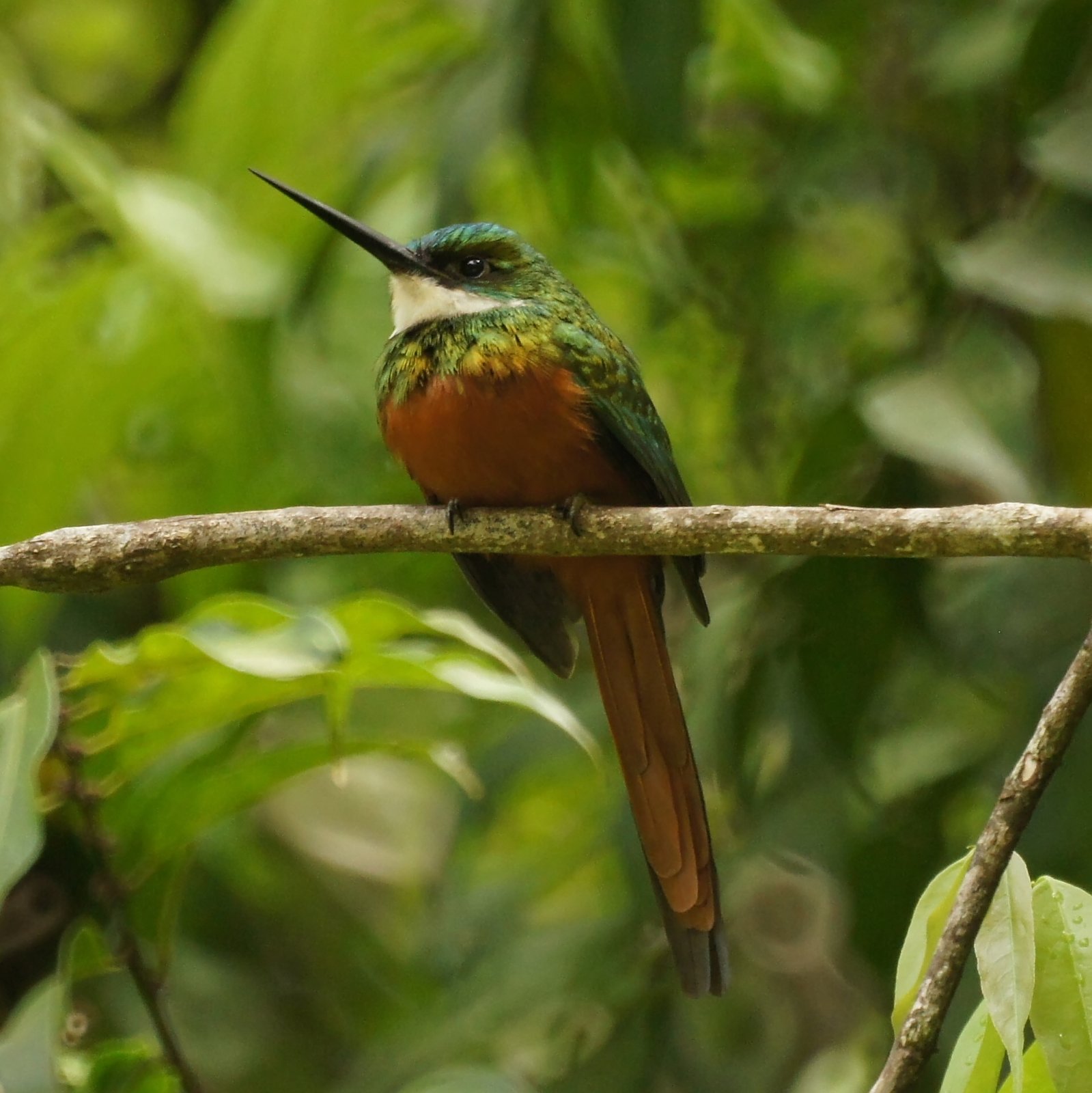
The Rufous-tailed Jacamar is the only jacamar found throughout the southern part of the guide area, from southern Mexico to Panama. It sits upright on an open branch along a forest trail or stream, turns its head quickly from side to side and sallies out after passing butterflies and dragonflies. With its metallic green upperparts and long needle-like bill it looks like a large hummingbird.
Voice
A sharp, high peek or pee-ik, often repeated. The song is a series of high notes that accelerates and ends in a trill, sometimes alternated by the mate.
Recording: JAYRSON ARAUJO DE OLIVEIRA — CC BY-NC-SA 4.0 · converted to mono · xeno-canto
Identification
20–25 cm, much of it bill and tail. Upperparts, head and a broad breast band metallic green with a golden or coppery sheen; belly and undertail coverts rufous. The male has a white throat, the female a buff one. Birds in the guide area have a black chin. The bill is long, straight, thin and black. The tail is long and graduated; the central feathers are green, the outer ones rufous.
Confusion species
Great Jacamar Jacamerops aureus is much larger, with a thick, slightly curved bill, plain rufous underparts without a green breast band and a green tail. Dusky-backed Jacamar Brachygalba salmoni (eastern Panama) is smaller and blackish above, with a shorter dark tail.
Habitat
Shady edges and openings in humid lowland and foothill forest up to about 1200 m, secondary forest, gallery forest and vegetated stream banks. It usually perches low to mid-level. It hunts mainly butterflies, but also dragonflies, wasps and bees, which it beats against a branch before eating them. It digs its nest in an earth bank, stream bank or sometimes a termite mound.
Where the bird is most at home, classified by the vegetation units of Mexico and Central America.





Range and movements
Lowlands of southern Mexico (southern Veracruz, Oaxaca, Tabasco, Chiapas, Campeche and Quintana Roo) through Belize, Guatemala, Honduras and Nicaragua to Costa Rica and Panama, mainly on the Caribbean slope; in Costa Rica and Panama also on the Pacific side. Absent from El Salvador and the dry Pacific lowlands. Outside the guide area from Colombia to northern Argentina.
- Resident
- dark = core range, pale = thinly spread
How and when to look
Common at La Selva and Carara in Costa Rica, at Tikal in Guatemala and along Pipeline Road (Camino del Oleoducto) in Panama. It often allows close views on a favourite branch beside a trail, to which it keeps returning after each sally.
Conservation status
Not threatened. It tolerates secondary forest and forest edges and is common in large parts of its range.
Scientific name
Galbula ruficauda | Cuvier, GLCFD, 1816
Cuvier, GLCFD described the species in 1816 and placed it straight away in the genus where it still stands. The genus Galbula was introduced in 1760 by Brisson. Galbula is the Latin word for a small yellow bird. ruficauda is Latin, from rufus 'red' and cauda 'tail', after the rufous tail. The specimen the first description was based on came from the Guianas (unspecified).