All species › Jacamars and puffbirds › Puffbirds › Barred Puffbird
Position in the tree Birds Aves › Birds with a flexible palate Neognathae › All other modern birds Neoaves › Landbirds Telluraves › Raptors, owls, kingfishers and woodpeckers Afroaves › Mousebirds, rollers and woodpeckers Coraciimorphae › Trogons and cavity nesters Cavitaves › Hornbills, kingfishers and woodpeckers Picocoraciae › Kingfishers, bee-eaters and woodpeckers Picodynastornithes
Barred Puffbird | Nystalus radiatus
Gebandeerde baardkoekoek | Buco barrado
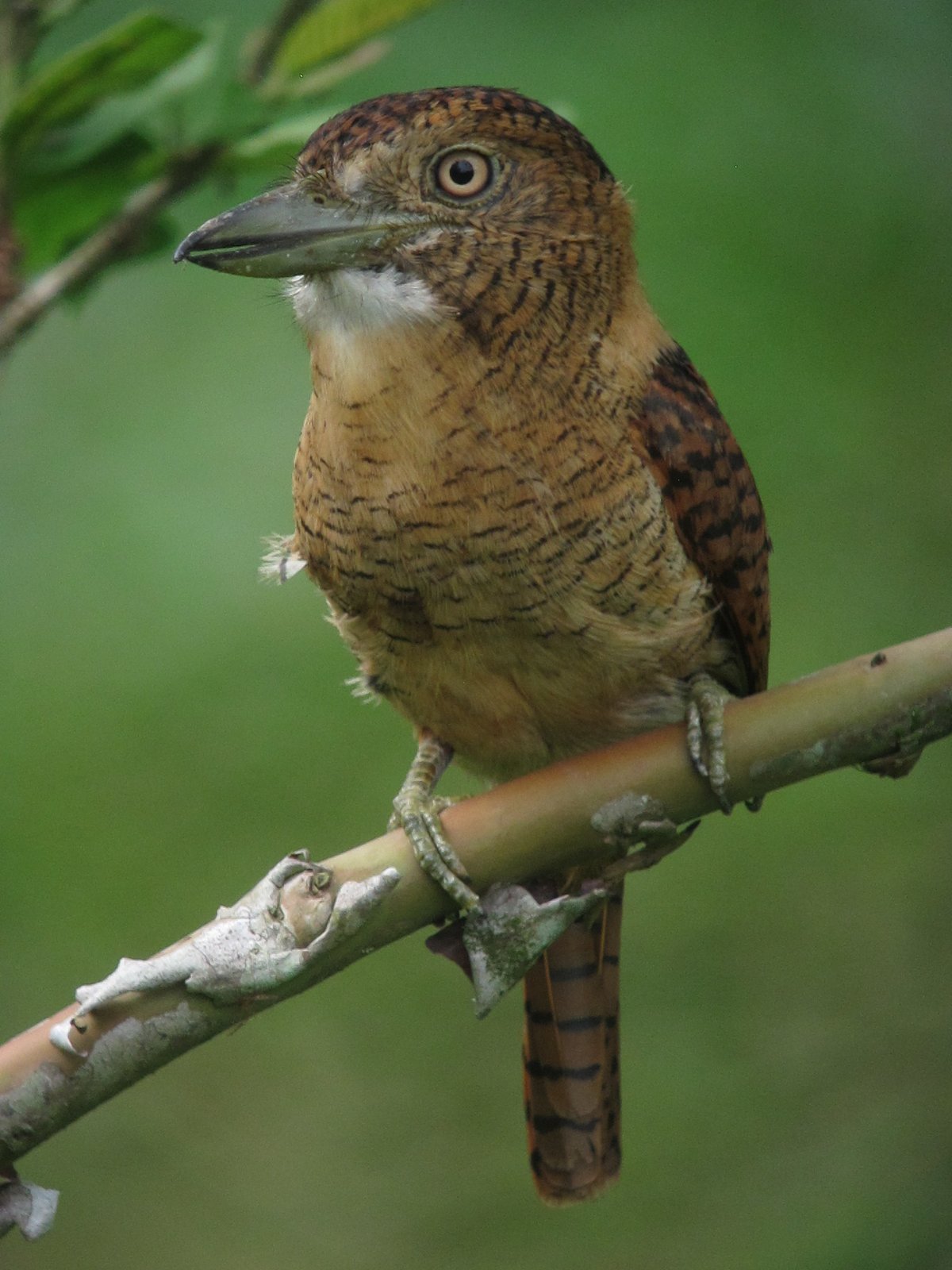
The Barred Puffbird is a big-headed, cinnamon-brown puffbird finely barred with black all over. Within the guide area it lives only in central and eastern Panama. Like other puffbirds it sits still for long periods on a lookout perch and is heard more often than seen.
Voice
A loud, drawn-out two-part whistle, the first note rising and the second falling, wheeeet-wheeeeeuw, like a wolf whistle. It is repeated at intervals for long periods, often in the middle of the day.
Recording: José María Loaiza B. — CC BY-NC-SA 4.0 · shortened to the first 60 s, mono · xeno-canto
Identification
20–22 cm. Upperparts rufous-brown to cinnamon with dense, fine black barring; a pale buff band across the nape. Underparts paler buff, also finely barred black, with a paler throat. The head is large and the bill thick, hook-tipped and greyish to horn-coloured. The tail is fairly short and barred. Sexes alike; the female is slightly browner.
Confusion species
Fasciated Antshrike Cymbilaimus lineatus is smaller, black with narrow white or buff bars, with a red eye and, in the male, a black cap; it moves more through dense foliage. Barred Antshrike Thamnophilus doliatus is barred black and white and crested. White-whiskered Puffbird Malacoptila panamensis is streaked rather than barred and has white whiskers.
Habitat
Edges of humid and semi-humid lowland and foothill forest, clearings with scattered trees, tall secondary forest and wooded pasture, up to about 900 m. It sits on a bare branch or in a tree crown at the edge of a clearing and drops from there onto large insects, spiders and lizards. It nests in a hole dug by the pair in an earth bank or termite nest.
Where the bird is most at home, classified by the vegetation units of Mexico and Central America.




Range and movements
Within the guide area only in central and eastern Panama, from Coclé and the Canal Area (Colón and Panamá) east to Darién. Outside the guide area in western Colombia and western Ecuador.
- Resident
- dark = core range, pale = thinly spread
How and when to look
The loud two-part whistle is regularly heard at Cerro Azul and in Darién in Panama. The bird itself often sits high and motionless on a dead branch at the forest edge.
Conservation status
Not threatened. It tolerates forest edges and semi-open land with trees.
Scientific name
Nystalus radiatus | (Sclater, 1854)
Sclater described the species in 1854 as Bucco radiatus; because it was later moved to another genus, the author and year stand in brackets. The genus Nystalus was introduced in 1863 by Cabanis & Heine. Nystalus comes from Greek nustalos 'drowsy', after the quiet, motionless perching of these puffbirds. radiatus is Latin for 'rayed, barred', after the fine barring over the whole plumage. The specimen the first description was based on came from Magdalena Valley, Colombia.