All species › Passerines › New World sparrows › Rufous-winged Sparrow
Position in the tree Birds Aves › Birds with a flexible palate Neognathae › All other modern birds Neoaves › Landbirds Telluraves › Falcons, parrots and passerines Australaves › Falcons and passerines Eufalconimorphae › Parrots and passerines Psittacopasserae
Rufous-winged Sparrow | Peucaea carpalis
Roestvleugelgors | Zacatonero ala rufa
The Rufous-winged Sparrow is a slim, grey sparrow with rufous head stripes and two dark whisker stripes, living in desert grassland with scattered bushes. It breeds only after the summer rains have begun. In the guide area it occurs in Sonora and Sinaloa; elsewhere only in southern Arizona.

Voice
The song is a series of sharp chip notes accelerating into a clear trill, like a bouncing ball. There is also a shorter song of a few ticks followed by a trill. The call is a high tseep.
Recording: Pat Goltz — CC BY-NC-SA 4.0 · converted to mono · xeno-canto
Identification
13–15 cm. Head grey with a rufous crown, often with a narrow grey central stripe, and a rufous stripe behind the eye. Two narrow dark stripes on the side of the throat: a moustachial stripe and a malar stripe. Back greyish brown with dark streaks. Underparts plain pale grey, unstreaked. The rufous patch on the shoulder is often hidden. Tail fairly long and rounded. Bill conical and yellowish pink. The sexes are alike; juveniles have a finely streaked breast.
Confusion species
Chipping Sparrow Spizella passerina is smaller, with a dark eye-stripe reaching the bill, no whisker stripes and a shorter, notched tail. Rufous-crowned Sparrow Aimophila ruficeps has a single black malar stripe, a white eye-ring and a darker rufous crown, and lives on rocky slopes. Botteri's Sparrow Peucaea botterii and Cassin's Sparrow Peucaea cassinii have a browner, streaked head without a rufous crown.
Habitat
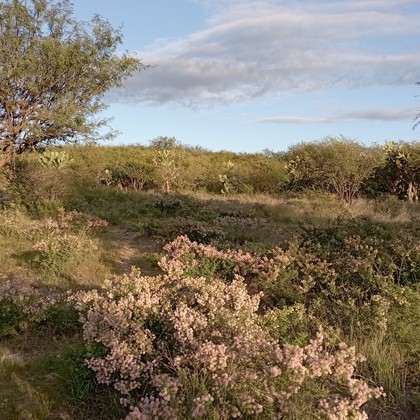
Flat to gently rolling desert grassland with scattered mesquite, acacia and other thorny shrubs, open thornscrub and grassy edges of dry washes, mostly below 1200 m. It forages on the ground for seeds and insects. It begins breeding only once the summer rains have fallen.
Where the bird is most at home, classified by the vegetation units of Mexico and Central America.



Range and movements
In the guide area in northern and central Sonora and south into Sinaloa. Elsewhere in southern Arizona.
- Resident
- dark = core range, pale = thinly spread
How and when to look
Best found in July and August, when males sing from a bush or mesquite after the first summer rains; at other times quiet and inconspicuous.
Conservation status
Not threatened (LC). Locally common, but dependent on desert grassland that is being lost to overgrazing, shrub encroachment and urban development.
Scientific name
Peucaea carpalis | Coues, 1873
Coues described the species in 1873 and placed it straight away in the genus where it still stands. The genus Peucaea was introduced in 1839 by Audubon. Peucaea is Greek, from peukē 'pine tree'; Audubon called the type species the 'Pinewood-Finch', after the pine woods it inhabits. carpalis is Modern Latin for 'of the wrist', from carpus 'wrist', after the rufous patch at the bend of the wing. The specimen the first description was based on came from Tucson, Arizona, USA.