All species › Jacamars and puffbirds › Puffbirds › Russet-throated Puffbird
Position in the tree Birds Aves › Birds with a flexible palate Neognathae › All other modern birds Neoaves › Landbirds Telluraves › Raptors, owls, kingfishers and woodpeckers Afroaves › Mousebirds, rollers and woodpeckers Coraciimorphae › Trogons and cavity nesters Cavitaves › Hornbills, kingfishers and woodpeckers Picocoraciae › Kingfishers, bee-eaters and woodpeckers Picodynastornithes
Russet-throated Puffbird | Hypnelus ruficollis
Roestkeelbaardkoekoek | Buco bobito
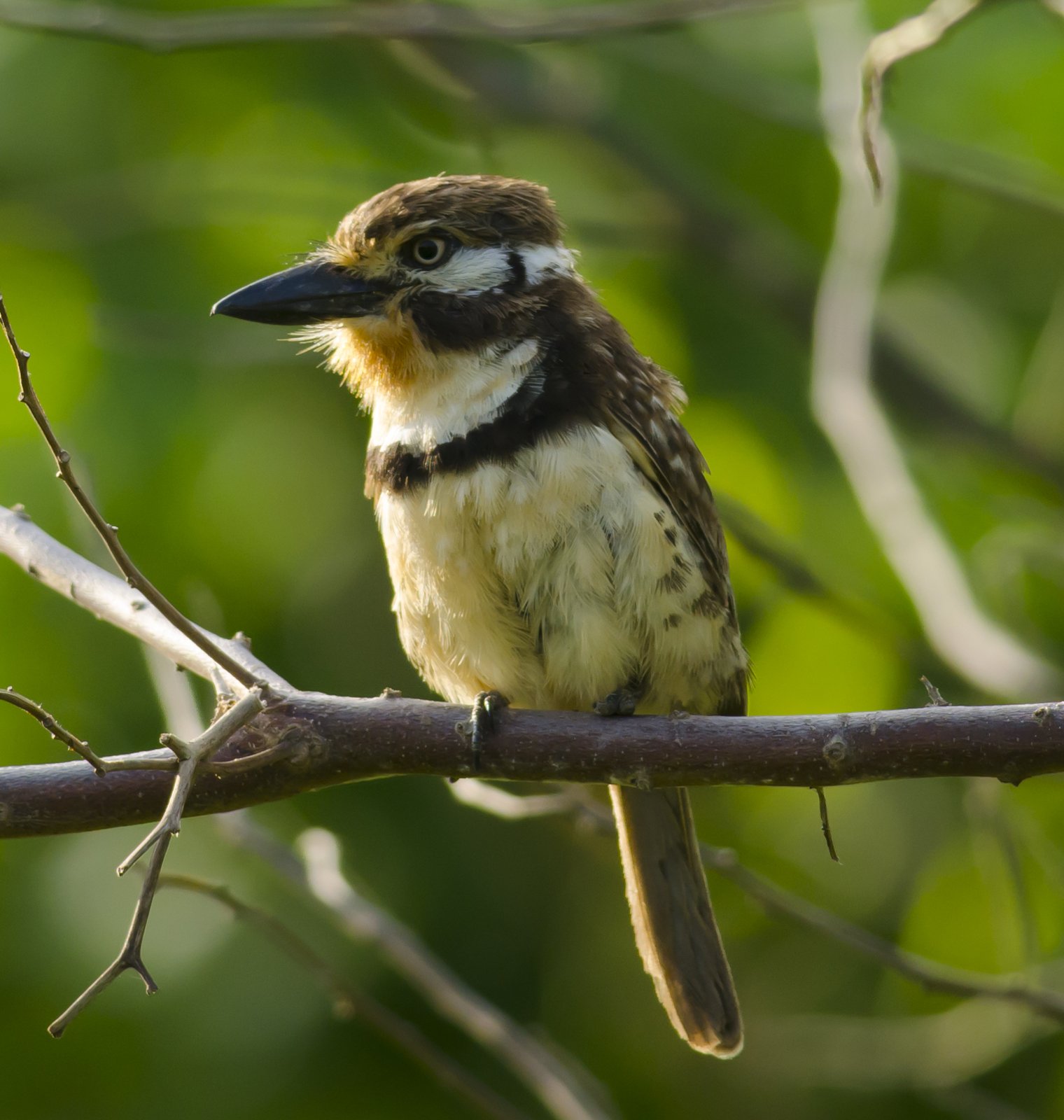
The Russet-throated Puffbird is a brown puffbird with a rufous throat and a single black breast band, a bird of dry, semi-open country in northern South America. In Panama it has been recorded only since 2017, at a few sites in the east of the country. It is probably spreading from Colombia into deforested land.
Voice
A loud, rhythmic, much-repeated wok-wok-wok-wok, often as a duet or by a small group together, which can go on for a long time.
Recording: Nick Komar — CC BY-NC-SA 4.0 · converted to mono · xeno-canto
Identification
20–22 cm. Crown and upperparts brown with small pale buff spots and fringes. Forehead, lores and cheeks white to pale buff. Throat and underparts rufous to buff, with a single broad black band across the breast. The eye is pale yellow. The bill is heavy, black and hooked at the tip. Sexes alike.
Confusion species
Barred Puffbird Nystalus radiatus is finely barred black all over and lacks a black breast band. White-whiskered Puffbird Malacoptila panamensis is smaller and streaked, with a red eye and white whiskers, and lives in the understorey of closed forest.
Habitat
Dry and semi-open country with shrubs and scattered trees, pasture with trees, riverside scrub, gallery forest and forest edges in the lowlands. It sits still for long periods on a low branch and drops onto large insects and small lizards on the ground or in foliage. It nests in a cavity in an arboreal termite nest.
Where the bird is most at home, classified by the vegetation units of Mexico and Central America.




Range and movements
In the guide area only a few records in eastern Panama: in 2017 near Tortí in eastern Panamá province, and later in Darién (along the Río Tuquesa) and in the far east of Guna Yala. Outside the guide area in northern Colombia and Venezuela.
How and when to look
The best chance is in open, deforested country with shrubs and trees in eastern Panamá province and in Darién. The loud, rhythmic call is noticed sooner than the quietly perched bird.
Conservation status
Globally not threatened. Rare in Panama; whether a permanent population exists is still unclear.
Scientific name
Hypnelus ruficollis | (Wagler, 1829)
Wagler described the species in 1829 as Capito ruficollis; because it was later moved to another genus, the author and year stand in brackets. The genus Hypnelus was introduced in 1863 by Cabanis & Heine. Hypnelus comes from Greek hupnēlos 'drowsy, indolent', from hupnos 'sleep', after the stolid behaviour of puffbirds. ruficollis is Latin, from rufus 'red, rufous' and collum 'neck', after the rufous throat. The specimen the first description was based on came from Cartagena, Colombia (originally given in error as 'Mexico').