All species › Passerines › New World sparrows › Rusty-crowned Ground Sparrow
Position in the tree Birds Aves › Birds with a flexible palate Neognathae › All other modern birds Neoaves › Landbirds Telluraves › Falcons, parrots and passerines Australaves › Falcons and passerines Eufalconimorphae › Parrots and passerines Psittacopasserae
Rusty-crowned Ground Sparrow | Melozone kieneri
Roestnekgors | Toquí nuquirrufo
The Rusty-crowned Ground Sparrow is a ground sparrow with a rufous crown and nape that lives almost entirely on the ground in dense scrub. It occurs only in Mexico, from southern Sonora along the Pacific slope and through the interior to Oaxaca and Puebla. Pairs usually keep hidden in the undergrowth.

Voice
The song is a short series of high, thin whistles and ticks, often ending in a quick little trill. The call is a high, thin tseep; pairs keep in contact with soft, squeaky notes.
Recording: Manuel Grosselet — CC BY-NC-SA 4.0 · shortened to the first 60 s, mono · xeno-canto
Identification
16–18 cm. Crown and nape rufous, lores and narrow eye-ring white, cheeks greyish. Throat white with a thin black malar stripe, and a small black spot in the centre of the breast. Rest of the underparts white with olive-brown flanks. Upperparts, wings and fairly long tail plain olive-brown. Bill dark, legs pale brown. The sexes are alike; juveniles are duller and finely streaked on the breast.
Confusion species
Rufous-crowned Sparrow Aimophila ruficeps is smaller and slimmer, with a streaked back, a grey supercilium and no breast spot, and lives on open, rocky slopes. Canyon Towhee Melozone fusca is larger and grey-brown, with a buff throat and cinnamon undertail coverts. White-throated Towhee Melozone albicollis (mainly Oaxaca) is larger, lacks the rufous crown and has a buff spot in front of the eye.
Habitat
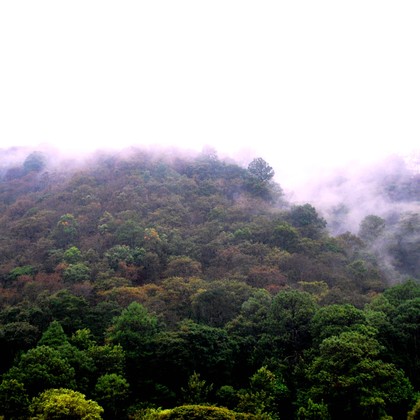
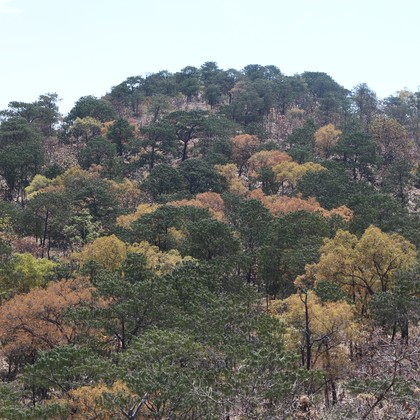
Dense undergrowth and edges of dry and semi-humid forest, thorn scrub, scrubby ravines and oak and pine-oak woodland, from the lowlands to about 2000 m; also overgrown field edges and old secondary growth. It forages on the ground, scratching among the leaf litter for insects and seeds. The cup-shaped nest is built low in a shrub.
Where the bird is most at home, classified by the vegetation units of Mexico and Central America.



Range and movements
Endemic to western and southern Mexico: from southern Sonora and south-western Chihuahua through Sinaloa, Nayarit, Jalisco, Colima and Michoacán to Guerrero, and in the interior in Morelos, the State of México, southern Mexico City, Puebla and Oaxaca.
- Resident
- dark = core range, pale = thinly spread
How and when to look
Best found by walking slowly along scrubby forest edges and dry ravines and listening for rustling in the leaf litter; the bird often appears briefly on a trail or in a clearing.
Conservation status
Not threatened (LC). Fairly common in suitable scrub; locally declining where dry forest is cleared.
Scientific name
Melozone kieneri | (Bonaparte, 1850)
Bonaparte described the species in 1850 as Pyrgisoma kieneri; because it was later moved to another genus, the author and year stand in brackets. The genus Melozone was introduced in 1850 by Reichenbach. Melozone is Greek, from mēlon 'cheek' and zōnē 'girdle, band', after the patterned cheeks of the type species. kieneri probably honours the French malacologist Louis Charles Kiener (1799–1881), a curator in Paris. The specimen the first description was based on came from San Blas, Nayarit, Mexico.