All species › Passerines › New World sparrows › Canyon Towhee
Position in the tree Birds Aves › Birds with a flexible palate Neognathae › All other modern birds Neoaves › Landbirds Telluraves › Falcons, parrots and passerines Australaves › Falcons and passerines Eufalconimorphae › Parrots and passerines Psittacopasserae
Canyon Towhee | Melozone fusca
Bruine towie | Toquí pardo
The Canyon Towhee is a large, grey-brown sparrow with a rufous crown that spends much time on the ground in dry, rocky terrain. It lives in the south-western United States and over much of the Mexican highlands. Around villages and in parks it often becomes tame.

Voice
The song is a series of clear, rapid chips and whistles, like chili-chili-chili. The call is a sharp chek or chip; pairs greet each other with an excited, squealing duet.
Recording: Pat Goltz — CC BY-NC-SA 4.0 · converted to mono · xeno-canto
Identification
20–23 cm. Body grey-brown with a warm rufous crown that is sometimes raised into a short crest. Throat pale buff, bordered by a necklace of fine dark streaks. A dark spot in the centre of the breast, belly paler greyish-buff. Undertail coverts cinnamon. Tail fairly long and dark brown. Bill conical and grey. The sexes are alike; juveniles are faintly streaked.
Confusion species
California Towhee Melozone crissalis (Baja California only) is more uniformly brown and lacks the rufous crown and the breast spot. Abert's Towhee Melozone aberti (Colorado delta and north-western Sonora) is cinnamon-brown with a black face around the base of the bill. White-throated Towhee Melozone albicollis (mainly Oaxaca) has a whiter throat, a buff spot in front of the eye and a brown crown.
Habitat
Dry, rocky terrain with scattered shrubs: slopes and canyons, desert grassland with shrubs, edges of oak and juniper woodland and thorn scrub, to well over 2500 m. Also in villages, gardens, parks and around farms. It searches the ground for seeds and insects, often by scratching backwards with both feet at once.
Where the bird is most at home, classified by the vegetation units of Mexico and Central America.

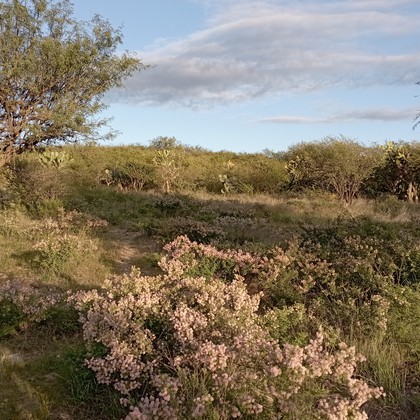

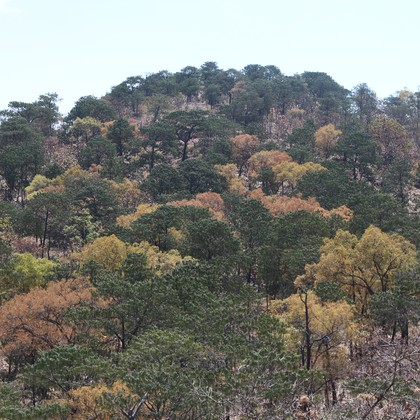
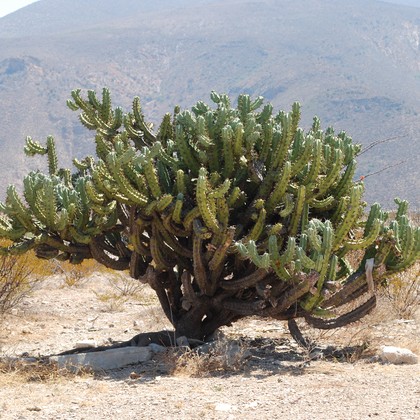

Range and movements
South-western United States. In the guide area over the Mexican highlands and adjacent slopes, from Sonora, Chihuahua, Coahuila and Nuevo León south through Durango, Zacatecas, San Luis Potosí, Jalisco, Guanajuato and Querétaro to Mexico City, Hidalgo, Morelos, Puebla, western Veracruz and extreme northern Oaxaca.
- Resident
- dark = core range, pale = thinly spread
How and when to look
In and around Mexico City common in parks and on rocky ground with shrubs, such as the lava fields of the Pedregal. It often perches on a wall or boulder and then drops to the ground.
Conservation status
Not threatened (LC). Common and widespread; adapts well to villages and gardens.
Scientific name
Melozone fusca | (Swainson, 1827)
Swainson described the species in 1827 as Pipilo fusca; because it was later moved to another genus, the author and year stand in brackets. The genus Melozone was introduced in 1850 by Reichenbach. Melozone is Greek, from mēlon 'cheek' and zōnē 'girdle, band', after the patterned cheeks of the type species. fusca is Latin for 'dusky, brownish', after the plain grey-brown plumage. The specimen the first description was based on came from Temascaltepec, State of Mexico, Mexico.