All species › Passerines › New World sparrows › White-throated Towhee
Position in the tree Birds Aves › Birds with a flexible palate Neognathae › All other modern birds Neoaves › Landbirds Telluraves › Falcons, parrots and passerines Australaves › Falcons and passerines Eufalconimorphae › Parrots and passerines Psittacopasserae
White-throated Towhee | Melozone albicollis
Witkeeltowie | Toquí oaxaqueño
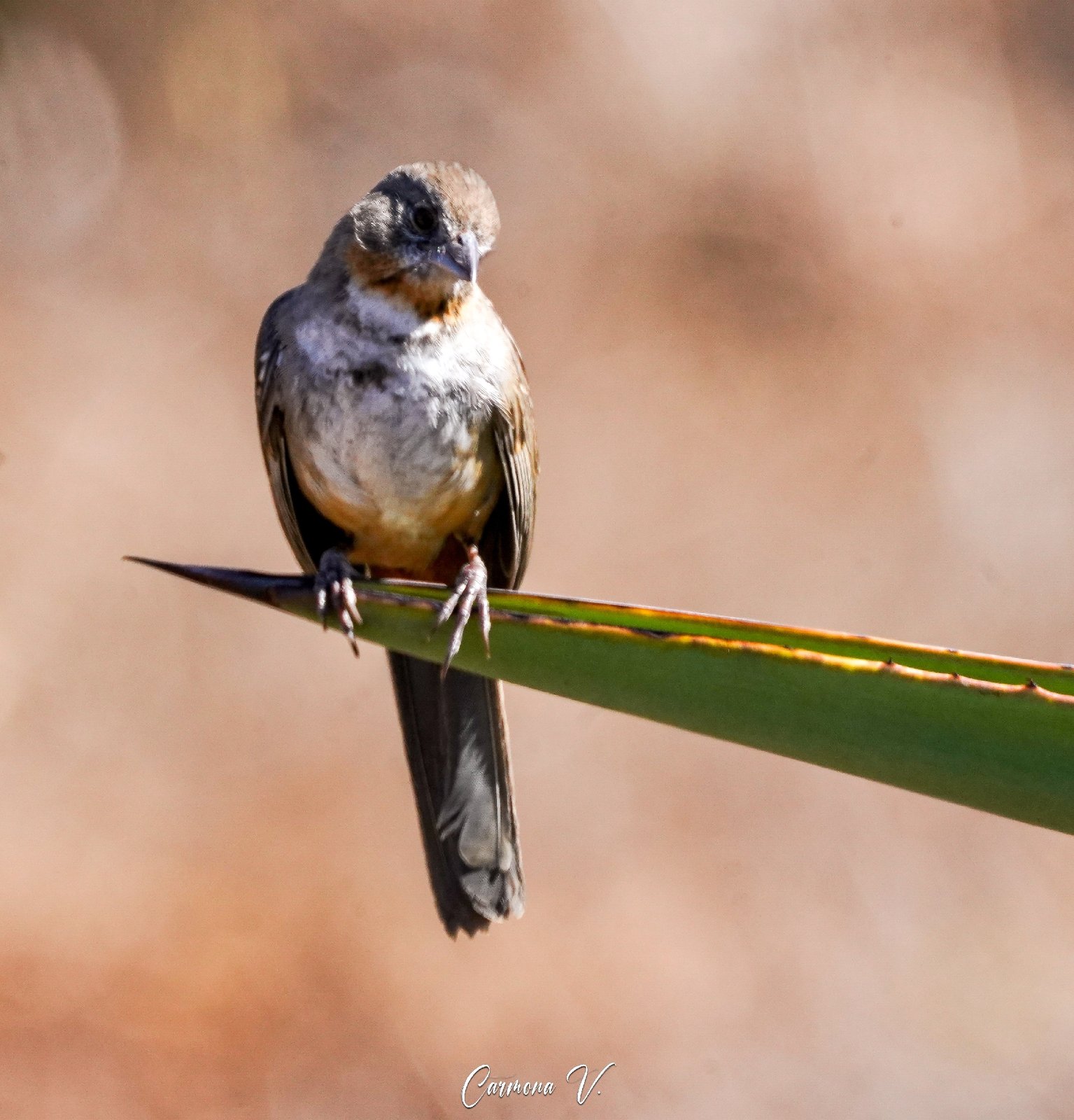
The White-throated Towhee is a large, brownish-grey sparrow with a whitish throat that occurs almost only in Oaxaca. It lives on the ground and in low shrubs in dry interior terrain and in the central valleys of Oaxaca is a common bird of yards, gardens and archaeological sites.
Voice
The song is a series of high, clear chips accelerating into a trill. The call is a metallic chink; pairs give a squealing duet when they meet.
Recording: Manuel Grosselet — CC BY-NC-SA 4.0 · shortened to the first 60 s, mono · xeno-canto
Identification
19–21 cm. Upperparts, crown and tail plain grey-brown. A buff spot in front of the eye, sometimes also a narrow pale eye-ring. Throat white to buffy white, bordered below by a faint band of dark spots across the upper breast. Breast and flanks grey-brown, centre of belly white. Undertail coverts cinnamon. Bill conical and grey. The sexes are alike.
Confusion species
Canyon Towhee Melozone fusca, which may occur in the same area in northern Oaxaca and Puebla, has a rufous crown, a buff throat with fine streaks and a dark spot in the centre of the breast. Rusty-crowned Ground Sparrow Melozone kieneri is smaller, with a rufous crown and nape and clean white underparts.
Habitat
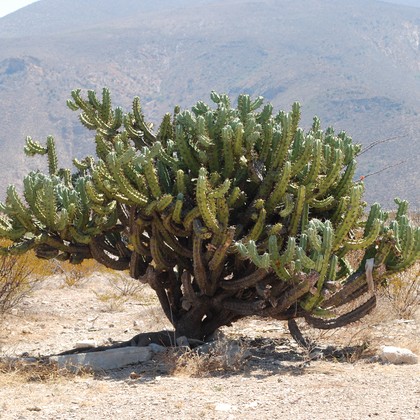
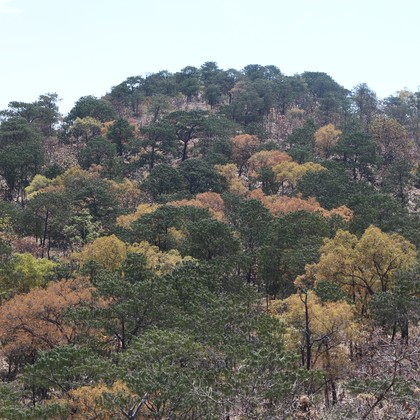
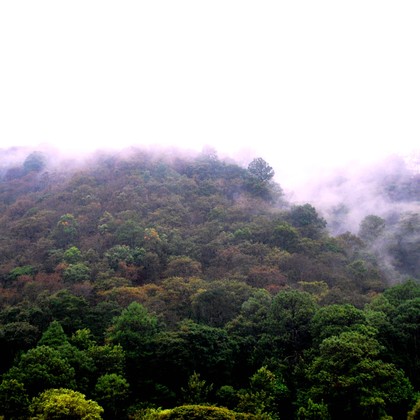
Dry scrub, thorn scrub and cactus vegetation in interior valleys and on the slopes above them, edges of dry oak and pine-oak woodland, rocky slopes, hedgerows, yards, gardens and archaeological sites, mainly between about 1000 and 2500 m. It searches the ground for seeds and insects.
Where the bird is most at home, classified by the vegetation units of Mexico and Central America.


Range and movements
Endemic to southern Mexico. Mainly in the interior of Oaxaca; also in southern Puebla and locally in Guerrero.
- Resident
- dark = core range, pale = thinly spread
How and when to look
Common in the central valleys of Oaxaca, for example around Monte Albán, Mitla and Yagul and in gardens in Oaxaca City. It often walks along paths and low walls.
Conservation status
Not threatened (LC). Common within its limited range and tolerant of human presence.
Scientific name
Melozone albicollis | (Sclater, 1858)
Sclater described the species in 1858 as Pipilo albicollis; because it was later moved to another genus, the author and year stand in brackets. The genus Melozone was introduced in 1850 by Reichenbach. Melozone is Greek, from mēlon 'cheek' and zōnē 'girdle, band', after the patterned cheeks of the type species. albicollis is Latin, from albus 'white' and collum 'neck', after the white throat. The specimen the first description was based on came from San Miguel de las Peras, Oaxaca, Mexico.