All species › Passerines › New World sparrows › Sagebrush Sparrow
Position in the tree Birds Aves › Birds with a flexible palate Neognathae › All other modern birds Neoaves › Landbirds Telluraves › Falcons, parrots and passerines Australaves › Falcons and passerines Eufalconimorphae › Parrots and passerines Psittacopasserae
Sagebrush Sparrow | Artemisiospiza nevadensis
Nevadagors | Zacatonero de Nevada
The Sagebrush Sparrow is a pale, grey-brown sparrow of dry scrubland, with a dark breast spot and a tail that is often flicked up and down. It breeds in the sagebrush steppes of the Great Basin in the western United States and winters in the deserts of the south-western United States and northern Mexico. Until 2013 it was treated together with Bell's Sparrow as a single species.

Voice
The song is a short, rhythmic series of high, chirping and buzzy notes; little heard in the guide area. The call is a thin, high tseet or a soft ticking sound, often in small groups.
Recording: Richard E. Webster — CC BY-NC-SA 4.0 · shortened to the first 60 s, mono · xeno-canto
Identification
13–16 cm. Medium-sized and slender, with a fairly long, dark tail and a small, pointed bill. Head grey with a white spot in front of the eye, a narrow white eye-ring, a white moustachial stripe and a thin dark malar stripe. Back pale grey-brown with distinct fine dark streaks. Underparts white, with a small dark spot in the centre of the breast and fine streaks on the flanks. Tail blackish with narrow white edges. The sexes are alike; young birds are streaked on the breast and head.
Confusion species
Bell's Sparrow Artemisiospiza belli closely resembles Sagebrush Sparrow. The form resident in north-western Baja California is darker, has an unstreaked back and a heavier black malar stripe; the pale interior form of Bell's Sparrow is barely separable from Sagebrush Sparrow in the field, but has a browner, less streaked back and a slightly shorter tail. Black-throated Sparrow Amphispiza bilineata has a black throat and a conspicuous white supercilium. Brewer's Sparrow Spizella breweri is smaller, browner and more finely streaked, without a breast spot.
Habitat
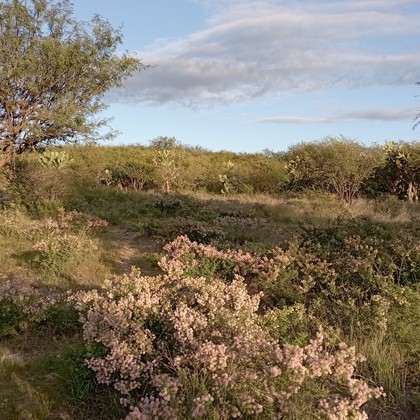
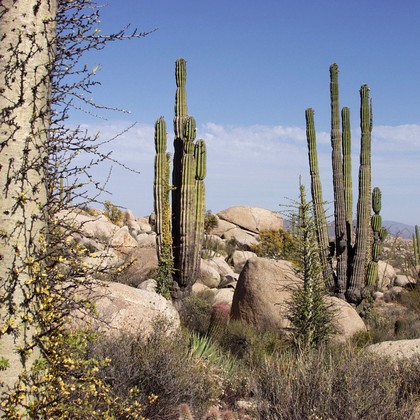
In winter open desert scrub with scattered shrubs such as creosote bush and saltbush, high-plateau scrub and dry semi-desert grassland. It runs quickly over the bare ground between shrubs with the tail raised and takes seeds and small insects. In winter it lives in loose small groups, sometimes with other sparrows.
Where the bird is most at home, classified by the vegetation units of Mexico and Central America.


Range and movements
Breeds in the Great Basin and adjacent areas of the western United States. Winters in the south-western United States and northern Mexico. In the guide area in north-eastern Baja California, Sonora, Chihuahua and Coahuila, and further south on the plateau into Durango and Zacatecas, scarce and local.
- Winter visitor (c. Oct–Mar)
- dark = core range, pale = thinly spread
How and when to look
In winter best found by watching flat desert scrub for small, pale sparrows running over the ground between shrubs and flicking the tail when they stop.
Conservation status
Least Concern (LC). Dependent on extensive sagebrush steppe, which is declining on the breeding grounds through fires, invasive grasses and land clearance; in the guide area a fairly scarce winter visitor.
Scientific name
Artemisiospiza nevadensis | (Ridgway, 1874)
Ridgway described the species in 1874 as Poospiza belli nevadensis; because it was later moved to another genus, the author and year stand in brackets. The genus Artemisiospiza was introduced in 2011 by Klicka & Banks. Artemisiospiza combines Artemisia, the sagebrush genus, with Greek spiza 'finch', after the sagebrush steppes these sparrows inhabit. nevadensis refers to Nevada (USA), where the type was collected. The specimen the first description was based on came from West Humboldt Mountains, Nevada.