All species › Passerines › Tyrant flycatchers and allies › Scale-crested Pygmy Tyrant
Position in the tree Birds Aves › Birds with a flexible palate Neognathae › All other modern birds Neoaves › Landbirds Telluraves › Falcons, parrots and passerines Australaves › Falcons and passerines Eufalconimorphae › Parrots and passerines Psittacopasserae
Scale-crested Pygmy Tyrant | Lophotriccus pileatus
Schubkuifdwergtiran | Cimerillo crestiescamado
The Scale-crested Pygmy Tyrant is a small tyrant flycatcher of humid foothill and montane forest, with a crest of black feathers tipped rufous that gives a scaly look. Its dry, surprisingly loud calls are heard far more often than the bird itself is seen. In the guide area it lives in Costa Rica and Panama.

Voice
Surprisingly loud, dry, rattling trills and sharp preet notes, often in series that rise in pitch.
Recording: Alain Verneau — CC BY-NC-SA 4.0 · converted to mono · xeno-canto
Identification
10 cm. Crown feathers long, black with broad rufous tips; the crest usually lies flat and is raised when excited. Forehead tinged rufous. Upperparts olive-green. Wings dark with two faint yellowish wing-bars and yellow edges to the tertials. Iris pale. Throat and breast whitish with fine dark streaks, belly yellowish. Bill fairly long and flat. Sexes alike.
Confusion species
Black-capped Pygmy Tyrant Myiornis atricapillus is smaller, with a black cap without a crest, white spectacles, almost no tail and an unstreaked breast, and lives mainly in the lowlands. Pale-eyed Pygmy Tyrant Atalotriccus pilaris also has a pale iris but lacks the crest and lives in dry scrub. Tyrannulets (Zimmerius, Ornithion) have a short bill and no scaly crest.
Habitat
Understorey and middle levels of humid foothill forest and lower montane forest, also forest edges and mature secondary forest; mainly in the foothills and the lower montane zone, locally lower. It takes insects with short sallies to leaves.
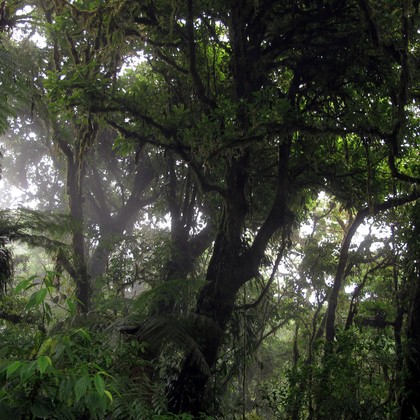
Where the bird is most at home, classified by the vegetation units of Mexico and Central America.



Range and movements
Costa Rica and Panama, mainly in the foothills and lower montane zone; in Panama also in the mountains of Darién. Outside the guide area in the Andes and adjacent ranges from Colombia and Venezuela to Peru.
- Resident
- dark = core range, pale = thinly spread
How and when to look
Found by sound in foothill forest in Costa Rica and Panama. The raising of the scaly crest can only be seen at close range; the loud call usually gives the bird away first.
Conservation status
Not threatened. Fairly common in suitable forest but inconspicuous; dependent on foothill and montane forest.
Scientific name
Lophotriccus pileatus | (Tschudi, 1844)
Tschudi described the species in 1844 as E[uscarthmus] pileatus; because it was later moved to another genus, the author and year stand in brackets. The genus Lophotriccus was introduced in 1884 by Berlepsch. Lophotriccus is Greek, from lophos 'crest' and trikkos 'small bird': 'crested tyrannulet', after the erectile crown feathers. pileatus is Latin for 'capped' (from pileus 'felt cap'), after the scaly, erectile crest. The specimen the first description was based on came from Vitoc valley, Junín, Peru.