All species › Swifts › Hummingbirds › Scaly-breasted Hummingbird
Position in the tree Birds Aves › Birds with a flexible palate Neognathae › All other modern birds Neoaves › Birds of the elements Elementaves › Nightjars and swifts Strisores
Scaly-breasted Hummingbird | Phaeochroa cuvierii
Schubborstkolibrie | Fandanguero pecho escamoso
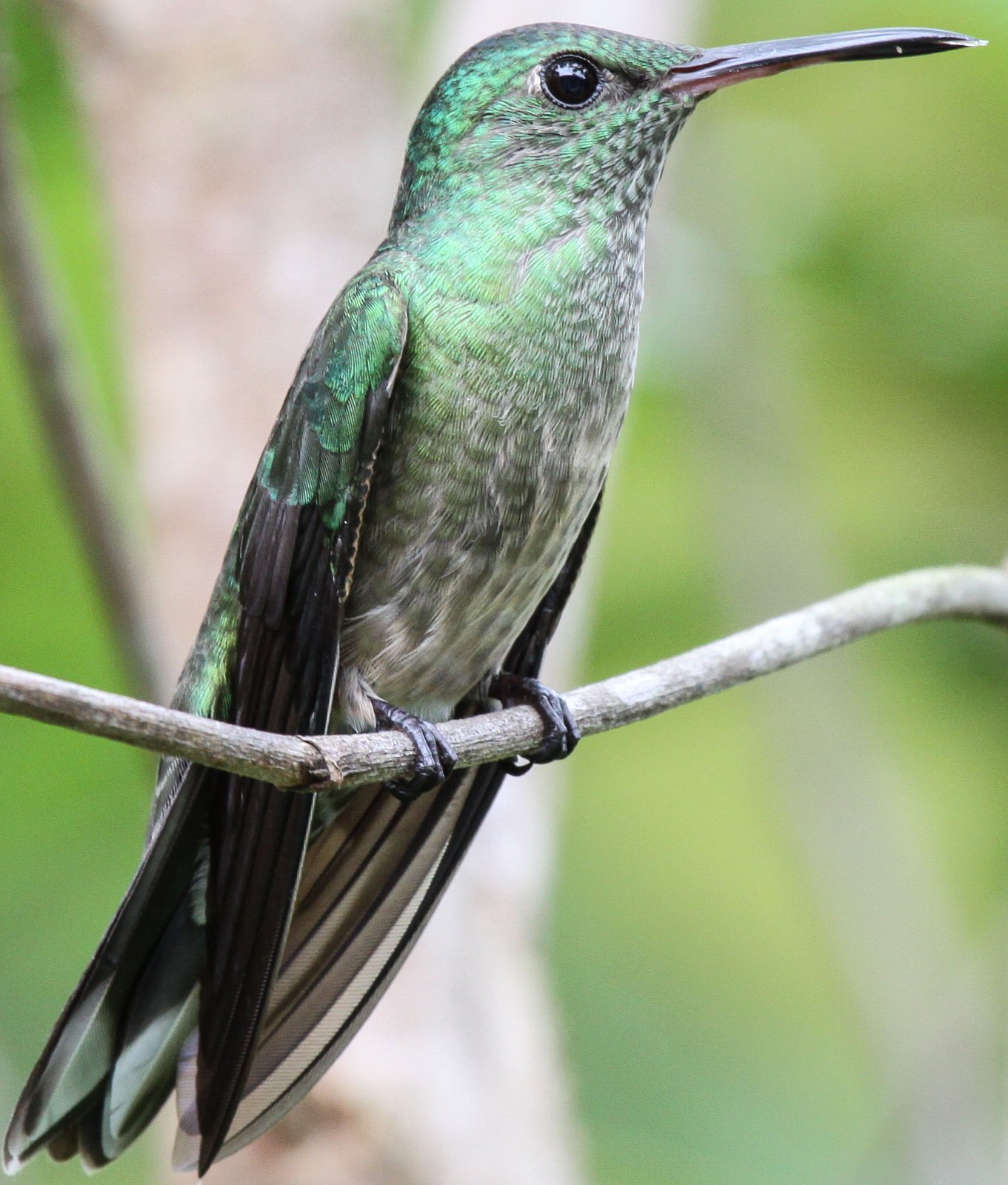
The Scaly-breasted Hummingbird is a large, plain-coloured hummingbird of forest edges and semi-open country in the lowlands from southern Mexico to Panama. It is named after the green scaling on the throat and breast. Males sing for long periods from a fixed perch, often fairly high in a tree. The northern population, from Belize to Nicaragua, is sometimes treated as a separate species.
Voice
A sharp, dry chip. The male's song is a long, repeated series of sharp, squeaky and chipping notes, delivered from a fixed perch.
Recording: ALAN MONROY OJEDA — CC BY-NC-SA 4.0 · converted to mono · xeno-canto
Identification
12–13 cm, with a fairly long, straight to slightly curved black bill with a pale base to the lower mandible. The upperparts are dull bronze-green. The throat and breast are greyish with green, scale-like spots, the belly pale greyish-buff. The tail is bronze-green with a dark band and broad white tips to the outer feathers. The sexes are alike; the male has thickened shafts to the outer primaries.
Confusion species
Wedge-tailed Sabrewing Pampa curvipennis has a glittering blue crown, plain pale grey underparts without scaling and a long, wedge-shaped tail. Violet Sabrewing Campylopterus hemileucurus is larger, the male is dark violet and both sexes have entirely white outer tail feathers. Rufous-tailed Hummingbird Amazilia tzacatl is smaller and has a red bill with a black tip, a green throat and a rufous tail. Female White-necked Jacobin Florisuga mellivora has a blue-green scaled throat, but a white belly and a straight, shorter bill.
Habitat
Forest edges, gallery forest, secondary forest, semi-open country with scattered trees, plantations and gardens, mainly in the lowlands, locally up to about 1200 m. It visits flowering trees and shrubs at various heights and defends flower-rich spots against other hummingbirds.
Where the bird is most at home, classified by the vegetation units of Mexico and Central America.





Range and movements
In south-eastern Mexico in eastern Chiapas; further in Belize, northern Guatemala, northern Honduras, Nicaragua, Costa Rica and Panama. In Costa Rica mainly on the Pacific side and in the north, in Panama on both sides of the country. Outside the guide area to northern Colombia.
- Resident
- dark = core range, pale = thinly spread
How and when to look
In Carara National Park and along the Tárcoles River in Costa Rica, in gardens and forest edges in the Cayo District of Belize and along forest edges in the Panama Canal area. Singing males are more often noticed for their voice than for their colour.
Conservation status
Not threatened. Fairly common in a large range. The species also uses forest edges, secondary forest and gardens and appears little affected by deforestation.
Scientific name
Phaeochroa cuvierii | (Delattre & Bourcier, 1846)
Delattre & Bourcier described the species in 1846 as Trochilus Cuvierii; because it was later moved to another genus, the author and year stand in brackets. The genus Phaeochroa was introduced in 1861 by Gould. Phaeochroa is Greek, from phaios 'dusky' and khroa 'complexion, colour', after the dull, rather unglittering plumage. cuvierii honours the French zoologist and palaeontologist Georges Cuvier (1769–1832), founder of comparative anatomy. The specimen the first description was based on came from Isthmus of Panama and Telemán (Guatemala).