All species › Swifts › Hummingbirds › Violet-crowned Hummingbird
Position in the tree Birds Aves › Birds with a flexible palate Neognathae › All other modern birds Neoaves › Birds of the elements Elementaves › Nightjars and swifts Strisores
Violet-crowned Hummingbird | Ramosomyia violiceps
Violetkapamazilia | Amazilia coronivioleta
The Violet-crowned Hummingbird is a medium-sized hummingbird of arid and semi-arid regions in western and interior Mexico. It stands out for its red bill and entirely white underparts. The species extends into the south-western United States, where it breeds mainly along sycamore-lined canyons.

Voice
A dry, hard chak or tsik, often repeated. The song is a soft, repeated series of high, squeaky notes, mainly early in the morning.
Recording: Manuel Grosselet — CC BY-NC-SA 4.0 · converted to mono · xeno-canto
Identification
10–11 cm, with a straight red bill with a dark tip. The crown is violet-blue in northern birds and greener blue to turquoise in southern birds. The upperparts are dull bronze-green, the underparts entirely white, without green on the flanks. The tail is greyish-green to olive-bronze. The female has a duller crown; young birds have a brownish crown and pale fringes to the upperparts.
Confusion species
Green-fronted Hummingbird Ramosomyia viridifrons has a green crown, and in birds from Chiapas and Guatemala cinnamon flanks. Azure-crowned Hummingbird Saucerottia cyanocephala has a blackish bill with only a red base to the lower mandible and green flanks. White-bellied Emerald Chlorestes candida is smaller and has a green crown and green-spotted flanks. Female Broad-billed Hummingbird Cynanthus latirostris has grey underparts and a white stripe behind the eye.
Habitat
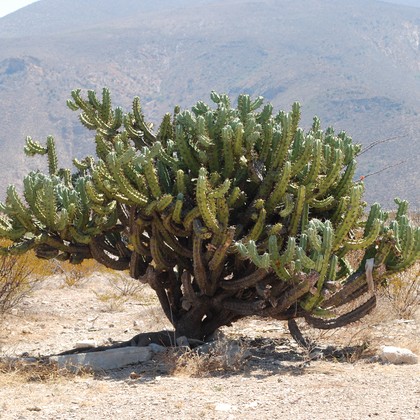
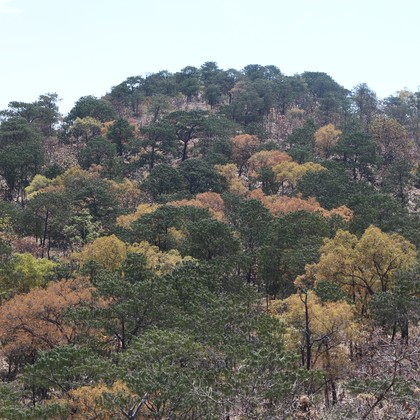
Dry and semi-deciduous forest, thorn scrub, riparian woodland along canyons, open oak woodland, ravines and gardens, from sea level to about 2200 m. It feeds at flowering trees, shrubs and agaves and catches small insects in flight.
Where the bird is most at home, classified by the vegetation units of Mexico and Central America.




Range and movements
In western and interior Mexico, from Sonora and south-western Chihuahua through Sinaloa, Durango, Nayarit, Jalisco, Colima and Michoacán to Guerrero and western Oaxaca; in the interior also in Aguascalientes, Guanajuato, Querétaro, Hidalgo, the State of Mexico, Morelos and Puebla. Outside the guide area in south-eastern Arizona and south-western New Mexico.
- Resident
- dark = core range, pale = thinly spread
How and when to look
Around Álamos in Sonora, in gardens and barrancas around Guadalajara in Jalisco and in gardens and parks in Cuernavaca in Morelos. Often at flowering trees and feeders.
Conservation status
Not threatened. Fairly common in a large range. The species also uses gardens and scrub and appears little sensitive to disturbance.
Scientific name
Ramosomyia violiceps | (Gould, 1859) (GBIF: Leucolia violiceps)
Gould described the species in 1859 as Cyanomyia violiceps; because it was later moved to another genus, the author and year stand in brackets. The genus Ramosomyia was introduced in 2021 by Stiles & Bruce. Ramosomyia (Bruce & Stiles, 2021) presumably honours the Mexican ornithologist Mario Alberto Ramos, with Greek muia 'fly', a common suffix in hummingbird names. violiceps is Latin, from viola 'violet' and -ceps '-crowned', after the violet-blue crown. The specimen the first description was based on came from Atlixco, Puebla, Mexico.