All species › Passerines › Wrens › Sedge Wren
Position in the tree Birds Aves › Birds with a flexible palate Neognathae › All other modern birds Neoaves › Landbirds Telluraves › Falcons, parrots and passerines Australaves › Falcons and passerines Eufalconimorphae › Parrots and passerines Psittacopasserae
Sedge Wren | Cistothorus stellaris
Zeggewinterkoning | Cucarachero culibarrado
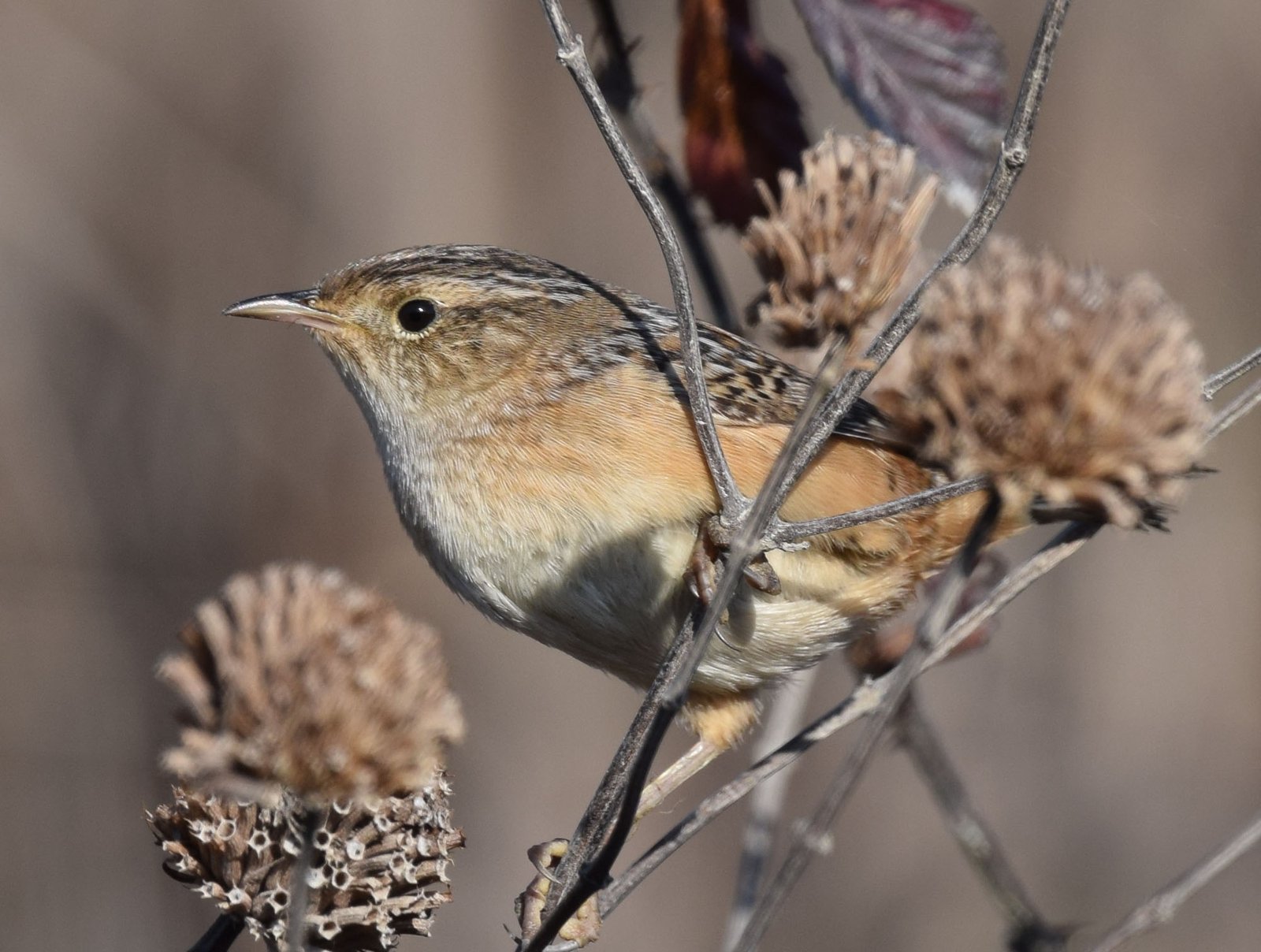
The Sedge Wren is a small, streaked wren of wet grassland and sedge meadows. It breeds in North America and reaches the guide area only as a scarce winter visitor to north-eastern Mexico. For a long time it was treated as part of Grass Wren; it is now regarded as a separate species.
Voice
The song begins with a few high, dry chip notes and ends in a dry, even rattle. In winter mainly the call: a dry, short chep, often repeated; towards the end of winter sometimes also song.
Recording: Bill Pyle — CC BY-NC-SA 4.0 · shortened to the first 60 s, mono · xeno-canto
Identification
10–12 cm. Small and compact, with a short, thin bill. Crown brown with fine black and pale streaks; back dark with distinct white streaks. Supercilium faint and pale buff, not crisp white. Throat and centre of belly white, breast and flanks warm buff. Wings, rump and short tail brown with dark bars; the tail is often cocked. The sexes are alike.
Confusion species
Grass Wren Cistothorus platensis closely resembles Sedge Wren in plumage; in the field they are separated mainly by range, season and song. In the guide area Grass Wren is a resident of scattered populations in central and southern Mexico and south to Panama, whereas Sedge Wren appears only in winter in north-eastern Mexico. The song of Sedge Wren consists of a few dry ticks followed by an even rattle; that of Grass Wren is more varied and differs greatly from region to region. Marsh Wren Cistothorus palustris, which winters in the same region, has a longer bill, an unstreaked dark crown, a crisp white supercilium and lives in reeds and cattails.
Habitat
In winter dense, damp grassland, sedge meadows, edges of freshwater marshes and the grassy margins of coastal marshes; also rank, overgrown fields. It stays low in the vegetation and flies up only briefly and low. It searches for small insects and spiders among the grasses.
Where the bird is most at home, classified by the vegetation units of Mexico and Central America.


Range and movements
Breeds in southern Canada and the northern and central United States. Winters in the south-eastern United States, from the Gulf Coast to Florida and the southern Atlantic coast, and in north-eastern Mexico. In the guide area mainly in Tamaulipas and Nuevo León, more scarcely in northern Veracruz and in Coahuila.
- Winter visitor (c. Oct–Mar)
- dark = core range, pale = thinly spread
How and when to look
In winter best found by walking slowly along the edge of wet, dense grassland and listening for the dry call; a flushed bird flies a short way, low, and then drops straight back into the grass.
Conservation status
Not threatened (LC). Widespread in North America; in the guide area a scarce winter visitor. The loss of wet grassland and sedge meadows through drainage and conversion to farmland is the main threat.
Scientific name
Cistothorus stellaris | (Naumann, 1823) (GBIF: Cistothorus platensis)
Naumann described the species in 1823 as Troglodytes stellaris; because it was later moved to another genus, the author and year stand in brackets. The genus Cistothorus was introduced in 1851 by Cabanis. Cistothorus is Greek, from kistos 'shrub, rock-rose' and thoos 'nimble, quick': 'nimble shrub-bird'. stellaris is Latin for 'starry', after the fine white spots on the back and crown. The specimen the first description was based on came from Carolina, United States.