All species › Passerines › Ovenbirds and woodcreepers › Sharp-tailed Streamcreeper
Position in the tree Birds Aves › Birds with a flexible palate Neognathae › All other modern birds Neoaves › Landbirds Telluraves › Falcons, parrots and passerines Australaves › Falcons and passerines Eufalconimorphae › Parrots and passerines Psittacopasserae
Sharp-tailed Streamcreeper | Lochmias nematura
Beekstekelstaart | Riachuelero
The Sharp-tailed Streamcreeper is a dark brown ovenbird that lives almost exclusively along forest streams, walking over rocks and banks. Characteristic are the white-spotted underparts, the thin, slightly decurved bill and the short black tail with spiny tips. In the guide area it occurs only in the mountains of eastern Panama.

Voice
The song is a long, dry, fast trill that first swells somewhat; also sharp calls.
Recording: Christiana Fattorelli — CC BY-NC-SA 4.0 · converted to mono · xeno-canto
Identification
14–15 cm; tail short, blackish, with bare, spiny feather shafts at the tip. Upperparts dark rufous-brown. Underparts dark brown, densely marked with white spots and drops. Narrow white supercilium, not equally distinct in all birds. Bill thin, fairly long and slightly decurved. Legs pink.
Confusion species
Buff-rumped Warbler Myiothlypis fulvicauda also lives along forest streams but has a pale buffy rump, unspotted underparts and constantly swings its tail. Other ovenbirds in the area are not so closely tied to water.
Habitat
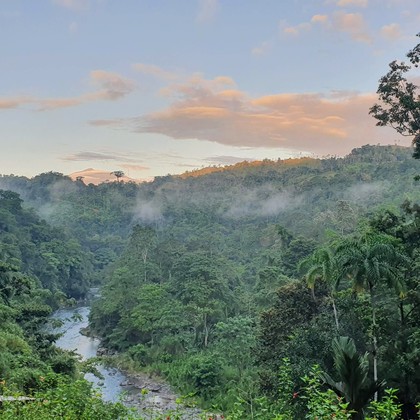
Fast-flowing streams with boulders and vegetated banks in humid foothill and montane forest. Forages by walking and hopping over rocks, roots and muddy banks for insects and other small invertebrates, often half hidden under overhanging plants. Nests in a burrow in a stream bank.
Where the bird is most at home, classified by the vegetation units of Mexico and Central America.


Range and movements
In the guide area only in the mountains of eastern Panama (Darién). Outside the guide area in the Andes from Colombia to Bolivia and Argentina, in the tepui mountains and in south-eastern Brazil.
- Resident
- dark = core range, pale = thinly spread
How and when to look
Along forest streams in the Darién mountains; usually found low down near the water, where it quickly disappears among rocks and roots.
Conservation status
Not threatened. Widespread in South America; in the guide area restricted to a small and remote area.
Scientific name
Lochmias nematura | (Lichtenstein, 1823)
Lichtenstein described the species in 1823 as Myiothera nematura; because it was later moved to another genus, the author and year stand in brackets. The genus Lochmias was introduced in 1827 by Swainson. Lochmias is Greek, from lokhmē 'thicket, coppice': 'thicket-dweller'. nematura is Greek, from nēma 'thread' and oura 'tail', after the tail feathers ending in bare, spiny shaft tips. The specimen the first description was based on came from São Paulo, Brazil.