All species › Passerines › Tyrant flycatchers and allies › Sooty-headed Tyrannulet
Position in the tree Birds Aves › Birds with a flexible palate Neognathae › All other modern birds Neoaves › Landbirds Telluraves › Falcons, parrots and passerines Australaves › Falcons and passerines Eufalconimorphae › Parrots and passerines Psittacopasserae
Sooty-headed Tyrannulet | Phyllomyias griseiceps
Dwergvliegenpikker | Mosquerito cabecigrís
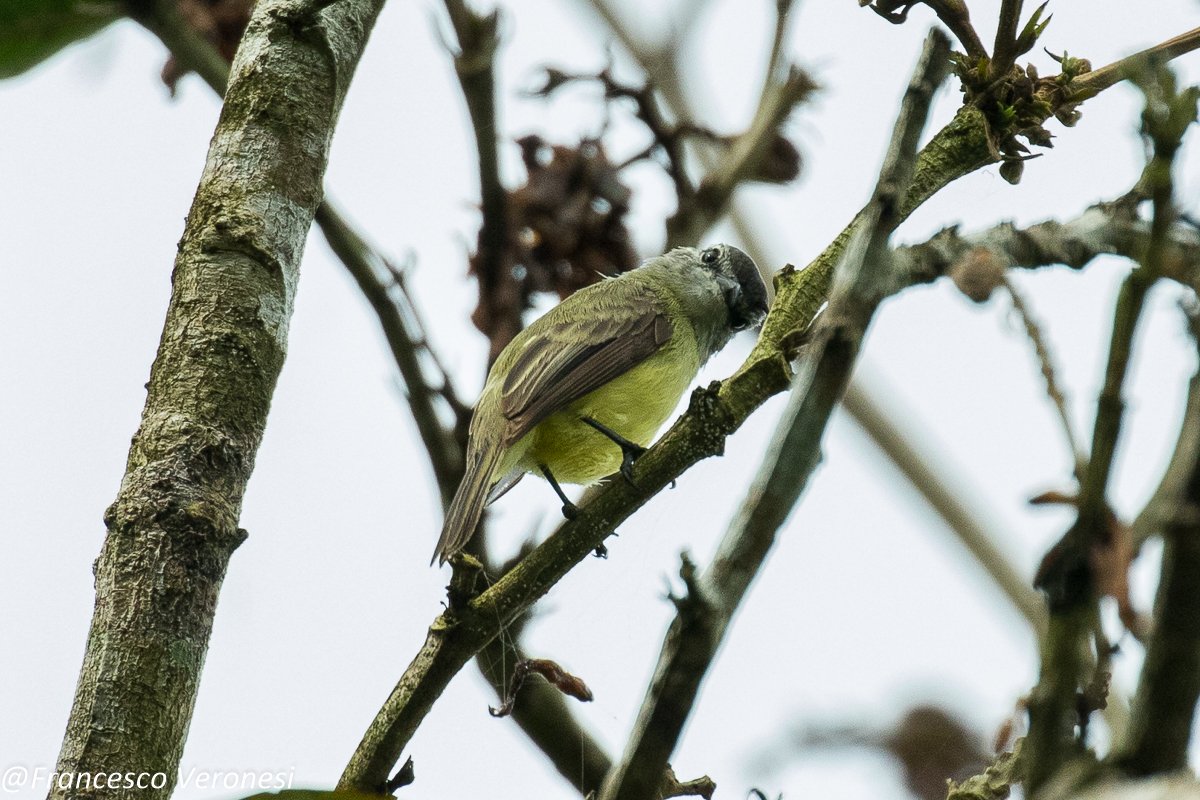
The Sooty-headed Tyrannulet is a tiny tyrant flycatcher with a grey head, a short bill and a yellow belly, living in the canopy of forest edges and open country with trees. It is hard to see but draws attention with its clear, frequently repeated song. In the guide area it occurs only in eastern Panama.
Voice
A clear, rhythmic series of a few short whistles followed by a lower, faster ending. The song is repeated throughout the day and is usually the first sign of the species.
Recording: Juan Freile — CC BY-NC-SA 4.0 · converted to mono · xeno-canto
Identification
10 cm, with a rounded head and a very short dark bill. Crown dark sooty grey, with a narrow whitish supercilium. Back olive-green. Wings dark without distinct wing-bars, with narrow yellow edges to the flight feathers. Throat whitish, breast greyish-olive, belly yellow. Male and female are alike.
Confusion species
Mistletoe Tyrannulet Zimmerius parvus has a pale iris, conspicuous yellow edges to the wing-coverts and a less dark crown. Yellow-crowned Tyrannulet Tyrannulus elatus has two distinct white wing-bars and a (usually concealed) yellow crown patch. Southern Beardless Tyrannulet Camptostoma obsoletum has a small crest, cinnamon or whitish wing-bars and a duller yellow belly.
Habitat
Canopy and edges of humid forest, secondary forest, gallery forest and open country with scattered tall trees, mostly in the lowlands. It forages high in the trees among the foliage for small insects and also eats small fruits.
Where the bird is most at home, classified by the vegetation units of Mexico and Central America.




Range and movements
In the guide area only in eastern Panama, mainly from the Canal area east to Darién. Outside the guide area over much of northern and western South America, from Colombia and Venezuela to Ecuador, Peru and Amazonian Brazil.
- Resident
- dark = core range, pale = thinly spread
How and when to look
Best located by its song, after which the canopy has to be searched patiently for a small, active bird with a dark head.
Conservation status
Not threatened. Widespread in South America; in Panama at the edge of its range and locally rather scarce.
Scientific name
Phyllomyias griseiceps | (Sclater & Salvin, 1871)
Sclater & Salvin described the species in 1871 as Tyranniscus griseiceps; because it was later moved to another genus, the author and year stand in brackets. The genus Phyllomyias was introduced in 1860 by Cabanis & Heine. Phyllomyias is Greek, from phullon 'leaf' and Modern Latin myias 'flycatcher': 'leaf-flycatcher', after its foraging among foliage. griseiceps is Modern Latin, from griseus 'grey' and -ceps '-headed', after the grey head. The specimen the first description was based on came from Babahoyo, Los Ríos, Ecuador.