All species › Cranes, rails and allies › Rails, gallinules and coots › Sora
Position in the tree Birds Aves › Birds with a flexible palate Neognathae › All other modern birds Neoaves › Birds of the elements Elementaves › Cranes and waders Gruimorphae
Sora | Porzana carolina
Soraral | Polluela sora
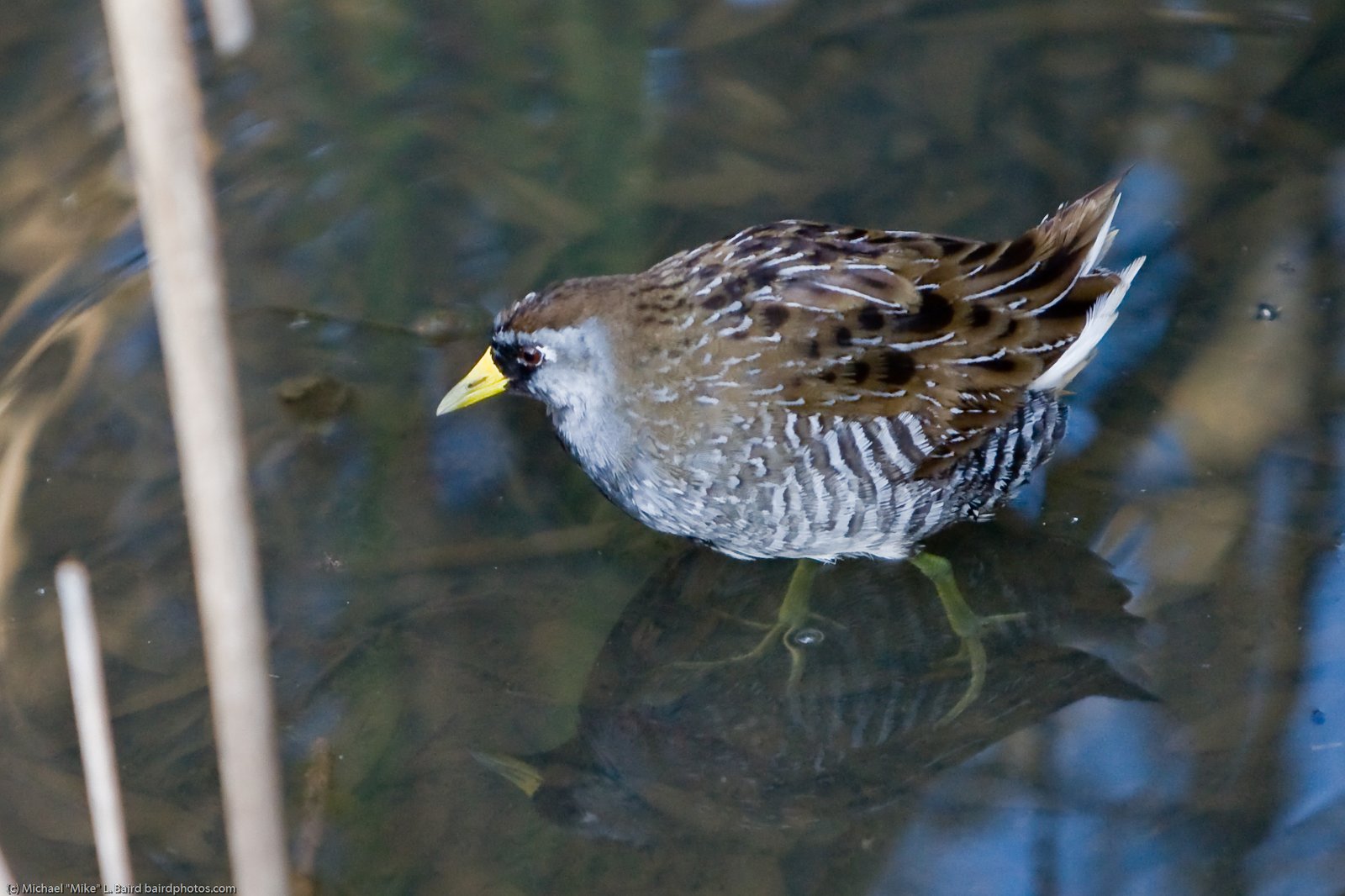
Sora is a small, plump rail with a short, thick yellow bill and a black face, the most numerous rail of North America. It breeds in the marshes of Canada and the United States and moves south in large numbers in winter. In the guide area it is a widespread winter visitor from Mexico to Panama, which also regularly shows itself at the open edge of a marsh.
Voice
A loud, descending whinnying series, ko-WEE-hee-hee-hee-hee-hee, that from a distance sounds like laughter; also a rising, whistled ker-WEE and a sharp keek in response to noise, such as a handclap or a splash. On the wintering grounds mainly the short calls.
Recording: Don Profota — CC BY-NC-SA 4.0 · converted to mono · xeno-canto
Identification
20–25 cm, with a short, conical yellow bill and a short, often cocked tail. Adults have a black face and a black throat patch, a grey cheek, neck and breast, and brown upperparts with black feather centres and fine white streaks. Flanks barred grey and white; the undertail is pale buff to white. The legs are greenish yellow. In winter the black on throat and face is reduced. Young birds in their first autumn lack the black face and are warm buff on the neck and breast, with a pale throat and a duller bill.
Confusion species
Virginia Rail Rallus limicola has a long, reddish bill and a rufous breast. Yellow-breasted Crake Laterallus flaviventer is much smaller, buff with a white supercilium and black-and-white barred flanks, and has a dark bill. Paint-billed Crake Mustelirallus erythrops is dark olive-brown and grey, with a yellow bill with a red base and red legs. Spotted Rail Pardirallus maculatus is larger, with a long greenish-yellow bill and densely white-spotted plumage.
Habitat
Freshwater marshes with cattail, bulrush and sedge, wet grassland, the vegetated edges of lakes, ponds and canals, rice fields and ditches; in winter also in brackish coastal marshes and mangrove edges. From the lowlands up to the plateau. Forages at the edge of vegetation and on open mud, mainly on seeds of marsh plants and also on insects, snails and other small invertebrates.
Where the bird is most at home, classified by the vegetation units of Mexico and Central America.



Range and movements
In winter widespread across almost all of Mexico, except the driest parts, and through Central America to Panama, more numerous in the north than in the south. Passage mainly in September and October and in March and April. In summer only a few records, mainly in northern Baja California, where it may breed locally. Outside the guide area breeding in Canada and the northern and western United States; also winters in the southern United States, the Caribbean and north-western South America.
- Winter visitor (c. Oct–Mar)
- dark = core range, pale = thinly spread
How and when to look
In winter in almost any marsh with cattail or bulrush, preferably in the early morning where dense vegetation meets open mud, as at Palo Verde in Costa Rica or in the marshes around Mexico City. A handclap or a sudden noise often prompts a sharp call that reveals a bird's presence.
Conservation status
Not threatened. The species is numerous but suffers in North America from the loss of marshes; on the wintering grounds the same applies to drainage and the loss of wet grassland.
Scientific name
Porzana carolina | (Linnaeus, 1758)
Linnaeus described the species in 1758 as Rallus carolinus; because it was later moved to another genus, the author and year stand in brackets. The genus Porzana was introduced in 1816 by Vieillot. Porzana is a Latinised Venetian folk name for the small crakes. carolina refers to Carolina in North America. The specimen the first description was based on came from Hudson Bay, Canada.