All species › Cranes, rails and allies › Rails, gallinules and coots › Virginia Rail
Position in the tree Birds Aves › Birds with a flexible palate Neognathae › All other modern birds Neoaves › Birds of the elements Elementaves › Cranes and waders Gruimorphae
Virginia Rail | Rallus limicola
Virginiaral | Rascón limícola
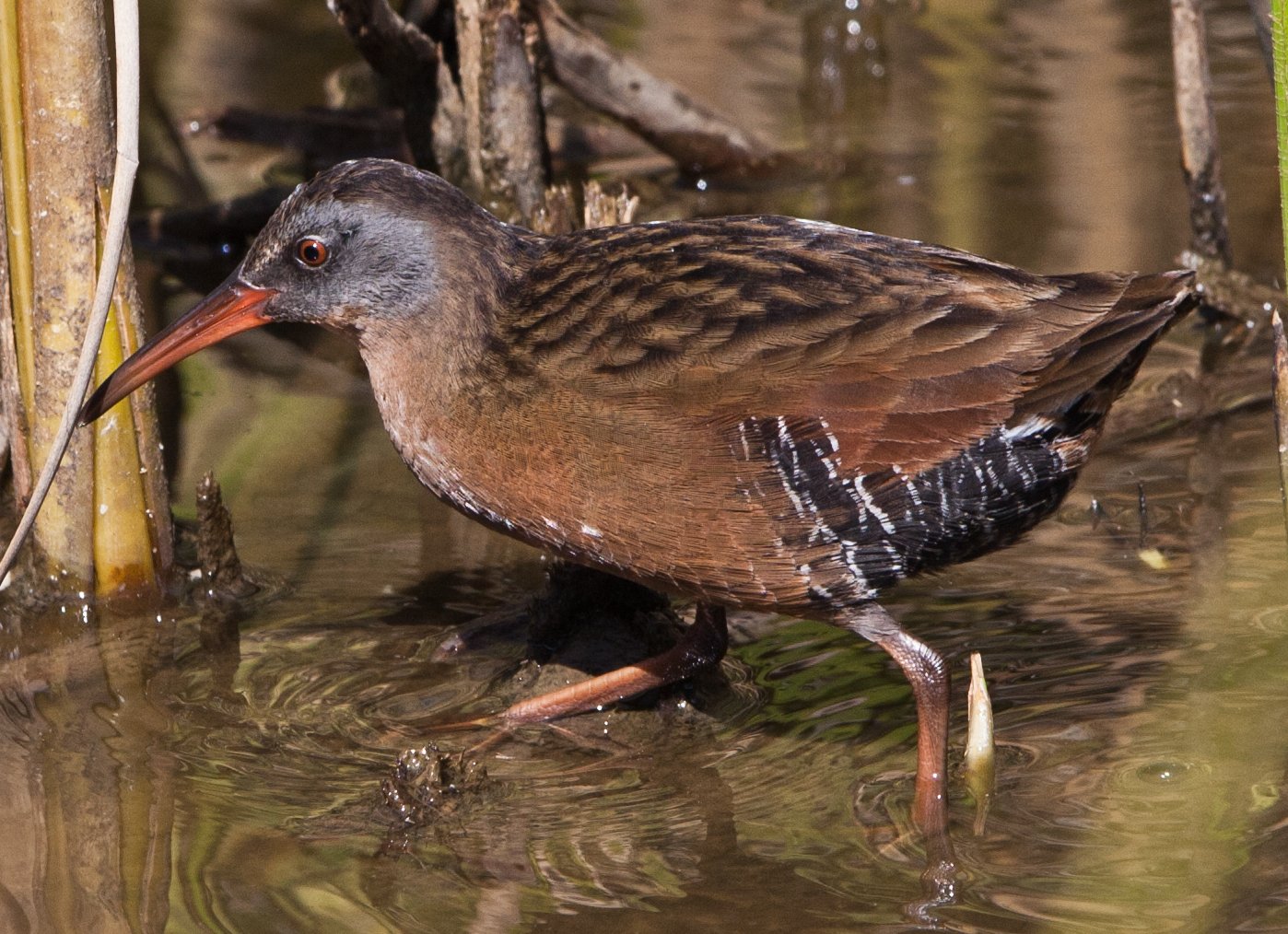
Virginia Rail is a small, rusty rail with grey cheeks and a long, slightly decurved reddish bill: in colour and pattern a King Rail in miniature. It lives hidden in reed and cattail marshes and is heard far more often than seen. In the guide area it breeds in north-western Mexico and in the marshes of the central plateau; in winter it is joined by birds from North America.
Voice
A repeated, metallic ticking kid-ik kid-ik kid-ik, mainly in the breeding season, and a series of grunting, descending notes, oink-oink-oink-oink, in rapid succession. Also short, sharp kik calls and soft muttering. Calls most at dusk and at night.
Recording: Richard E. Webster — CC BY-NC-SA 4.0 · shortened to the first 60 s, mono · xeno-canto
Identification
22–27 cm, with a long, slender, slightly decurved bill, reddish with a dark culmen. Crown and upperparts are brown with blackish feather centres; cheek and side of the head are clearly grey. Throat whitish. Neck, breast and wing coverts are warm rufous. Flanks and belly are black with narrow white bars; the undertail is partly white and black. The legs are reddish brown. The short tail is often flicked up while walking. Young birds are darker, with blackish mottling on the breast and flanks. Flies rarely and briefly, with dangling legs.
Confusion species
King Rail Rallus elegans and Aztec Rail Rallus tenuirostris have a similar colour pattern but are much larger, with brownish rather than grey cheeks and a less red bill. Aztec Rail lives in the same highland marshes as Virginia Rail. Sora Porzana carolina has a short, thick yellow bill, a black face and a grey breast. Black Rail Laterallus jamaicensis is much smaller and darker, with a short black bill and white spots on the back.
Habitat
Freshwater marshes with cattail, bulrush and reed, wet grassland and the vegetated edges of lakes, ponds and canals, on the plateau to above 2500 m. In winter also in brackish coastal marshes. Forages by walking through shallow water and wet mud in dense vegetation, on insects and their larvae, snails, worms, small crustaceans and some seeds. The nest is a cup of plant material in dense vegetation above the water, often with a canopy of bent-over stems.
Where the bird is most at home, classified by the vegetation units of Mexico and Central America.


Range and movements
In Mexico breeding in northern Baja California and Sonora, including the Colorado delta, and in the marshes of the central plateau, such as those of the upper Lerma in the State of México and of Xochimilco near Mexico City. In winter more widespread across northern and central Mexico and in the lowlands of the Gulf coast, south to Veracruz and Oaxaca; recorded year-round in the highlands of Chiapas. In Guatemala and further south only a few reports. Outside the guide area breeding in southern Canada and much of the United States.
- Resident
- Winter visitor (c. Oct–Mar)
- Passage (Mar–Apr, Oct–Nov)
- dark = core range, pale = thinly spread
How and when to look
In the marshes near Toluca and Lerma and at Xochimilco, in the early morning along edges of cattail and open water; also in the Ciénega de Santa Clara in the Colorado delta. The ticking and grunting calls give the birds away; with patience one sometimes steps briefly out of cover.
Conservation status
Not threatened, although the marshes of the Mexican plateau have shrunk greatly through drainage, urban growth and water extraction, confining the resident birds there to a few remnant sites.
Scientific name
Rallus limicola | Vieillot, 1819
Vieillot described the species in 1819 and placed it straight away in the genus where it still stands. The genus Rallus was introduced in 1758 by Linnaeus. Rallus is the name English ornithologists such as Willughby and Albin already used for the water rail before Linnaeus; the precise origin of the word is uncertain. limicola is Latin, from limus 'mud' and -cola 'dweller': 'mud-dweller'. The specimen the first description was based on came from Pennsylvania.