All species › Waders, gulls and terns › Sandpipers and allies › Spotted Sandpiper
Position in the tree Birds Aves › Birds with a flexible palate Neognathae › All other modern birds Neoaves › Birds of the elements Elementaves › Cranes and waders Gruimorphae
Spotted Sandpiper | Actitis macularius
Amerikaanse oeverloper | Andarríos maculado
The Spotted Sandpiper is a small wader that bobs its rear end up and down almost constantly. In the guide area it is a winter visitor and passage migrant from North America, found along almost any kind of water, from rocky mountain streams to mangrove edges and harbour quays. Birds usually feed alone.

Voice
A clear, descending pee-weet or a series weet-weet-weet, usually on taking flight; also a soft peet from the ground.
Recording: Manuel Grosselet — CC BY-NC-SA 4.0 · converted to mono · xeno-canto
Identification
18–20 cm, compact, with a fairly short neck, a short straight bill and short, yellowish to flesh-coloured legs. In non-breeding plumage, the one most seen in the guide area, plain grey-brown above and white below, with a grey-brown patch on the breast sides and a white notch between the breast patch and the wing; a pale supercilium and a dark eye-stripe. In spring many birds acquire breeding plumage, with round black spots on the white underparts and an orange bill with a dark tip. Juveniles have finely barred wing coverts. It flies low over the water with short, stiff, flickering beats alternating with glides, showing a narrow white wing bar.
Confusion species
Solitary Sandpiper Tringa solitaria is longer-legged and slimmer, with a white eye-ring, finely spotted upperparts, a dark rump and no wing bar; it bobs its head rather than its rear. Wandering Tattler Tringa incana also bobs, but is larger, plain dark slate-grey and almost confined to rocky shores. Sandpipers such as Least Sandpiper Calidris minutilla do not bob and usually move in small flocks.
Habitat
Banks of rivers, streams and lakes, ponds, ditches, rice fields, mangroves, mudflats, rocky shores and harbours, from sea level into the high mountains. It walks along the waterline picking up insects and other small animals, often with a quick lunge.
Where the bird is most at home, classified by the vegetation units of Mexico and Central America.
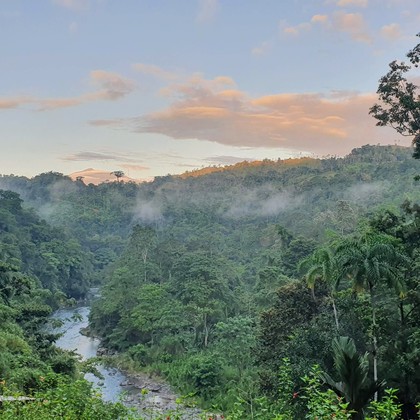

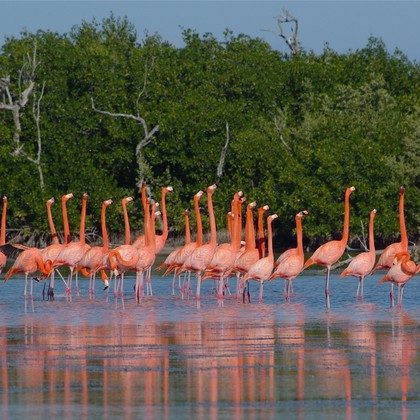
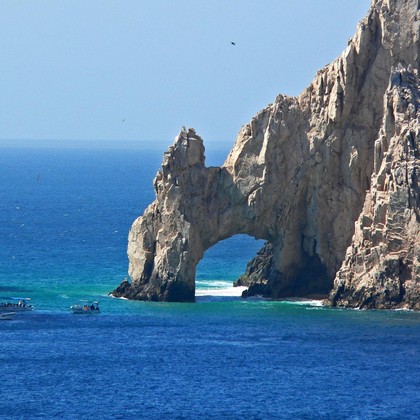
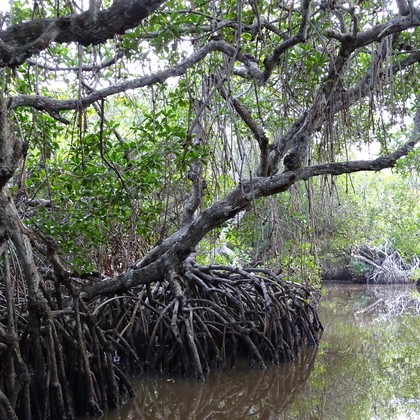

Range and movements
Widespread throughout the guide area, from Baja California and northern Mexico to Panama, on both coasts and inland. Outside the guide area the species breeds across much of North America, from Alaska and Canada to the central United States, and winters from the southern United States and the Caribbean to northern Chile and Argentina.
- Winter visitor (c. Oct–Mar)
- dark = core range, pale = thinly spread
How and when to look
Almost any riverbank, shoreline or quay outside the breeding season holds one; the constant bobbing and the low flight on flickering wingbeats over the water give the species away at a distance.
Conservation status
Not threatened. The species is widespread and also uses man-made banks, canals and reservoirs. A slow decline has been recorded on the breeding grounds.
Scientific name
Actitis macularius | (Linnaeus, 1766)
Linnaeus described the species in 1766 as Tringa macularia; because it was later moved to another genus, the author and year stand in brackets. The genus Actitis was introduced in 1811 by Illiger. Actitis is Greek, from aktitēs, 'coast-dweller', from aktē, 'coast'. macularius is Latin for 'spotted', after the black spots on the underparts in breeding plumage. The specimen the first description was based on came from Pennsylvania.