All species › Passerines › Crows, jays and magpies › Steller's Jay
Position in the tree Birds Aves › Birds with a flexible palate Neognathae › All other modern birds Neoaves › Landbirds Telluraves › Falcons, parrots and passerines Australaves › Falcons and passerines Eufalconimorphae › Parrots and passerines Psittacopasserae
Steller's Jay | Cyanocitta stelleri
Stellers gaai | Chara crestada
Steller's Jay is a large, blue jay with a prominent pointed crest that lives in pine-oak and coniferous forest in the mountains, from Baja California and the Sierra Madre to Nicaragua. It is noisy and bold and forages both in the trees and on the ground.

Voice
Harsh, hoarse series such as shaak-shaak-shaak, dry rattles and softer, varied notes. It also imitates the calls of birds of prey.
Recording: GABRIEL LEITE — CC BY-NC-SA 4.0 · converted to mono · xeno-canto
Identification
29–34 cm, including the fairly long tail. Head, long pointed crest and breast dark, blackish to dark blue depending on the region; in Mexico and Central America often with pale streaks on the forehead and a white spot above the eye. Back blue-grey to blue, belly brighter blue. Wings and tail bright blue with fine black bars. Bill and legs black.
Confusion species
Mexican Jay Aphelocoma wollweberi, Transvolcanic Jay Aphelocoma ultramarina and Unicolored Jay Aphelocoma unicolor have no crest and no black bars on the wings and tail. Pinyon Jay Gymnorhinus cyanocephalus lacks a crest and has a short tail. Azure-hooded Jay Cyanolyca cucullata has a pale blue hood without a crest and lives in more humid forest.
Habitat
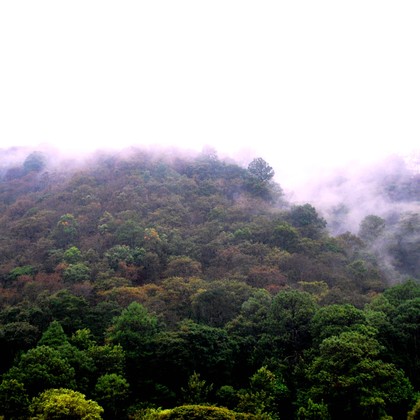
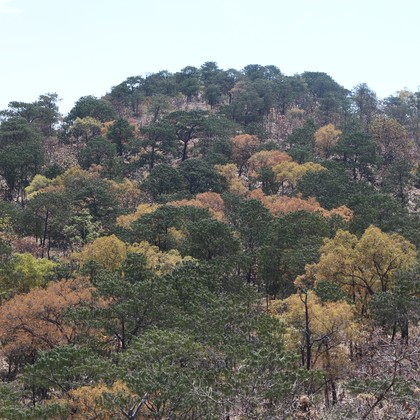
Pine-oak, oak and coniferous forest in the mountains, also forest edges, clearings and the surroundings of villages and campsites in the forest. It eats seeds, acorns, fruit, insects and sometimes eggs and nestlings of other birds; it caches acorns and seeds as a store.
Where the bird is most at home, classified by the vegetation units of Mexico and Central America.

Range and movements
In the guide area in the mountains of northern Baja California, along the Sierra Madre Occidental and Sierra Madre Oriental, in the volcanic belt of central Mexico and the mountains of Guerrero, Oaxaca and Chiapas, and on through the highlands of Guatemala, El Salvador and Honduras to northern Nicaragua. Outside the guide area in the western United States and Canada to southern Alaska.
- Resident
- dark = core range, pale = thinly spread
How and when to look
Regularly present at picnic sites and campsites in montane forest, where it comes to food scraps. Its harsh calls give it away from afar.
Conservation status
Not threatened. Widespread and locally common in montane forest.
Scientific name
Cyanocitta stelleri | (Gmelin, 1788)
Gmelin described the species in 1788 as Corvus stelleri; because it was later moved to another genus, the author and year stand in brackets. The genus Cyanocitta was introduced in 1845 by Strickland. Cyanocitta is Greek, from kuanos 'dark blue' and kitta 'jay, magpie': 'blue jay'. stelleri honours the German naturalist Georg Wilhelm Steller (1709–1746), who saw the species in Alaska in 1741 on Bering's expedition. The specimen the first description was based on came from Nootka Sound, Vancouver Island, British Columbia (Canada).