All species › Passerines › Ovenbirds and woodcreepers › Streak-breasted Treehunter
Position in the tree Birds Aves › Birds with a flexible palate Neognathae › All other modern birds Neoaves › Landbirds Telluraves › Falcons, parrots and passerines Australaves › Falcons and passerines Eufalconimorphae › Parrots and passerines Psittacopasserae
Streak-breasted Treehunter | Thripadectes rufobrunneus
Streepborstboomjager | Trepamusgo pechirrayado
The Streak-breasted Treehunter is a large, heavy ovenbird with a thick black bill that lives hidden in the dense understorey of montane forest in Costa Rica and western Panama. It is hard to see and mostly gives itself away by its harsh call. It occurs only in the guide area.

Voice
A harsh, hoarse, nasal call such as kreek or chek, often repeated. The song is a series of similar harsh notes.
Recording: Tuomas Seimola — CC BY-NC-SA 4.0 · converted to mono · xeno-canto
Identification
20–22 cm. Upperparts dark brown, crown and mantle with narrow ochre-buff streaks. Throat and breast ochre-buff with dark edges, giving a streaked to scaled look. Belly olive-brown, tail rufous. Bill short, thick and black. Sexes alike.
Confusion species
Lineated Foliage-gleaner Syndactyla subalaris is smaller and slimmer, with a thinner bill with a pale lower mandible and narrower streaks. Ruddy Foliage-gleaner Clibanornis rubiginosus is plain rufous-brown, without streaks. Buffy Tuftedcheek Pseudocolaptes lawrencii has a conspicuous whitish tuft on the side of the neck and forages higher, in epiphytes.
Habitat
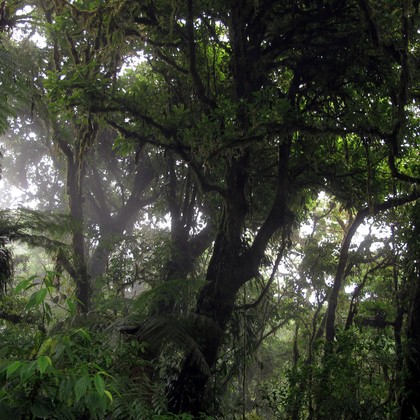
Dense understorey of humid, mossy montane forest, especially in ravines, along streams and on steep slopes with bamboo, mainly between about 1200 and 2500 m, locally lower. It searches moss, epiphytes, dead leaves and bamboo for insects and other invertebrates, sometimes in mixed flocks. The nest is at the end of a tunnel in an earth bank.
Where the bird is most at home, classified by the vegetation units of Mexico and Central America.

Range and movements
Mountains of Costa Rica and western Panama (mainly Chiriquí). Occurs only in the guide area.
- Resident
- dark = core range, pale = thinly spread
How and when to look
Found in dense growth along streams at Tapantí and in the San Gerardo de Dota valley in Costa Rica. Listen for the harsh call and look for a large, dark bird rustling through dense moss and bamboo.
Conservation status
Not threatened. Fairly common but hard to see within its limited range, a large part of which lies in protected areas.
Scientific name
Thripadectes rufobrunneus | (Lawrence, 1865)
Lawrence described the species in 1865 as Philydor rufobrunneus; because it was later moved to another genus, the author and year stand in brackets. The genus Thripadectes was introduced in 1862 by Sclater. Thripadectes is Greek, from thrips 'woodworm' and dēktēs 'biter': 'woodworm-biter', after its search for insects in dead wood. rufobrunneus is Latin, from rufus 'rufous' and brunneus 'brown', after the rufous-brown plumage. The specimen the first description was based on came from San José, Costa Rica.