All species › Passerines › Ovenbirds and woodcreepers › Ruddy Foliage-gleaner
Position in the tree Birds Aves › Birds with a flexible palate Neognathae › All other modern birds Neoaves › Landbirds Telluraves › Falcons, parrots and passerines Australaves › Falcons and passerines Eufalconimorphae › Parrots and passerines Psittacopasserae
Ruddy Foliage-gleaner | Clibanornis rubiginosus
Rosse bladspeurder | Breñero rojizo
The Ruddy Foliage-gleaner is a dark rufous-brown, secretive ovenbird of the dense understorey of humid montane forest. It is heard far more often than seen: its nasal call comes from thick cover close to the ground. In the guide area it lives from southern Mexico to Panama.

Voice
The call is a nasal, rising kwee-eek, often repeated from cover. Also a dry, sharp chek.
Recording: Max Noack — CC BY-NC-SA 4.0 · converted to mono · xeno-canto
Identification
18–20 cm. Mostly dark rufous-brown, without streaks. Throat and breast brighter cinnamon-rufous, belly duller olive-brown. Tail dark rufous-brown to blackish. Bill fairly heavy and straight. Sexes alike.
Confusion species
Ruddy Woodcreeper Dendrocincla homochroa is similar in colour but climbs trunks and has a longer bill. Ochre-throated Foliage-gleaner Automolus ochrolaemus has a pale ochre-buff throat and lives in the lowlands. Tawny-throated Leaftosser Sclerurus mexicanus lives on the forest floor and has a long, thin bill and a short black tail.
Habitat
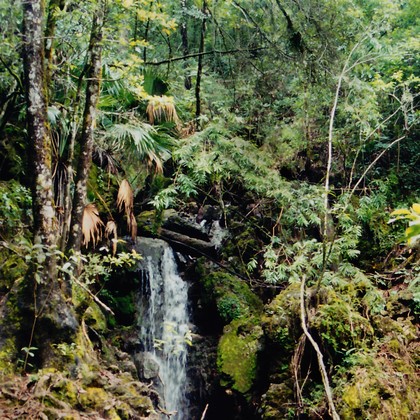
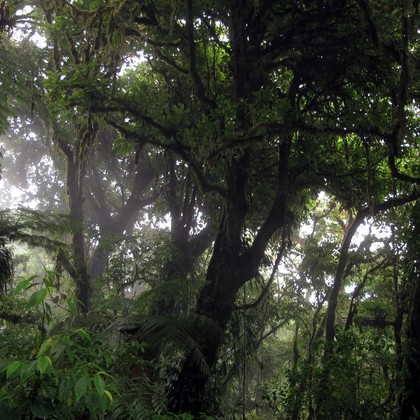
Dense understorey of humid montane and foothill forest, especially in ravines, on steep slopes and at forest edges with thick growth. It forages low near the ground in dead leaves, moss and vine tangles for insects and other arthropods, alone or in pairs. The nest is at the end of a tunnel in an earth bank.
Where the bird is most at home, classified by the vegetation units of Mexico and Central America.

Range and movements
Mountains of southern Mexico (including Guerrero, Oaxaca, Veracruz and Chiapas) through Guatemala, El Salvador, Honduras, Nicaragua and Costa Rica to Panama. Outside the guide area related forms occur in the mountains of South America; which of these are included in this species differs between taxonomic treatments.
- Resident
- dark = core range, pale = thinly spread
How and when to look
Best tracked down by its nasal call from dense growth along forest trails and ravines, for example at Monteverde in Costa Rica and in the montane forests of Guatemala. Waiting patiently at the edge of a thick patch sometimes gives a brief view.
Conservation status
Not threatened. Fairly common but inconspicuous in suitable forest; sensitive to deforestation.
Scientific name
Clibanornis rubiginosus | (Sclater, 1857) (GBIF: Automolus rubiginosus)
Sclater described the species in 1857 as Anabates rubiginosus; because it was later moved to another genus, the author and year stand in brackets. The genus Clibanornis was introduced in 1873 by Sclater & Salvin. Clibanornis is Greek, from klibanos 'oven' and ornis 'bird': 'ovenbird', after the family Furnariidae (Latin furnus 'oven'). rubiginosus is Latin for 'rusty', after the rufous plumage. The specimen the first description was based on came from Córdoba, Veracruz, Mexico.