All species › Passerines › Ovenbirds and woodcreepers › Buff-fronted Foliage-gleaner
Position in the tree Birds Aves › Birds with a flexible palate Neognathae › All other modern birds Neoaves › Landbirds Telluraves › Falcons, parrots and passerines Australaves › Falcons and passerines Eufalconimorphae › Parrots and passerines Psittacopasserae
Buff-fronted Foliage-gleaner | Dendroma rufa
Geelkapbladspeurder | Limpiafronda frentianteada
The Buff-fronted Foliage-gleaner is a slim foliage-gleaner of the canopy and middle levels of humid montane forest, with an ochre-buff forehead and plain ochre-buff underparts. It moves nimbly along branches and through foliage, often with mixed flocks. In the guide area it is local and scarce in the mountains of Costa Rica and Panama.

Voice
The song is a fast, rather shrill, slightly descending series of sharp notes. The call is a sharp, dry chik.
Recording: Jonas Nilsson — CC BY-NC-SA 4.0 · converted to mono · xeno-canto
Identification
18–20 cm. Forehead and eyebrow ochre-buff, crown grey, contrasting with the olive-brown back. Wings tinged rufous, tail cinnamon-rufous. Throat and underparts plain ochre-buff, slightly darker on the flanks. A dark eye-line. Bill fairly long and straight. Sexes alike.
Confusion species
Scaly-throated Foliage-gleaner Anabacerthia variegaticeps is smaller, with an ochre-buff eyering, a scaled throat and an olive-brown breast. Russet Antshrike Thamnistes anabatinus is similar in colour and behaviour, but has a heavy hooked bill and no grey crown. Lineated Foliage-gleaner Syndactyla subalaris is darker and distinctly streaked.
Habitat
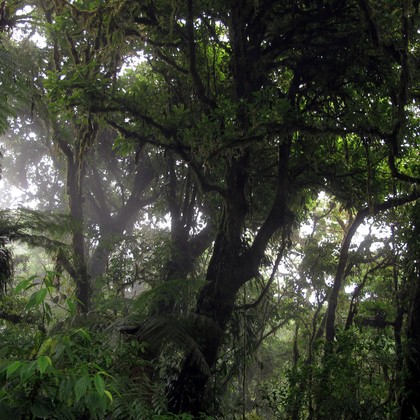
Canopy, middle levels and edges of humid montane and foothill forest. It hangs and creeps along branches and searches foliage, epiphytes and clusters of dead leaves for insects, usually in mixed flocks.
Where the bird is most at home, classified by the vegetation units of Mexico and Central America.

Range and movements
Mountains of Costa Rica and Panama, where it is local and scarce. Outside the guide area in the mountains of Venezuela and the Andes from Colombia to Bolivia, and in south-eastern Brazil, eastern Paraguay and north-eastern Argentina.
- Resident
- dark = core range, pale = thinly spread
How and when to look
Best chance is in mixed flocks in the canopy of montane forest along roads and forest edges, where the ochre-buff forehead and plain ochre-buff underparts are visible at a distance.
Conservation status
Not threatened. Widespread globally; local and scarce in the guide area.
Scientific name
Dendroma rufa | (Vieillot, 1818) (GBIF: Philydor rufum)
Vieillot described the species in 1818 as Dendrocopus rufus; because it was later moved to another genus, the author and year stand in brackets. The genus Dendroma was introduced in 1836 by Swainson. Dendroma is probably Greek, from dendron 'tree' and -dromos 'runner', after its clambering through the canopy; the exact formation could not be verified. rufa is Latin for 'red, rufous', after the buffy to rufous plumage. The specimen the first description was based on came from Brazil (probably Rio de Janeiro).