All species › Passerines › Ovenbirds and woodcreepers › Lineated Foliage-gleaner
Position in the tree Birds Aves › Birds with a flexible palate Neognathae › All other modern birds Neoaves › Landbirds Telluraves › Falcons, parrots and passerines Australaves › Falcons and passerines Eufalconimorphae › Parrots and passerines Psittacopasserae
Lineated Foliage-gleaner | Syndactyla subalaris
Gestreepte bladspeurder | Limpiafronda lineada
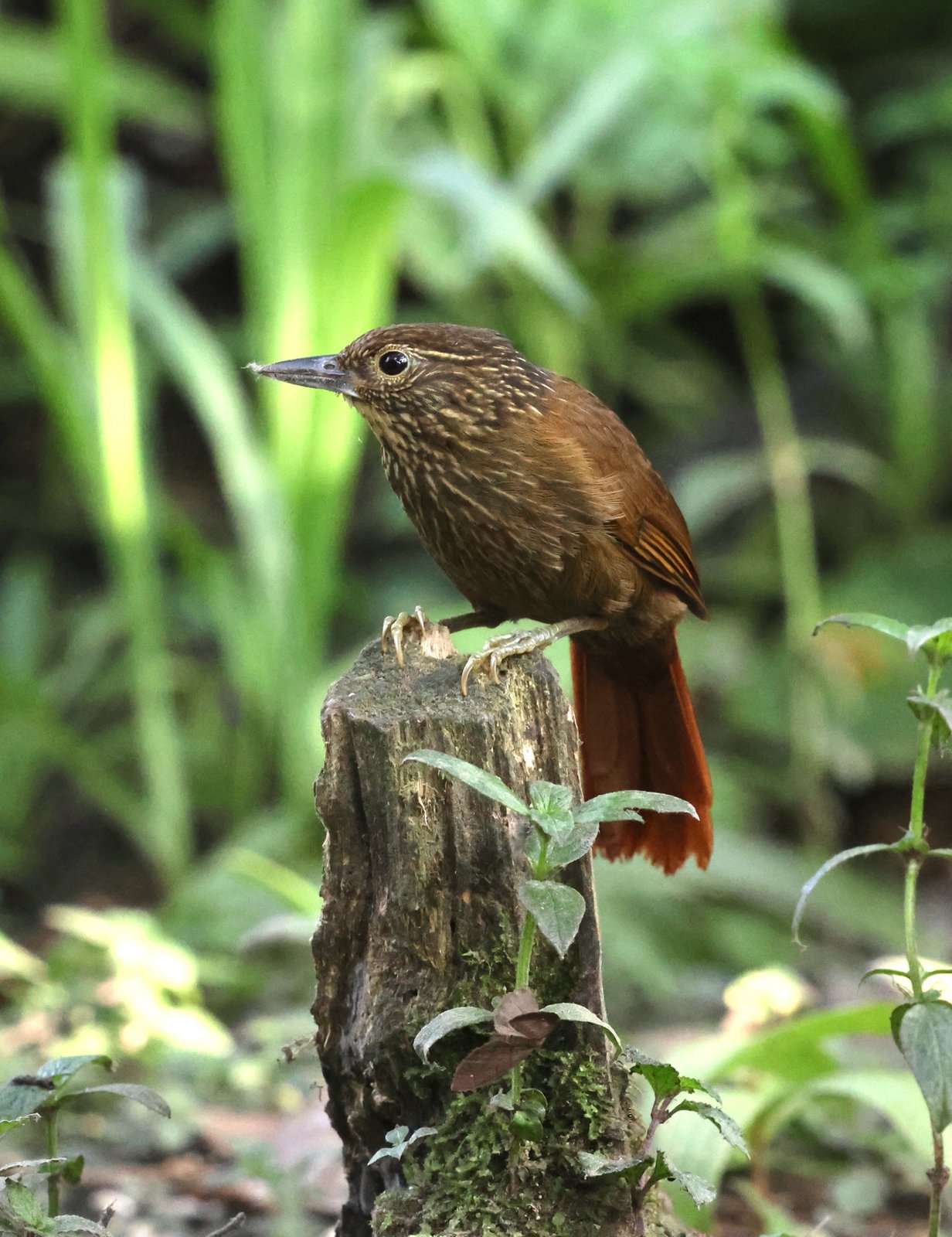
The Lineated Foliage-gleaner is a dark brown, finely streaked foliage-gleaner of the understorey and middle levels of humid montane forest. It noisily rummages through dead leaves and vine tangles, often with mixed flocks. In the guide area it lives in the mountains of Costa Rica and Panama.
Voice
The song is a harsh, dry, accelerating rattle of short notes. The call is a hoarse, nasal kshek.
Recording: Juan Freile — CC BY-NC-SA 4.0 · converted to mono · xeno-canto
Identification
18–19 cm. Upperparts dark olive-brown with narrow pale streaks on the crown, nape and mantle. A narrow ochre-buff eyebrow. Throat ochre-buff. Underparts olive-brown with narrow ochre-buff streaks, especially on the breast. Tail rufous. Bill fairly long and straight, with a pale lower mandible. Sexes alike.
Confusion species
Streak-breasted Treehunter Thripadectes rufobrunneus is larger and heavier, with a thick black bill and an ochre-buff, dark-scaled breast. Scaly-throated Foliage-gleaner Anabacerthia variegaticeps is smaller, with a conspicuous ochre-buff eyering and hardly any streaking. Western Woodhaunter Automolus virgatus has a similar streaked pattern but lives mainly lower, in foothill forest.
Habitat
Understorey and middle levels of humid, mossy montane and foothill forest, especially in dense growth with vines and bamboo, also forest edges, mostly between about 900 and 2300 m. It searches hanging dead leaves, moss and epiphytes for insects and other arthropods, often in mixed flocks.
Where the bird is most at home, classified by the vegetation units of Mexico and Central America.


Range and movements
Mountains of Costa Rica and Panama. Outside the guide area in the Andes and coastal ranges of Venezuela, Colombia and Ecuador to Peru.
- Resident
- dark = core range, pale = thinly spread
How and when to look
Seen in mixed flocks in the cloud forests of Monteverde and at Tapantí in Costa Rica. Look for a streaked brown bird rustling noisily through dead leaves in the understorey.
Conservation status
Not threatened. Fairly common in suitable montane forest.
Scientific name
Syndactyla subalaris | (Sclater, 1859)
Sclater described the species in 1859 as Anabates subalaris; because it was later moved to another genus, the author and year stand in brackets. The genus Syndactyla was introduced in 1853 by Reichenbach. Syndactyla is Greek, from sun 'together' and daktulos 'toe', after the outer toe being fused to the middle toe up to the first joint. subalaris is Latin for 'under the wings', after the dark fawn underwing coverts noted by the describer. The specimen the first description was based on came from Pallatanga, Ecuador.