All species › Passerines › Ovenbirds and woodcreepers › Scaly-throated Foliage-gleaner
Position in the tree Birds Aves › Birds with a flexible palate Neognathae › All other modern birds Neoaves › Landbirds Telluraves › Falcons, parrots and passerines Australaves › Falcons and passerines Eufalconimorphae › Parrots and passerines Psittacopasserae
Scaly-throated Foliage-gleaner | Anabacerthia variegaticeps
Schubkeelbladspeurder | Breñero cejudo
The Scaly-throated Foliage-gleaner is a fairly small, olive-brown foliage-gleaner of humid montane forest, recognised by the conspicuous ochre-buff eyering with a stripe behind it that gives it a spectacled look. It forages actively along branches at middle levels and is a regular member of mixed flocks. In the guide area it lives from southern Mexico to Panama.

Voice
The call is a sharp, squeaky chweek or squeek. The song is a fast series of similar sharp notes.
Recording: José María Loaiza B. — CC BY-NC-SA 4.0 · converted to mono · xeno-canto
Identification
16–17 cm. Crown greyish olive, back olive-brown, wings and tail rufous. A broad ochre-buff eyering extending behind the eye as a short stripe. Throat pale yellowish buff with fine dark scaling. Breast and belly buffy olive-brown with faint pale streaks on the breast. Bill fairly short and straight. Sexes alike.
Confusion species
Lineated Foliage-gleaner Syndactyla subalaris is larger, with distinct pale streaks on the back and underparts and no obvious eyering. Buff-fronted Foliage-gleaner Dendroma rufa has an ochre-buff forehead, a grey crown and plain ochre-buff underparts. Woodcreepers such as Spot-crowned Woodcreeper Lepidocolaptes affinis climb trunks and have a longer, curved bill.
Habitat
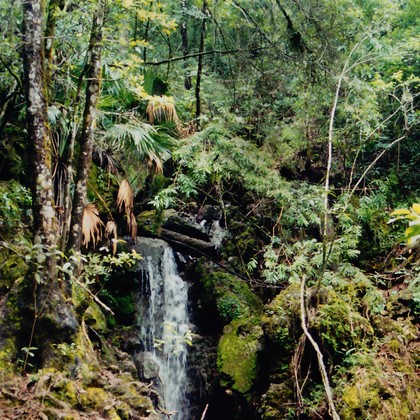
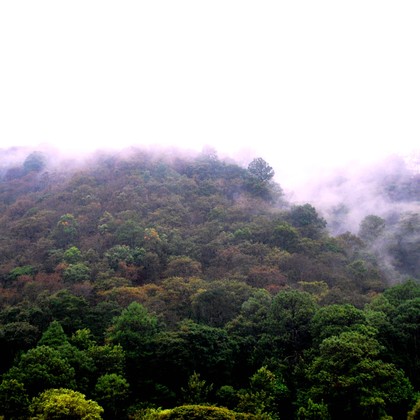
Middle levels and lower canopy of humid cloud forest, foothill forest and humid pine-oak forest, also forest edges and mature secondary forest, mostly between about 600 and 2500 m. It hangs and creeps along branches and searches dead leaves, moss and epiphytes for insects and spiders, nearly always in mixed flocks.
Where the bird is most at home, classified by the vegetation units of Mexico and Central America.


Range and movements
Mountains of southern Mexico (including Guerrero, Oaxaca and Chiapas), Guatemala, El Salvador and Honduras, and also Costa Rica and western Panama. Outside the guide area in the Western Andes of Colombia and Ecuador.
- Resident
- dark = core range, pale = thinly spread
How and when to look
Fairly easy to find in mixed flocks in the cloud forests of Monteverde in Costa Rica and in the montane forests of Chiapas and Guatemala. The spectacled head stands out as soon as the bird pauses.
Conservation status
Not threatened. Fairly common in suitable montane forest, but sensitive to clearance of cloud forest.
Scientific name
Anabacerthia variegaticeps | (Sclater, 1857)
Sclater described the species in 1857 as Anabazenops variegaticeps; because it was later moved to another genus, the author and year stand in brackets. The genus Anabacerthia was introduced in 1841 by De Lafresnaye. Anabacerthia combines the genus names Anabates (Greek anabatēs 'climber', now Philydor) and Certhia (treecreeper). variegaticeps is Latin, from variegatus 'variegated' and -ceps '-headed', after the patterned head with eye-ring and stripe. The specimen the first description was based on came from Córdoba, Veracruz, Mexico.