All species › Passerines › Tyrant flycatchers and allies › Stub-tailed Spadebill
Position in the tree Birds Aves › Birds with a flexible palate Neognathae › All other modern birds Neoaves › Landbirds Telluraves › Falcons, parrots and passerines Australaves › Falcons and passerines Eufalconimorphae › Parrots and passerines Psittacopasserae
Stub-tailed Spadebill | Platyrinchus cancrominus
Kortstaartbreedbektiran | Mosquero pico chato
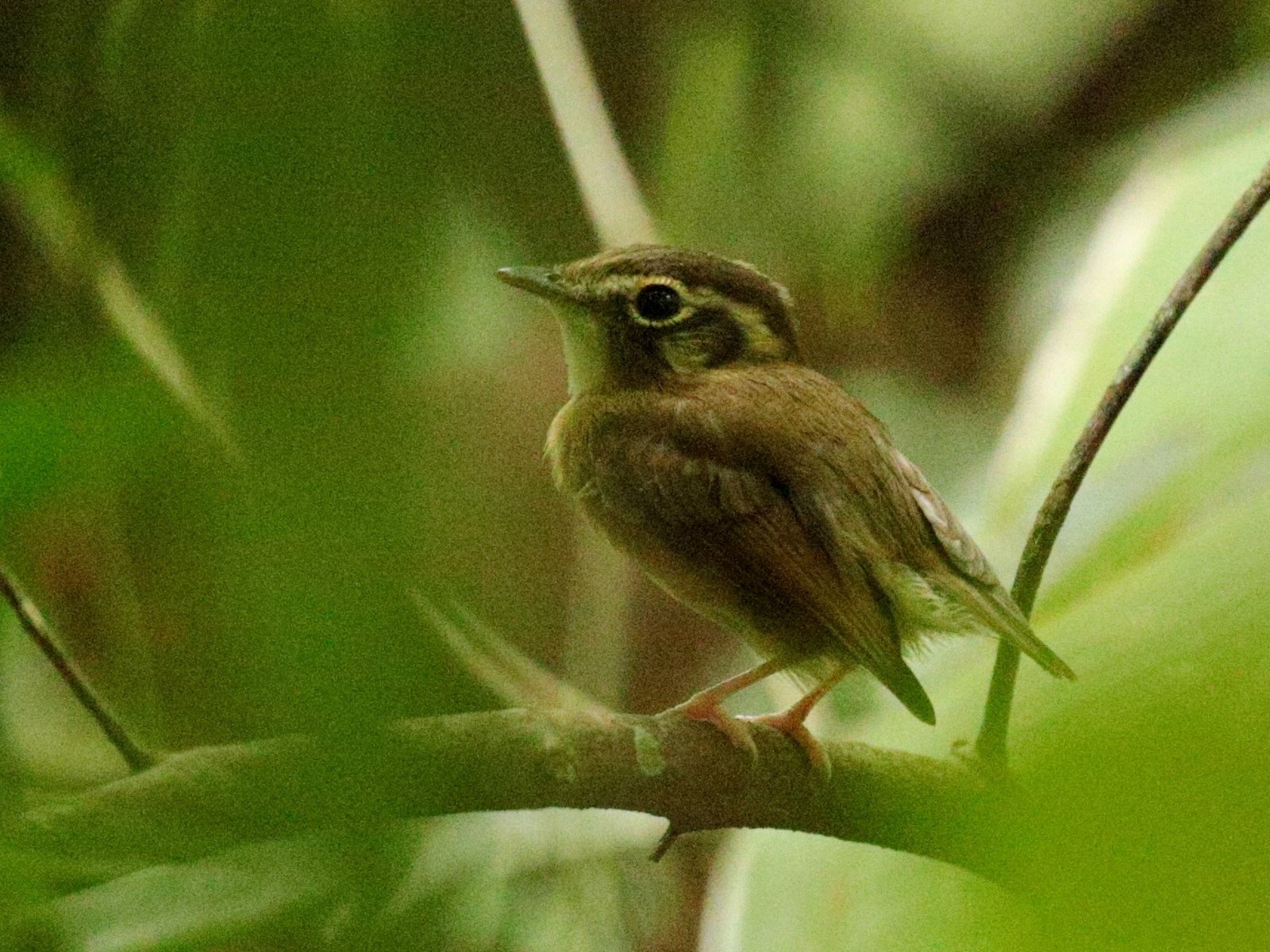
The Stub-tailed Spadebill is a small, brownish-olive Platyrinchus flycatcher with a very broad, flat bill and a strikingly short tail. It lives in the understorey of lowland forest and is heard more often than seen. In the guide area it occurs from south-eastern Mexico to north-western Costa Rica.
Voice
A high, sharp, squeaky call and a short, high, slightly buzzy trill that may rise and fall.
Recording: Joren van Schie — CC BY-NC-SA 4.0 · converted to mono · xeno-canto
Identification
9–10 cm. Round and big-headed, with a stubby tail barely projecting beyond the wingtips. Upperparts olive-brown. Distinctive face pattern: pale lores and eye-ring, a dark crescent on the ear coverts and a dark malar line. Throat white, breast and flanks brownish buff, belly paler. Bill very broad and flat, dark above and pale below.
Confusion species
White-throated Spadebill Platyrinchus mystaceus is very similar, but in Costa Rica and Panama lives mainly at higher elevations in foothill and montane forest and has a slightly longer tail and a more olive-green back. Golden-crowned Spadebill Platyrinchus coronatus is smaller, with a rufous crown and yellowish underparts. The bentbills (Oncostoma) are greener and have a narrow, downcurved bill.
Habitat
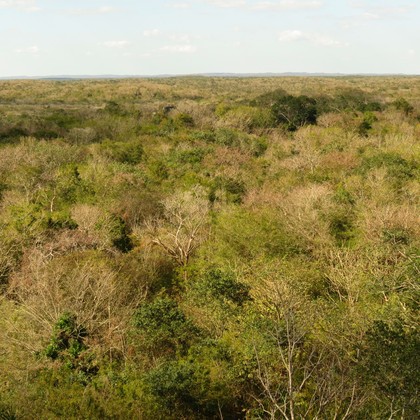
Understorey and middle levels of humid and semi-humid lowland forest, seasonal forest and mature secondary forest, also gallery forest, from sea level to about 1200 m. It perches motionless on a thin twig and suddenly sallies to the underside of a leaf to snatch an insect.
Where the bird is most at home, classified by the vegetation units of Mexico and Central America.





Range and movements
From southern Veracruz and Oaxaca through Tabasco, Chiapas and the Yucatán Peninsula, Belize and Guatemala to Honduras and Nicaragua, reaching north-western Costa Rica. It does not occur outside the guide area.
- Resident
- dark = core range, pale = thinly spread
How and when to look
Listen for the high squeak in the understorey; a perched bird stays still for long periods and is easily overlooked despite its face pattern. Usually alone or in pairs, not in mixed flocks.
Conservation status
Not threatened. Fairly common in suitable forest within its range; disappears where the understorey is lost.
Scientific name
Platyrinchus cancrominus | Sclater & Salvin, 1860
Sclater & Salvin described the species in 1860 and placed it straight away in the genus where it still stands. The genus Platyrinchus was introduced in 1805 by Desmarest, A-G. Platyrinchus is Greek, from platus 'broad' and rhunkhos 'bill', after the strikingly broad, flat bill. cancrominus means 'resembling cancromus': Sclater and Salvin found it barely different from Temminck's Brazilian Platyrhynchos cancromus, except for the white throat and shorter tail. The specimen the first description was based on came from Choctún, Alta Verapaz, Guatemala.