All species › Passerines › Tyrant flycatchers and allies › White-throated Spadebill
Position in the tree Birds Aves › Birds with a flexible palate Neognathae › All other modern birds Neoaves › Landbirds Telluraves › Falcons, parrots and passerines Australaves › Falcons and passerines Eufalconimorphae › Parrots and passerines Psittacopasserae
White-throated Spadebill | Platyrinchus mystaceus
Witkeelbreedbektiran | Picochato goliblanco
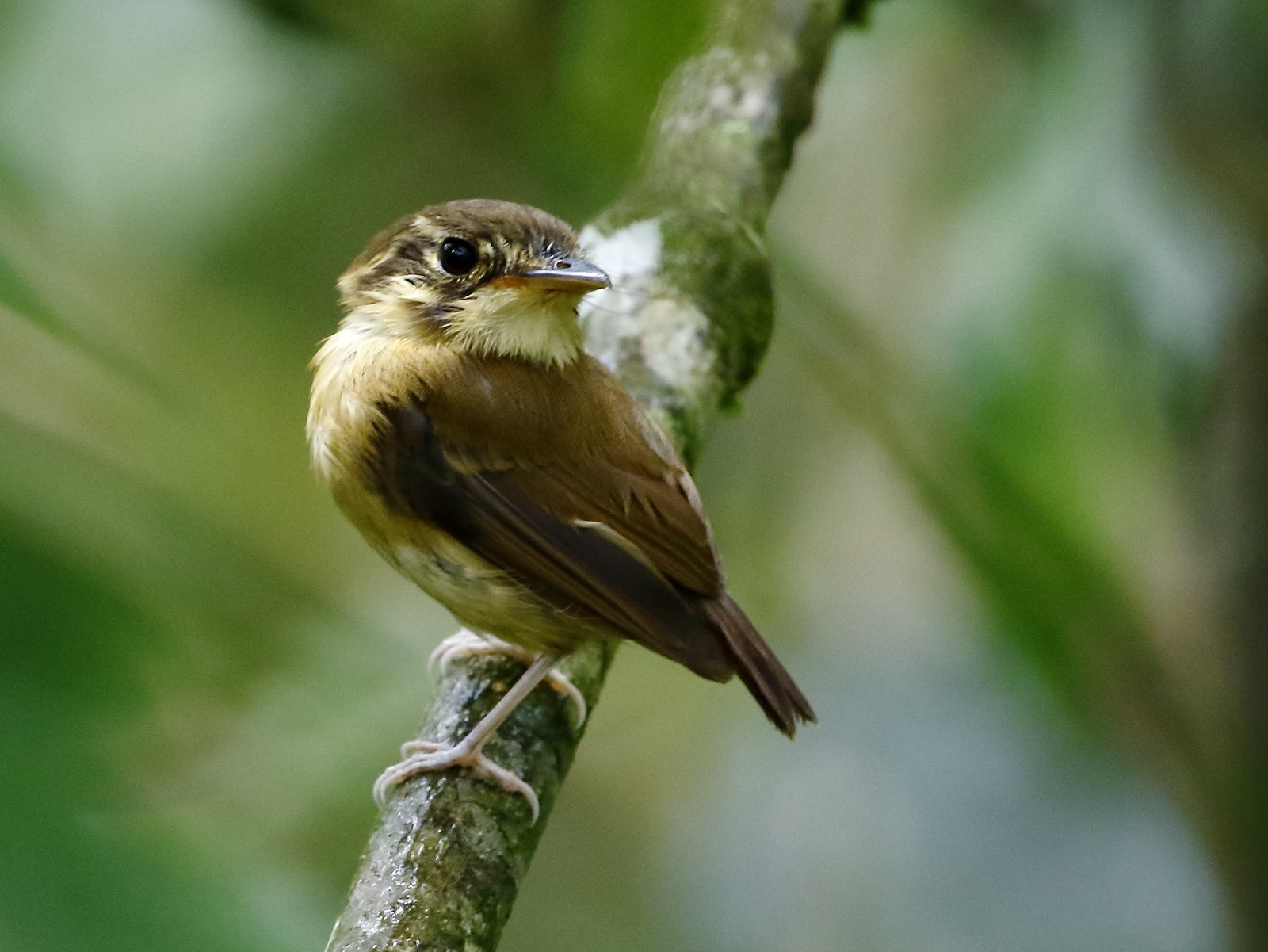
The White-throated Spadebill is a small, olive-brown Platyrinchus flycatcher with a very broad bill, a patterned face and a white throat. In the guide area it is a bird of the understorey of foothill and montane forest in Costa Rica and Panama. It is a widespread species that ranges far into South America.
Voice
A high, sharp squeep and a high, thin trill that first rises and then falls away.
Recording: Juan Freile — CC BY-NC-SA 4.0 · converted to mono · xeno-canto
Identification
10 cm. Round and big-headed with a short tail. Upperparts olive-brown, crown slightly darker; the male has a concealed yellow crown patch. Face with pale lores and eye-ring, a dark crescent on the ear coverts and a dark malar stripe. Throat bright white, breast brownish olive, belly paler yellowish. Bill very broad and flat, pale below.
Confusion species
Stub-tailed Spadebill Platyrinchus cancrominus is very similar, but lives in lowland forest from southern Mexico to north-western Costa Rica, has an even shorter tail and is browner above. Golden-crowned Spadebill Platyrinchus coronatus is smaller, has a rufous crown and lives mainly in the lowlands.
Habitat
Understorey of humid foothill and montane forest, mainly between about 700 and 2100 m, also mature secondary forest with dense undergrowth. It perches still on a thin twig low in the forest and sallies to the underside of leaves to take insects. It builds a small cup nest in a fork low in the undergrowth.
Where the bird is most at home, classified by the vegetation units of Mexico and Central America.


Range and movements
Foothill and montane forest of Costa Rica and Panama, east to Darién. Outside the guide area in much of South America, from Colombia and Venezuela to Bolivia, north-eastern Argentina and south-eastern Brazil.
- Resident
- dark = core range, pale = thinly spread
How and when to look
On trails through montane forest in Costa Rica and western Panama it is often first noticed by its sharp squeak. A perched bird stands out by its white throat in the gloom.
Conservation status
Not threatened. Fairly common in suitable forest. Its taxonomy is in flux: some authors place the Central American birds in a separate species.
Scientific name
Platyrinchus mystaceus | Vieillot, 1818
Vieillot described the species in 1818 and placed it straight away in the genus where it still stands. The genus Platyrinchus was introduced in 1805 by Desmarest, A-G. Platyrinchus is Greek, from platus 'broad' and rhunkhos 'bill', after the strikingly broad, flat bill. mystaceus is Modern Latin for 'moustached', from Greek mustax 'moustache', after the dark cheek stripe; Azara called it 'Bigotillos'. The specimen the first description was based on came from San Ignacio Guazú, Paraguay.