All species › Passerines › Tyrant flycatchers and allies › Golden-crowned Spadebill
Position in the tree Birds Aves › Birds with a flexible palate Neognathae › All other modern birds Neoaves › Landbirds Telluraves › Falcons, parrots and passerines Australaves › Falcons and passerines Eufalconimorphae › Parrots and passerines Psittacopasserae
Golden-crowned Spadebill | Platyrinchus coronatus
Geelkapbreedbektiran | Picochato coronidorado
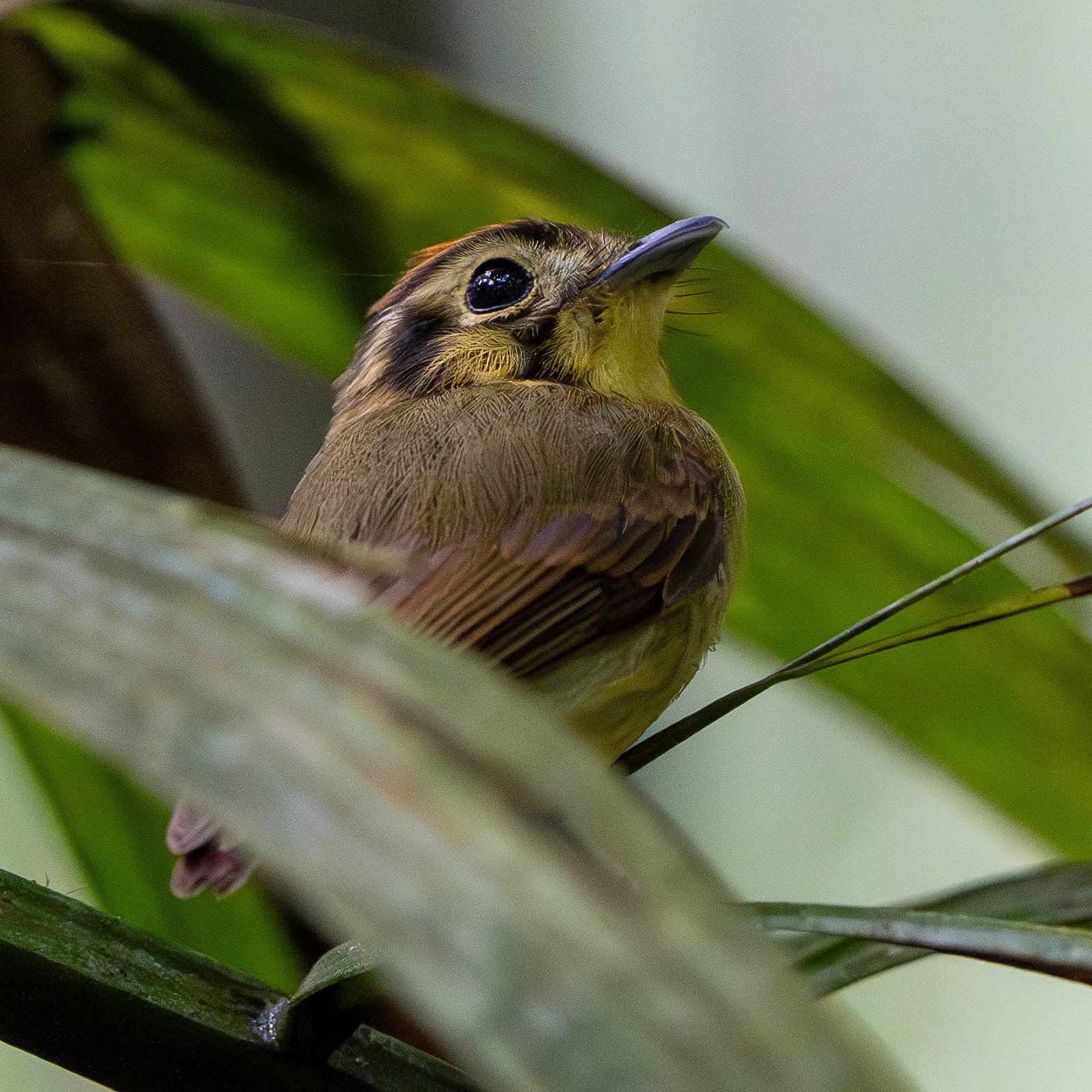
The Golden-crowned Spadebill is the smallest spadebill in the guide area: an olive-green ball with a very broad bill, a patterned face and a rufous crown with a yellow central stripe. It lives in the understorey of humid lowland forest. In the guide area it occurs from Honduras to Panama.
Voice
A very high, thin, buzzy trill, reminiscent of an insect and easily overlooked.
Recording: Guilherme Melo — CC BY-NC-SA 4.0 · converted to mono · xeno-canto
Identification
9 cm. Very small and round, with a large head and a stubby tail. Crown rufous, bordered black on each side; the male has a yellow central crown stripe, smaller or absent in the female. Face yellowish with a dark spot behind the eye and a dark crescent on the ear coverts. Upperparts olive-green. Throat whitish, breast olive-yellow, belly yellow. Bill very broad and flat.
Confusion species
Stub-tailed Spadebill Platyrinchus cancrominus and White-throated Spadebill Platyrinchus mystaceus are larger and browner, with an olive-brown crown lacking rufous and a brownish breast. Black-capped Pygmy Tyrant Myiornis atricapillus is even smaller, with a black head and a narrow bill.
Habitat
Understorey and lower middle levels of humid evergreen lowland and foothill forest, especially mature forest with an open understorey, mostly below about 1000 m. It perches still on a thin twig and sallies up to the underside of leaves to take insects.
Where the bird is most at home, classified by the vegetation units of Mexico and Central America.



Range and movements
Caribbean slope of Honduras, Nicaragua and Costa Rica, in south-western Costa Rica also on the Pacific slope; in Panama on both slopes east to Darién. Outside the guide area in western Colombia and Ecuador and over much of the Amazon basin.
- Resident
- dark = core range, pale = thinly spread
How and when to look
Found along trails through mature lowland forest, for example at La Selva in Costa Rica and along Pipeline Road (Camino del Oleoducto) in Panama. Listen for the high, buzzy trill just above the ground.
Conservation status
Not threatened. Fairly common but inconspicuous in mature lowland forest; sensitive to logging and forest fragmentation.
Scientific name
Platyrinchus coronatus | Sclater, 1858
Sclater described the species in 1858 and placed it straight away in the genus where it still stands. The genus Platyrinchus was introduced in 1805 by Desmarest, A-G. Platyrinchus is Greek, from platus 'broad' and rhunkhos 'bill', after the strikingly broad, flat bill. coronatus is Latin for 'crowned', after the golden-yellow crown patch. The specimen the first description was based on came from Río Napo, Ecuador.