All species › Birds of prey › Kites, Old World vultures, eagles and hawks › Swallow-tailed Kite
Position in the tree Birds Aves › Birds with a flexible palate Neognathae › All other modern birds Neoaves › Landbirds Telluraves › Raptors, owls, kingfishers and woodpeckers Afroaves › Hawks and owls Hieraves
Swallow-tailed Kite | Elanoides forficatus
Zwaluwstaartwouw | Milano tijereta
The Swallow-tailed Kite is a black-and-white kite with a long, deeply forked tail that spends almost its entire life in the air: it catches insects in flight, plucks lizards, tree frogs and nestlings from the canopy and drinks by skimming low over water. In the guide area it is a summer visitor that breeds in humid forest from January or February to August or September and then leaves for South America. In addition, birds from the southeastern United States pass through in spring and autumn.

Voice
A high, clear whistled klee-klee-klee or pee-pee, often in flight, especially from groups over the forest and around the nest.
Recording: José María Loaiza B. — CC BY-NC-SA 4.0 · converted to mono · xeno-canto
Identification
50–64 cm including the tail, which makes up almost half the length. Head, neck and underparts are white; back, wings and tail are black with a bluish or greenish gloss. In flight the long, narrow wings are white on the coverts and black on the flight feathers from below, and the tail is deeply forked with long outer feathers. Young birds have a shorter tail and fine dark streaks on the head and breast. Male and female are alike.
Confusion species
Its colours and deeply forked tail make it almost unmistakable. The White-tailed Kite Elanus leucurus is pale grey above and has a white, unforked tail. The Mississippi Kite Ictinia mississippiensis and Plumbeous Kite Ictinia plumbea are grey, with a square or slightly notched tail. The Magnificent Frigatebird Fregata magnificens also has a forked tail but is much larger, mostly black and lives on the coast.
Habitat
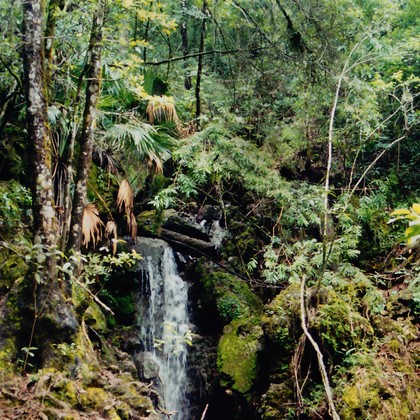
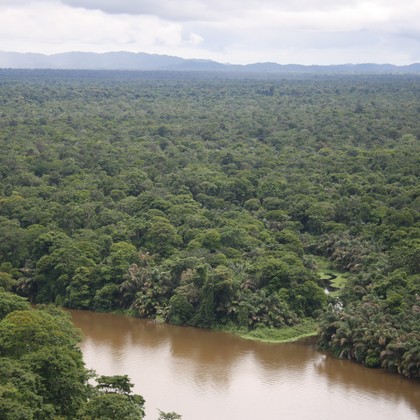
Humid lowland, foothill and montane forest up into cloud forest, forest edges and clearings, and swamp forest; on migration also over coastal plains and open country. It nests high in the crown of an emergent tree. It hunts in flight above and along the canopy, often in loose groups.
Where the bird is most at home, classified by the vegetation units of Mexico and Central America.





Range and movements
Breeds from southern Mexico (Veracruz, Oaxaca, Chiapas and the Yucatán Peninsula) through Belize, Guatemala, Honduras, Nicaragua and Costa Rica to Panama, commoner on the Caribbean than on the Pacific side; scarce in El Salvador. Breeding birds arrive in January and February and leave for South America in August and September. Birds from the southeastern United States pass through the guide area in March and April and especially in August and September, mainly along the Gulf coast of Veracruz, the Yucatán Peninsula and the Caribbean side of Central America. From October to December there are almost no birds in the guide area. Outside the guide area it breeds in the southeastern United States and in tropical South America.
- Summer visitor (c. Apr–Sep)
- dark = core range, pale = thinly spread
How and when to look
From February to May groups circle over the forest in the Caribbean lowlands and foothills of Costa Rica and Panama and in Belize, often during the morning as thermals develop. In August and September large groups sometimes migrate along the coast of Veracruz and the Yucatán Peninsula.
Conservation status
Not threatened. In the United States its breeding range contracted sharply in the twentieth century; in Central America it is sensitive to forest clearance.
Scientific name
Elanoides forficatus | (Linnaeus, 1758)
Linnaeus described the species in 1758 as Falco forficatus; because it was later moved to another genus, the author and year stand in brackets. The genus Elanoides was introduced in 1818 by Vieillot. Elanoides means 'resembling Elanus', from Greek elanos 'kite' and -oidēs 'resembling'. forficatus is Latin for 'scissor-shaped', from forfex 'scissors', after the deeply forked tail. The specimen the first description was based on came from Carolina, USA (after Catesby).