All species › Swifts › Hummingbirds › Talamanca Hummingbird
Position in the tree Birds Aves › Birds with a flexible palate Neognathae › All other modern birds Neoaves › Birds of the elements Elementaves › Nightjars and swifts Strisores
Talamanca Hummingbird | Eugenes spectabilis
Talamancakolibrie | Colibrí de Talamanca
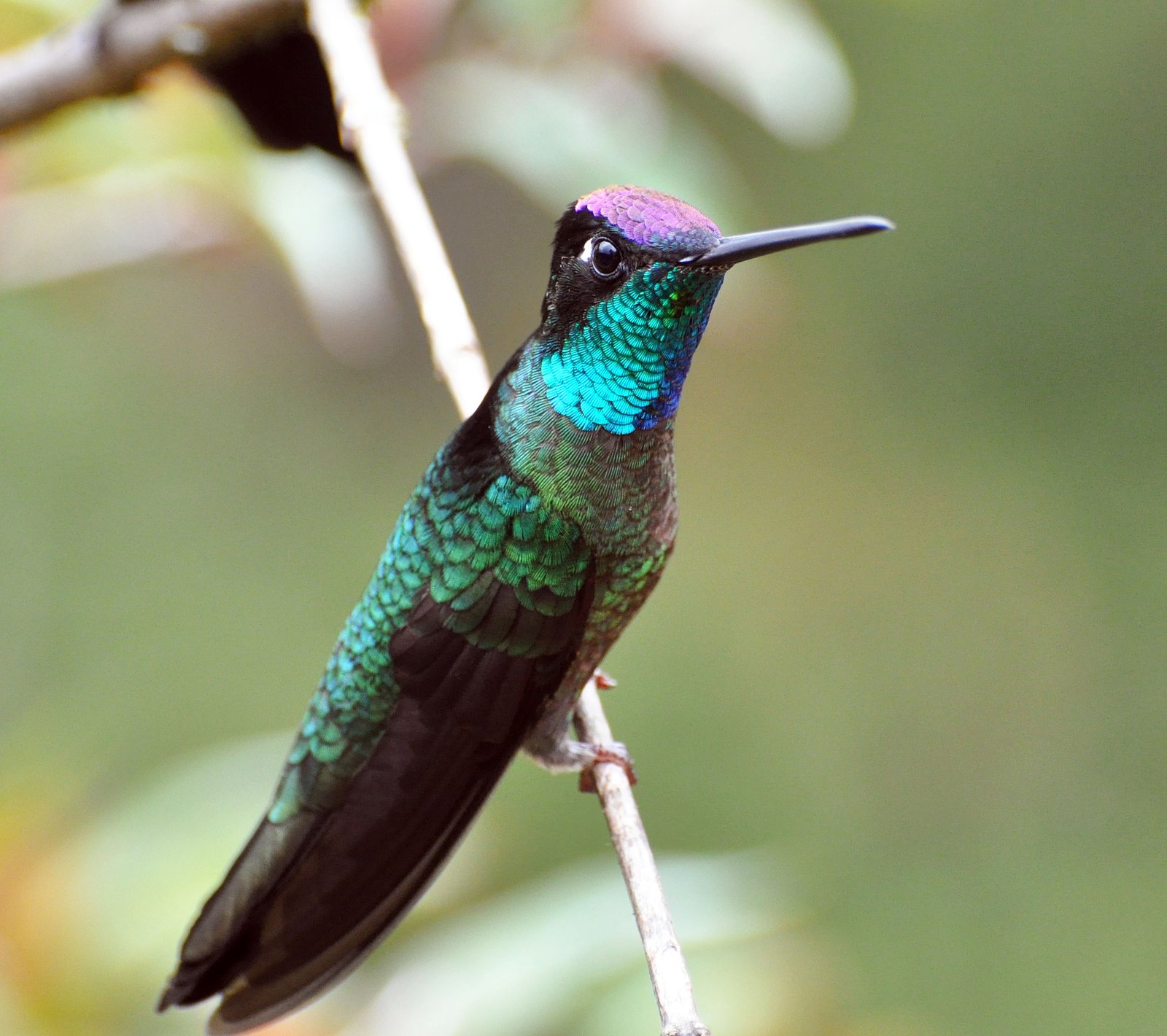
The Talamanca Hummingbird is one of the largest hummingbirds in Central America and lives only in the high mountains of Costa Rica and western Panama. Until 2017 it was treated as a subspecies of Rivoli's Hummingbird. At feeders in the Talamanca it displaces most smaller hummingbirds.
Voice
A sharp, dry chip, and in chases a dry twitter.
Recording: Nick Talbot — CC BY-NC-SA 4.0 · converted to mono · xeno-canto
Identification
13–14 cm, with a long, straight black bill. The male is dark green, with a glittering violet crown, a glittering turquoise to blue-green throat, a blackish breast and belly, a white spot behind the eye and a dark bronze-green tail. The female is green above, with a white stripe behind the eye, grey, green-spotted underparts and a green tail with greyish-white tips to the outer feathers.
Confusion species
Fiery-throated Hummingbird Panterpe insignis is much smaller and has a fiery red to golden throat and a blue breast patch. White-throated Mountaingem Lampornis castaneoventris is smaller, with a shorter bill; the male has a white throat, the female cinnamon underparts. Green-crowned Brilliant Heliodoxa jacula lives lower in the mountains and has a green throat without a purple crown. Rivoli's Hummingbird Eugenes fulgens occurs only north of Costa Rica.
Habitat
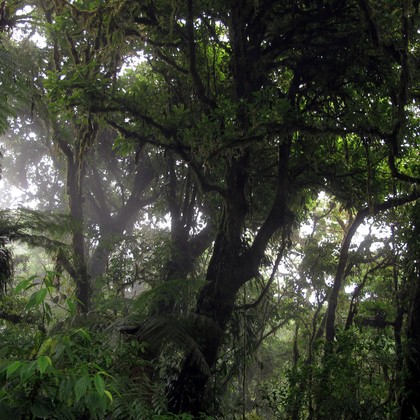
Oak forest and highland rainforest, forest edges, scrub and páramo edges in the high mountains, at about 1800 to 3300 m. It feeds at all levels at flowering shrubs, epiphytes and salvias, catches many insects in flight and visits feeders at lodges.
Where the bird is most at home, classified by the vegetation units of Mexico and Central America.



Range and movements
Endemic to the guide area. In the highlands of Costa Rica, in the Cordillera Central and the Cordillera de Talamanca, and in western Panama in Chiriquí and adjacent Bocas del Toro.
- Resident
- dark = core range, pale = thinly spread
How and when to look
At lodge feeders in the San Gerardo de Dota valley and along the Pan-American Highway near Cerro de la Muerte in Costa Rica; in Panama on the slopes of Barú volcano and at Cerro Punta.
Conservation status
Not threatened. Fairly common in suitable habitat. The range is small, but lies largely within protected areas.
Scientific name
Eugenes spectabilis | (Lawrence, 1867)
Lawrence described the species in 1867 as Heliomaster spectabilis; because it was later moved to another genus, the author and year stand in brackets. The genus Eugenes was introduced in 1856 by Gould. Eugenes is Greek, from eugenēs 'well-born, noble', after the stately appearance of this large hummingbird. spectabilis is Latin for 'remarkable, showy', after the splendid plumage. The specimen the first description was based on came from Costa Rica.