All species › Passerines › Tyrant flycatchers and allies › Torrent Tyrannulet
Position in the tree Birds Aves › Birds with a flexible palate Neognathae › All other modern birds Neoaves › Landbirds Telluraves › Falcons, parrots and passerines Australaves › Falcons and passerines Eufalconimorphae › Parrots and passerines Psittacopasserae
Torrent Tyrannulet | Serpophaga cinerea
Bergbeektachuri | Mosquerito guardarríos
The Torrent Tyrannulet is a small grey-and-black tyrant flycatcher that lives exclusively along fast-flowing rocky streams and rivers in the mountains. It perches on rocks in and beside the water and catches insects over the current. In the guide area it occurs in the mountains of Costa Rica and western Panama.

Voice
Sharp, short chip calls that carry well over the noise of the water, and rapid series of such notes.
Recording: Carlos Delgado JUMABITA — CC BY-NC-SA 4.0 · converted to mono · xeno-canto
Identification
11 cm, with a small dark bill. Head blackish, with a concealed white crown patch. Back pale grey. Wings and tail blackish, the wings with faint grey edges. Underparts whitish, pale grey on the breast. Male and female are alike. It often flicks or raises its tail.
Confusion species
Black Phoebe Sayornis nigricans also lives along streams but is larger, with a black head, breast and back and a sharply demarcated white belly. Buff-rumped Warbler Myiothlypis fulvicauda also perches on rocks along running water but is olive-brown with a buff rump and tail base.
Habitat
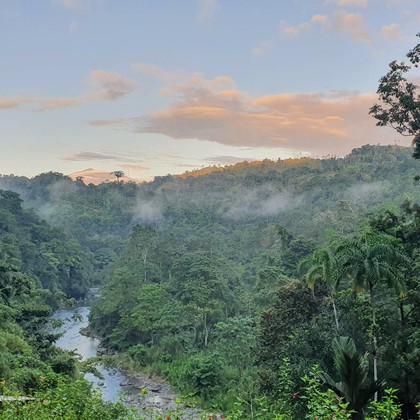
Fast-flowing, clear streams and rivers with large boulders and rocks in the mountains, mainly at middle elevations, usually bordered by forest or semi-open country. It catches insects in short flights over the water and from rocks. The cup-shaped nest is built on a branch or rock over or close to the water.
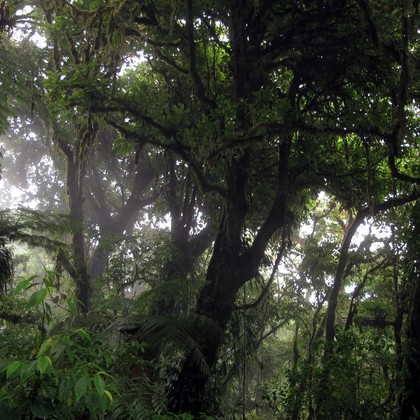
Where the bird is most at home, classified by the vegetation units of Mexico and Central America.

Range and movements
Mountains of Costa Rica, especially the Cordillera de Talamanca and the Cordillera Central, and of western Panama, east to about Veraguas. Outside the guide area in the Andes, from Venezuela and Colombia to Bolivia.
- Resident
- dark = core range, pale = thinly spread
How and when to look
Found by walking along mountain streams and scanning the rocks in the water; pairs stay on the same stretch of stream year-round. For example along the Río Savegre at San Gerardo de Dota in Costa Rica.
Conservation status
Not threatened. Locally fairly common along suitable streams; it depends on clean, fast-flowing water and is therefore sensitive to pollution and dam construction.
Scientific name
Serpophaga cinerea | (Tschudi, 1844)
Tschudi described the species in 1844 as L[eptopogon] cinereus; because it was later moved to another genus, the author and year stand in brackets. The genus Serpophaga was introduced in 1839 by Gould. Serpophaga is Greek, from serphos 'gnat' and -phagos '-eating': 'gnat-eater'. cinerea is Latin for 'ash-grey' (from cinis 'ashes'), after the grey plumage. The specimen the first description was based on came from near Tarma, Junín, Peru.