All species › Passerines › Mockingbirds and thrashers › Tropical Mockingbird
Position in the tree Birds Aves › Birds with a flexible palate Neognathae › All other modern birds Neoaves › Landbirds Telluraves › Falcons, parrots and passerines Australaves › Falcons and passerines Eufalconimorphae › Parrots and passerines Psittacopasserae
Tropical Mockingbird | Mimus gilvus
Tropische spotlijster | Cenzontle tropical
The Tropical Mockingbird is a slender, grey-and-white mockingbird with a dark eye mask and a long, white-tipped tail. It lives in open country, villages and gardens of the tropical lowlands. In the guide area it occurs from south-eastern Mexico to Honduras and El Salvador, and locally further south.

Voice
The song is a long, vigorous series of whistled and scratchy phrases, often repeated; imitations of other birds are less frequent than in Northern Mockingbird. It often sings from a high perch, also at night. The call is a hard chak.
Recording: José — CC BY-NC-SA 4.0 · converted to mono · xeno-canto
Identification
23–26 cm. Slender, with a long tail and a fairly long, slightly decurved black bill. Upperparts dull grey. Dark lores and eye-stripe form a narrow mask, with a whitish supercilium above. Underparts white, tinged greyish on the breast. Wings blackish with two narrow white wing bars and pale edges to the flight feathers, but without a large white patch. Tail blackish with broad white tips to the outer feathers. Iris yellow to orange-brown. The sexes are alike.
Confusion species
Northern Mockingbird Mimus polyglottos, which occurs in the north of the guide area and meets Tropical Mockingbird in southern Veracruz and Oaxaca, has a large white patch at the base of the primaries that is conspicuous in flight, more white on the tail sides and a less distinct mask. Loggerhead Shrike Lanius ludovicianus has a broad black mask, a shorter, hooked bill and a shorter tail.
Habitat
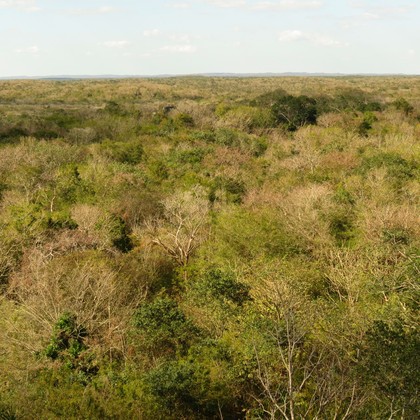
Open and semi-open country with scattered trees and shrubs in the lowlands: villages, gardens and parks, pastures with hedges, forest edges, coastal vegetation and open savanna, mostly below about 1500 m. It forages for insects on the ground and in shrubs and eats much fruit. It often perches conspicuously on posts, roofs and wires.
Where the bird is most at home, classified by the vegetation units of Mexico and Central America.





Range and movements
From south-eastern Mexico (southern Veracruz, Tabasco, Oaxaca, Chiapas and the Yucatán Peninsula) through Belize, Guatemala, El Salvador and Honduras; further south local and spreading, including central Panama. Outside the guide area in northern South America and the Lesser Antilles.
- Resident
- dark = core range, pale = thinly spread
How and when to look
Easy to see in villages and farmyards in Yucatán, Belize and Petén, where it often sings from a roof or antenna.
Conservation status
Not threatened (LC). Common and benefits from deforestation and the spread of open, man-made landscapes; it is expanding its range locally.
Scientific name
Mimus gilvus | (Vieillot, 1808)
Vieillot described the species in 1808 as Turdus gilvus; because it was later moved to another genus, the author and year stand in brackets. The genus Mimus was introduced in 1826 by Boie. Mimus is Latin for 'mimic', after the habit of imitating other sounds. gilvus is Latin for 'pale yellow, dun', after the pale greyish plumage. The specimen the first description was based on came from French Guiana (suggested; originally 'Guiana and the warmest parts of America').