All species › Passerines › Royal flycatchers and allies › Tropical Royal Flycatcher
Position in the tree Birds Aves › Birds with a flexible palate Neognathae › All other modern birds Neoaves › Landbirds Telluraves › Falcons, parrots and passerines Australaves › Falcons and passerines Eufalconimorphae › Parrots and passerines Psittacopasserae
Tropical Royal Flycatcher | Onychorhynchus coronatus
Tropische kroontiran | Mosquero real
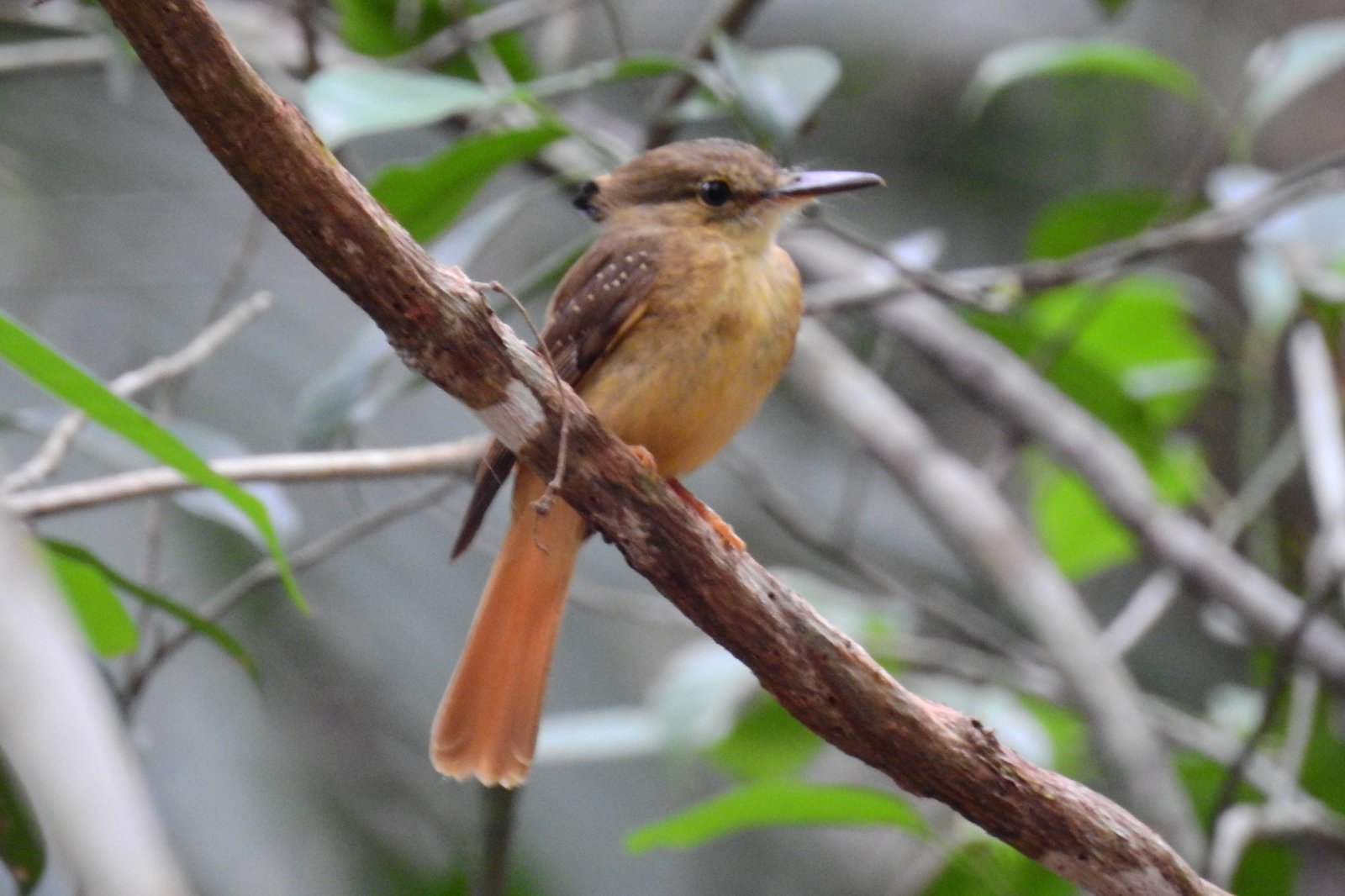
The Tropical Royal Flycatcher is a brown flycatcher with a long, broad, flat bill and a crest that usually lies flat and projects backwards, giving the head a hammer-like shape. When excited it opens the crest into a large half-fan, red in the male and orange-yellow in the female. In the guide area it lives from southern Mexico to Panama.
Voice
A loud, plaintive two-syllable whistle, roughly kee-yuk, repeated at intervals; somewhat recalls the call of a jacamar.
Recording: Paul Lenrumé — CC BY-NC-SA 4.0 · shortened to the first 60 s, mono · xeno-canto
Identification
16–17 cm. Upperparts brown, rump and tail bright cinnamon-rufous; small buff spots on the wing coverts. Throat whitish, rest of the underparts ochre-yellow to sandy buff, faintly barred darker on the breast. Crest usually closed and projecting backwards; when opened a fan of red (male) or orange-yellow (female) feathers with black and steel-blue tips. Bill strikingly long, broad and flat.
Confusion species
Ruddy-tailed Flycatcher Terenotriccus erythrurus also has a rufous tail, but is much smaller, with a short bill, a grey head and no crest. Sulphur-rumped Myiobius Myiobius sulphureipygius is smaller, with a yellow rump and a black tail. The combination of a hammer-shaped head and a long, flat bill is distinctive in the guide area.
Habitat
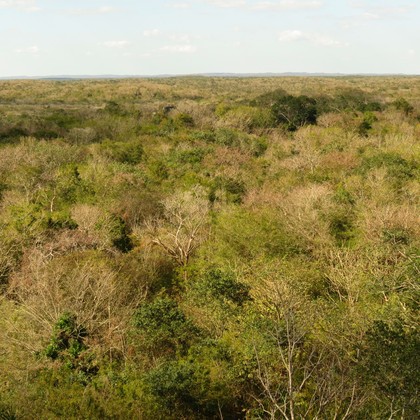
Lower and middle storeys of humid and semi-humid lowland forest, often along streams and rivers and in gallery forest, also mature secondary forest; in the north of the guide area also in seasonal forest. Mostly below 1000 m. It catches insects in short sallies from a perch. The nest is a long, hanging structure of plant fibres, often suspended over water from a branch or vine.
Where the bird is most at home, classified by the vegetation units of Mexico and Central America.




Range and movements
From southern Mexico (southern Veracruz and Oaxaca to the Yucatán Peninsula and Chiapas) through Belize, Guatemala, Honduras, Nicaragua and Costa Rica to Panama. Outside the guide area in much of northern South America and Amazonia.
- Resident
- dark = core range, pale = thinly spread
How and when to look
The long hanging nest over a stream often gives its presence away. Regularly seen along forest streams in Carara National Park in Costa Rica and along Pipeline Road (Camino del Oleoducto) in Panama.
Conservation status
Not threatened. Rather scarce but widespread in lowland forest; declines where riverine and lowland forest is lost. Species limits differ between classifications: some treat the birds of Mexico and Central America as a separate species.
Scientific name
Onychorhynchus coronatus | (Müller, 1776)
Müller described the species in 1776 as Muscicapa coronata; because it was later moved to another genus, the author and year stand in brackets. The genus Onychorhynchus was introduced in 1810 by Fischer von Waldheim. Onychorhynchus is Greek, from onux, onukhos 'nail, claw' and rhunkhos 'bill', after the hooked bill tip. coronatus is Latin for 'crowned', after the large fan-shaped crest. The specimen the first description was based on came from Cayenne, French Guiana.