All species › Passerines › Royal flycatchers and allies › Ruddy-tailed Flycatcher
Position in the tree Birds Aves › Birds with a flexible palate Neognathae › All other modern birds Neoaves › Landbirds Telluraves › Falcons, parrots and passerines Australaves › Falcons and passerines Eufalconimorphae › Parrots and passerines Psittacopasserae
Ruddy-tailed Flycatcher | Terenotriccus erythrurus
Roodstaarttiran | Mosquerito colirrojo
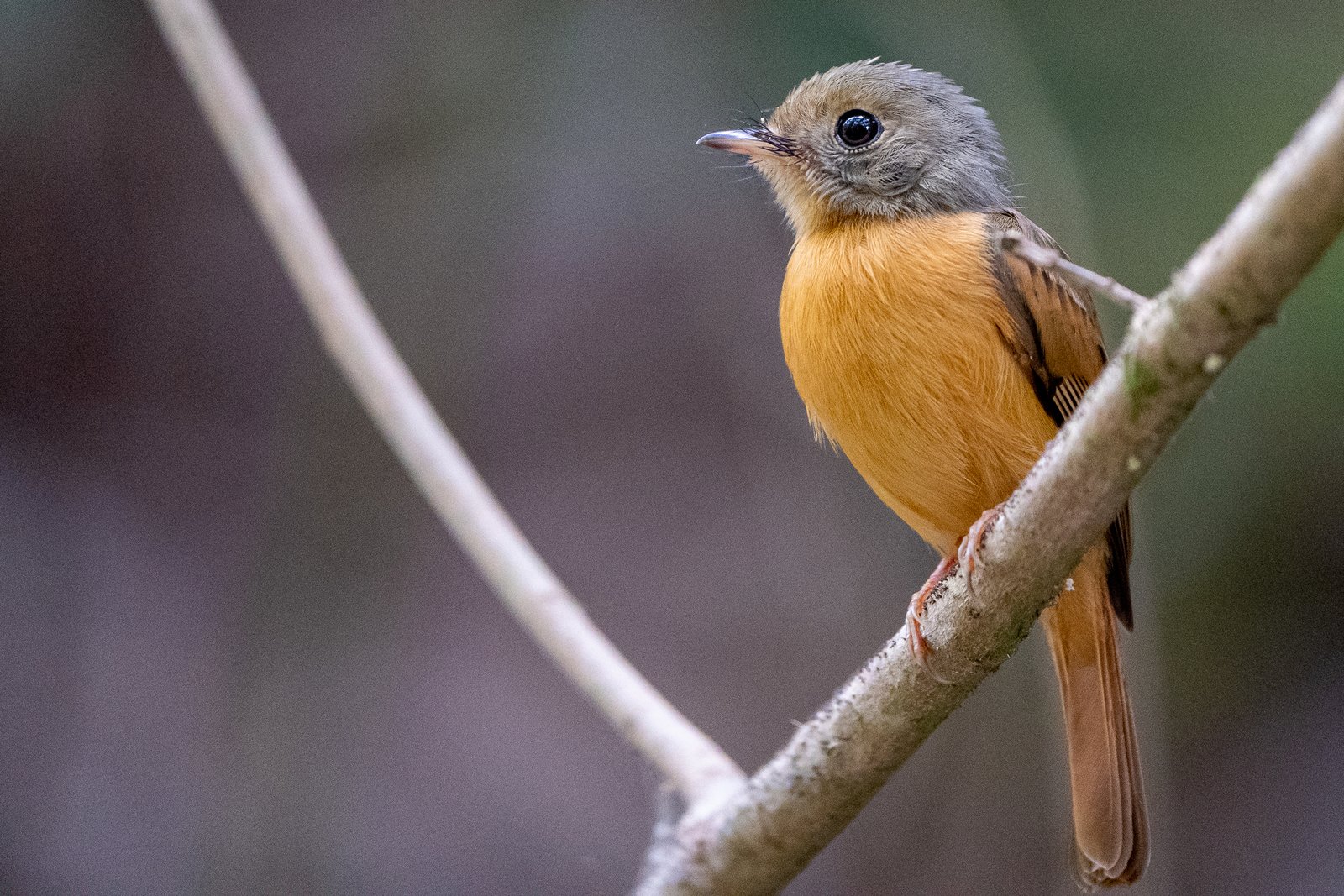
The Ruddy-tailed Flycatcher is a tiny flycatcher of the understorey and mid-storey of humid lowland forest, with a greyish head, cinnamon-rufous wings and a bright rufous tail. It often perches quietly on a thin twig, now and then lifting both wings at once. In the guide area it lives from south-eastern Mexico to Panama.
Voice
High, thin, sharp notes, often given in pairs or short series.
Recording: JAYRSON ARAUJO DE OLIVEIRA — CC BY-NC-SA 4.0 · converted to mono · xeno-canto
Identification
10 cm. Head and upper back greyish olive, with large dark eyes and a narrow pale eye-ring. Wings cinnamon-rufous, rump and tail bright rufous. Throat and breast pale cinnamon to buff, belly paler. Bill short and broad, lower mandible pale. Male and female are alike.
Confusion species
Sulphur-rumped Myiobius Myiobius sulphureipygius and Black-tailed Myiobius Myiobius atricaudus have a yellow rump and a black tail. Tropical Royal Flycatcher Onychorhynchus coronatus also has a rufous tail, but is much larger, with a long, flat bill and a hammer-shaped head.
Habitat
Understorey and mid-storey of humid evergreen lowland and foothill forest and mature secondary forest, mostly below 1000 m. It catches small insects in quick sallies to the undersides of leaves.
Where the bird is most at home, classified by the vegetation units of Mexico and Central America.




Range and movements
From south-eastern Mexico through Belize, Guatemala, Honduras and Nicaragua to Costa Rica and Panama; mainly on the Caribbean slope, in southern Costa Rica and Panama also on the Pacific slope. Outside the guide area in northern South America and much of Amazonia.
- Resident
- dark = core range, pale = thinly spread
How and when to look
Regularly seen at La Selva in Costa Rica and along Pipeline Road (Camino del Oleoducto) in Panama. In shady understorey, watch for a tiny bird that flicks both wings up at once.
Conservation status
Not threatened. Fairly common in humid lowland forest; disappears where the forest is cleared.
Scientific name
Terenotriccus erythrurus | (Cabanis, 1847)
Cabanis described the species in 1847 as M[yiobius] erythrurus; because it was later moved to another genus, the author and year stand in brackets. The genus Terenotriccus was introduced in 1905 by Ridgway. Terenotriccus is Greek, from terenos 'soft, delicate' and trikkos, an unidentified small bird used in ornithology for tyrant flycatchers: 'delicate tyrant'. erythrurus is Greek, from eruthros 'red' and -ouros '-tailed', after the rufous tail. The specimen the first description was based on came from Cayenne, French Guiana.