All species › Passerines › Royal flycatchers and allies › Sulphur-rumped Myiobius
Position in the tree Birds Aves › Birds with a flexible palate Neognathae › All other modern birds Neoaves › Landbirds Telluraves › Falcons, parrots and passerines Australaves › Falcons and passerines Eufalconimorphae › Parrots and passerines Psittacopasserae
Sulphur-rumped Myiobius | Myiobius sulphureipygius
Zwavelstuittiran | Mosquerito lomiamarillo
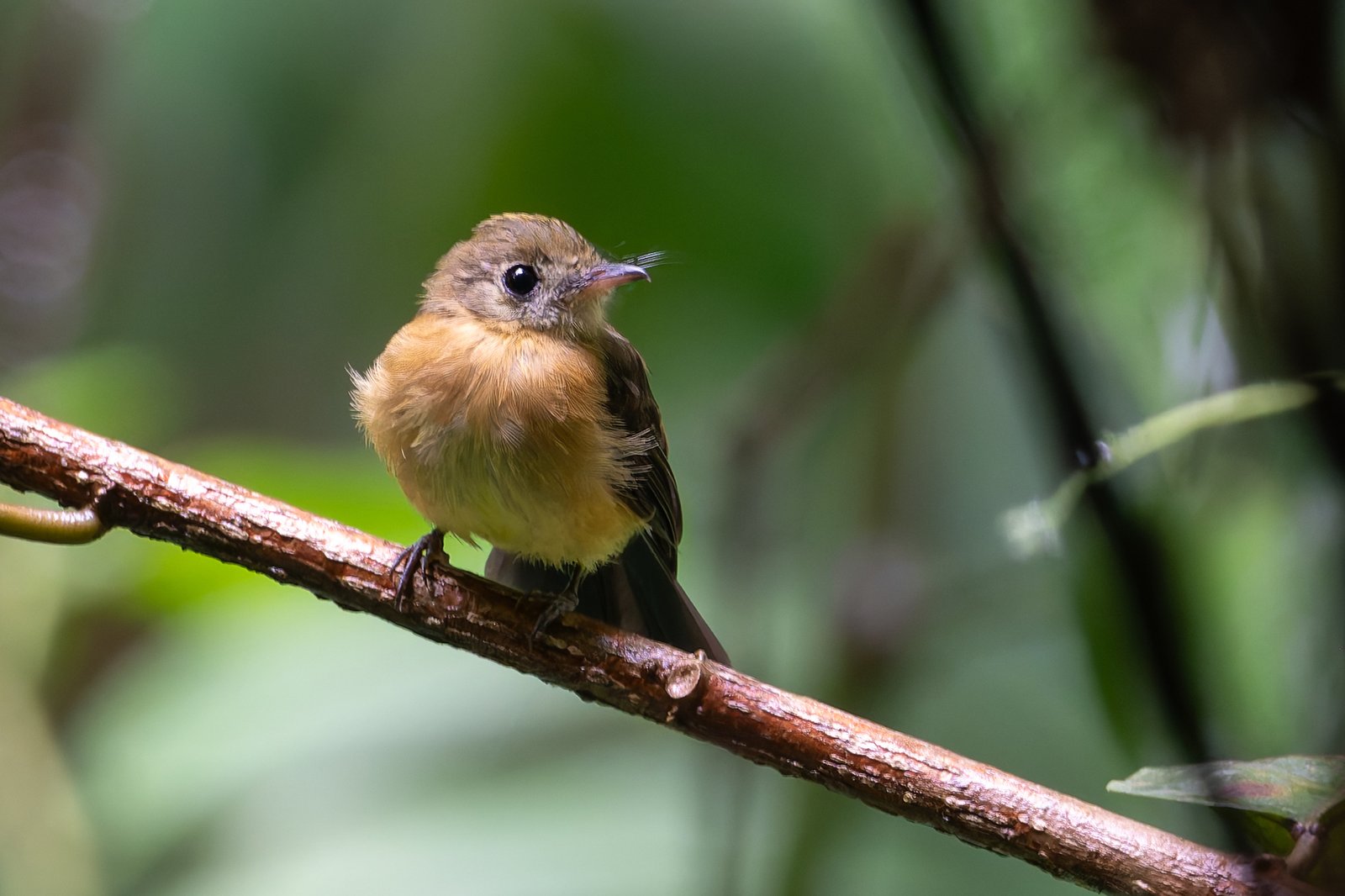
The Sulphur-rumped Myiobius is a small, active flycatcher of the understorey of humid forest, with a bright sulphur-yellow rump that contrasts with the black tail. It constantly fans its tail and droops its wings and often travels with mixed flocks. In the guide area it lives from south-eastern Mexico to Panama.
Voice
A sharp, short psit or tsik; the song is a series of similar notes.
Recording: Juan Freile — CC BY-NC-SA 4.0 · converted to mono · xeno-canto
Identification
12 cm. Upperparts olive-green with a conspicuous bright sulphur-yellow rump; tail black. Throat greyish white, breast and flanks warm tawny-ochre, belly yellow. The male has a mostly concealed yellow crown patch. Bill broad and flat, with long bristles at its base.
Confusion species
Black-tailed Myiobius Myiobius atricaudus (south-western Costa Rica and Panama) is very similar, but has a paler, buffier breast that contrasts less with the belly, and is more often at forest edges and in secondary forest. Ruddy-tailed Flycatcher Terenotriccus erythrurus has a rufous tail and no yellow rump.
Habitat
Understorey and lower mid-storey of humid evergreen lowland and foothill forest, also along streams and in mature secondary forest, mostly below 1000 m. It flutters with spread tail and drooped wings after insects it flushes, often in mixed understorey flocks.
Where the bird is most at home, classified by the vegetation units of Mexico and Central America.





Range and movements
From south-eastern Mexico through Belize, Guatemala, Honduras and Nicaragua to Costa Rica and Panama, mainly on the Caribbean slope. Outside the guide area in western Colombia and Ecuador.
- Resident
- dark = core range, pale = thinly spread
How and when to look
Regularly seen at La Selva in Costa Rica and along Pipeline Road (Camino del Oleoducto) in Panama. In mixed understorey flocks, watch for the yellow rump of a fluttering small bird.
Conservation status
Not threatened. Fairly common in humid forest; declines where lowland forest is lost.
Scientific name
Myiobius sulphureipygius | (Sclater, 1857) (GBIF: Myiobius barbatus)
Sclater described the species in 1857 as Tyrannula sulphureipygia; because it was later moved to another genus, the author and year stand in brackets. The genus Myiobius was introduced in 1839 by Gray. Myiobius is Greek, from muia 'fly' and bios 'life': 'living on flies'. sulphureipygius combines Latin sulphureus 'sulphur-yellow' and Greek -pugos '-rumped', after the bright yellow rump. The specimen the first description was based on came from Córdoba, Veracruz, Mexico.