All species › Cranes, rails and allies › Rails, gallinules and coots › Uniform Crake
Position in the tree Birds Aves › Birds with a flexible palate Neognathae › All other modern birds Neoaves › Birds of the elements Elementaves › Cranes and waders Gruimorphae
Uniform Crake | Amaurolimnas concolor
Effen bosral | Rascón café
The Uniform Crake is a medium-sized, entirely warm rufous-brown rail of wet forest floors, without streaks, bars or spots. It lives very secretively in dense undergrowth near water in lowland forest and is almost only detected by its whistled call. In the guide area it occurs in the Caribbean lowlands from southern Mexico to Panama.

Voice
A series of plaintive, rising whistles, tooo-wee, tooo-wee, tooo-wee, becoming louder and faster and then fading at the end, carrying far through the forest. Also a sharp kek when alarmed. Calls mainly at dusk and before rain.
Recording: Fabio Schunck — CC BY-NC-SA 4.0 · converted to mono · xeno-canto
Identification
20–23 cm. A compact rail with a fairly short tail and a medium-length, straight bill. The plumage is plain: the upperparts are olive-brown to rusty brown, the underparts warmer rufous-brown, paler on the throat. Wings and tail are also brown, without pattern. The bill is greenish-yellow, the eye red and the legs reddish to coral-red. The sexes are alike; juveniles are duller and darker brown, with a dark eye. Walks with short flicks of the tail and seldom flies.
Confusion species
Ruddy Crake Laterallus ruber is much smaller, with a grey head, a dark bill and greenish legs. Rufous-necked Wood Rail Aramides axillaris is larger, with a grey upper back and black rear parts. Russet-naped Wood Rail Aramides albiventris and Grey-cowled Wood Rail Aramides cajaneus are much larger, with a grey neck and a black belly. Paint-billed Crake Mustelirallus erythrops has a grey breast and barred flanks.
Habitat
Swamp forest, wet patches in lowland rainforest, dense undergrowth along streams, forest swamps with palms and heliconias and overgrown forest edges near water; locally also old secondary forest. Forages on the wet forest floor among leaves and mud for insects, spiders, small frogs and seeds. The nest is a cup of leaves low in the vegetation.
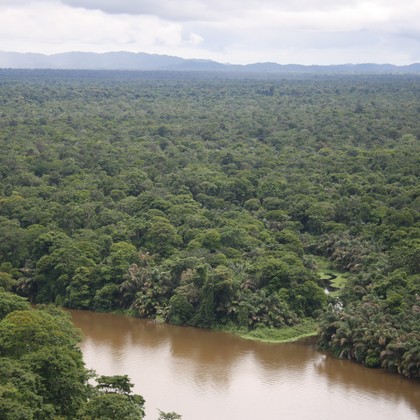
Where the bird is most at home, classified by the vegetation units of Mexico and Central America.



Range and movements
On the Caribbean side of southern Mexico (Veracruz, Oaxaca, Chiapas and locally the southern Yucatán Peninsula), in southern Belize, in Guatemala, Honduras and Nicaragua, and in the Caribbean lowlands of Costa Rica and Panama; in Costa Rica locally also on the Pacific side. Everywhere scarce and local, but probably often overlooked. Outside the guide area in western and northern South America to the Amazon basin.
- Resident
- dark = core range, pale = thinly spread
How and when to look
In the lowlands of northern Costa Rica, for example around La Fortuna, birds sometimes show on wet forest trails at dusk. Usually only the rising whistled series from dense vegetation is heard. Standing still at a wet spot in the forest gives the best chance.
Conservation status
Least Concern. In the guide area the species is scarce and very secretive, so its population is poorly known. Deforestation and drainage of lowland swamp forest are the main threats.
Scientific name
Amaurolimnas concolor | (Gosse, 1847)
Gosse described the species in 1847 as Rallus concolor; because it was later moved to another genus, the author and year stand in brackets. The genus Amaurolimnas was introduced in 1893 by Sharpe. Amaurolimnas is Greek, from amauros 'dark, dim' and limnas 'marsh-dweller', after the plain dark brown plumage. concolor is Latin for 'uniform in colour', after the plain brown plumage without streaks or barring. The specimen the first description was based on came from Jamaica.